Eugene Wigner La Irrazonable Eficacia de la Matemática en las Ciencias Naturales
Fuente: "The Unreasonable Effectiveness of Mathematics in the Natural Sciences," Communications in Pure and Applied Mathematics, febrero de 1960.
Eugene Paul Wigner fue un físico y matemático húngaro que recibió el Premio Nobel de Física en 1963 "por su contribución a la teoría del núcleo atómico y de las partículas elementales, en especial por el descubrimiento y aplicación de los importantes principios de simetría".
Ingresó en la facultad de la Universidad de Princeton en 1930 y adquirió la nacionalidad estadounidense en 1937. Fue uno de los cinco científicos que informaron al presidente Franklin D. Roosevelt en 1939 de la posible utilización militar de la energía atómica, y durante la II Guerra Mundial contribuyó al diseño de reactores de plutonio.
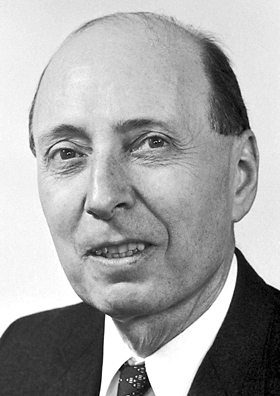
Eugene Wigner La Irrazonable Eficacia de la Matemática en las Ciencias Naturales
Fuente: "The Unreasonable Effectiveness of Mathematics in the Natural Sciences," Communications in Pure and Applied Mathematics, febrero de 1960.
Eugene Wigner (17 de noviembre de 1902 – 1 de enero de 1995), científico húngaro-estadounidense, premio Nobel de Física en 1963.
Fuente: Entrevista realizada por István Kardos (1978). Scientists face to face. Corvina Kiadó. p. 370. ISBN 963-13-0373-X.
Biographical memoir: "John von Neumann (1903 - 1957)" in Year book of the American Philosophical Society (1958); later in Symmetries and Reflections : Scientific Essays of Eugene P. Wigner (1967), p. 261
Contexto: A deep sense of humor and an unusual ability for telling stories and jokes endeared Johnny even to casual acquaintances. He could be blunt when necessary, but was never pompous. A mind of von Neumann's inexorable logic had to understand and accept much that most of us do not want to accept and do not even wish to understand. This fact colored many of von Neumann's moral judgments. "It is just as foolish to complain that people are selfish and treacherous as it is to complain that the magnetic field does not increase unless the electric field has a curl. Both are laws of nature." Only scientific intellectual dishonesty and misappropriation of scientific results could rouse his indignation and ire — but these did — and did almost equally whether he himself, or someone else, was wronged.
Biographical memoir: "John von Neumann (1903 - 1957)" in Year book of the American Philosophical Society (1958); later in Symmetries and Reflections : Scientific Essays of Eugene P. Wigner (1967), p. 261
Contexto: A deep sense of humor and an unusual ability for telling stories and jokes endeared Johnny even to casual acquaintances. He could be blunt when necessary, but was never pompous. A mind of von Neumann's inexorable logic had to understand and accept much that most of us do not want to accept and do not even wish to understand. This fact colored many of von Neumann's moral judgments. "It is just as foolish to complain that people are selfish and treacherous as it is to complain that the magnetic field does not increase unless the electric field has a curl. Both are laws of nature." Only scientific intellectual dishonesty and misappropriation of scientific results could rouse his indignation and ire — but these did — and did almost equally whether he himself, or someone else, was wronged.
Eugene Paul Wigner La Irrazonable Eficacia de la Matemática en las Ciencias Naturales
"The Unreasonable Effectiveness of Mathematics in the Natural Sciences," Communications in Pure and Applied Mathematics, February 1960.
in an interview by [István Kardos, Scientists face to face, Corvina Kiadó, 1978, 963130373X, 370]
“Where in the Schrödinger equation do you put the joy of being alive?”
As quoted by Freeman Dyson from a private conversation, Infinite in All Directions (1988)
Eugene Paul Wigner La Irrazonable Eficacia de la Matemática en las Ciencias Naturales
"The Unreasonable Effectiveness of Mathematics in the Natural Sciences," Communications in Pure and Applied Mathematics, February 1960, final sentence.


