Wilfred Thesiger libro Arabian Sands
Fuente: Arabian Sands (1959), p. 22.
Sir Wilfred Patrick Thesiger fue un escritor y explorador británico.
Nacido en Adís Abeba en Abisinia . Su padre fue un diplomático británico. Fue educado en Eton College y Oxford pero pronto volvió a África. Luchó con la Fuerza Aérea en el Norte de África durante la Segunda Guerra Mundial, y más tarde trabajó en Arabia con la organización contra la plaga de la langosta. Sus viajes también le llevaron a Irak, Persia , Kurdistán, Abisinia , Sudán, África Occidental Francesa, Pakistán y Kenia. Retornó a Inglaterra en 1990 y fue nombrado caballero en 1995.
Thesiger es principalmente conocido por sus libros de viajes:
Arenas de Arabia recoge sus viajes en el "Territorio vacío" del Desierto de Arabia entre 1945 y 1950 donde describe el desvaneciente mundo de los beduinos.
Los árabes de las marismas es una descripción de los pueblos que tradicionalmente vivieron en las marismas del sur de Irak.
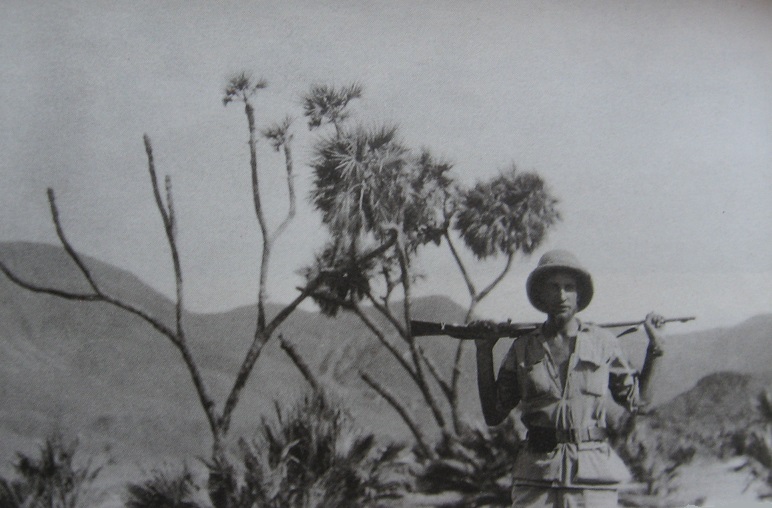
Thesiger tomó muchas fotografías durante sus viajes y donó su extensa colección de 25.000 negativos al museo Pitt-Rivers en Oxford.
Thesiger no era un gran enamorado de la cultura de Estados Unidos sobre la cual dijo:
El efecto a largo plazo de la cultura americana que se extiende hacia todos los rincones por todos los desiertos y valles será el fin de la Humanidad. Nuestra extraordinaria avaricia por las posesiones materiales, el modo en que la alimentamos, la falta de equilibrio en nuestras vidas y nuestra arrogancia cultural nos matará a todos antes de un siglo a menos que aprendamos a parar y pensarlo. Puede ser ya demasiado tarde.
Wilfred Thesiger libro Arabian Sands
Fuente: Arabian Sands (1959), p. 22.
Wilfred Thesiger libro Arabian Sands
Fuente: Arabian Sands (1959), p. 32.
Fuente: The Life Of My Choice (1987), p. 398.
Wilfred Thesiger libro Arabian Sands
Fuente: Arabian Sands (1959), pp. 209-210.
“As the plane climbed over the town and swung above the sea I knew how it felt to go into exile.”
Wilfred Thesiger libro Arabian Sands
Fuente: Arabian Sands (1959), p. 310.
Fuente: The Life Of My Choice (1987), p. 202.
“I craved for the past, resented the present, and dreaded the future.”
Wilfred Thesiger libro Arabian Sands
Fuente: Arabian Sands (1959), p. 20.
Fuente: The Life Of My Choice (1987), p. 295.
BBC Radio 4, Desert Island Discs https://www.bbc.co.uk/programmes/p009mx06, Fri 12 Oct 1979.
Wilfred Thesiger libro Arabian Sands
Fuente: Arabian Sands (1959), p. 82.
“God, you must be a couple of pansies.”
Newby, Eric (1958). A Short Walk in the Hindu Kush. Secker & Warburg.
The final sentence of the book as Thesiger watches Newby and Hugh Carless inflate their air beds
Wilfred Thesiger libro Arabian Sands
Fuente: Arabian Sands (1959), p. 310.
Wilfred Thesiger libro Arabian Sands
Fuente: Arabian Sands (1959), p. 36.
Wilfred Thesiger libro Arabian Sands
Fuente: Arabian Sands (1959), p. 94.
Wilfred Thesiger libro Arabian Sands
Fuente: Arabian Sands (1959), p. 148.
“What use will money be to him in the Sands.”
Wilfred Thesiger libro Arabian Sands
Fuente: Arabian Sands (1959), p. 122.
Wilfred Thesiger libro Arabian Sands
Preface to the 1984 edition
Arabian Sands (1959)
Fuente: The Life Of My Choice (1987), p. 56.
Wilfred Thesiger libro Arabian Sands
Fuente: Arabian Sands (1959), p. 103.
Wilfred Thesiger libro Arabian Sands
Fuente: Arabian Sands (1959), p. 85.
Wilfred Thesiger libro Arabian Sands
Prologue. p. 1.
Arabian Sands (1959)
Answer to “Do you think that hardship and, indeed, suffering bring nobility?”
Interview with Sir David Attenborough first broadcast on Channel 4 in August 1994.
Wilfred Thesiger in Africa, edited by Chris Morton and Philip Grover (2010), p. 82.
Fuente: The Life Of My Choice (1987), p. 443.
“To me it is always the people rather than the places that matter.”
Fuente: Desert, Marsh and Mountain (1979), p. 122.


