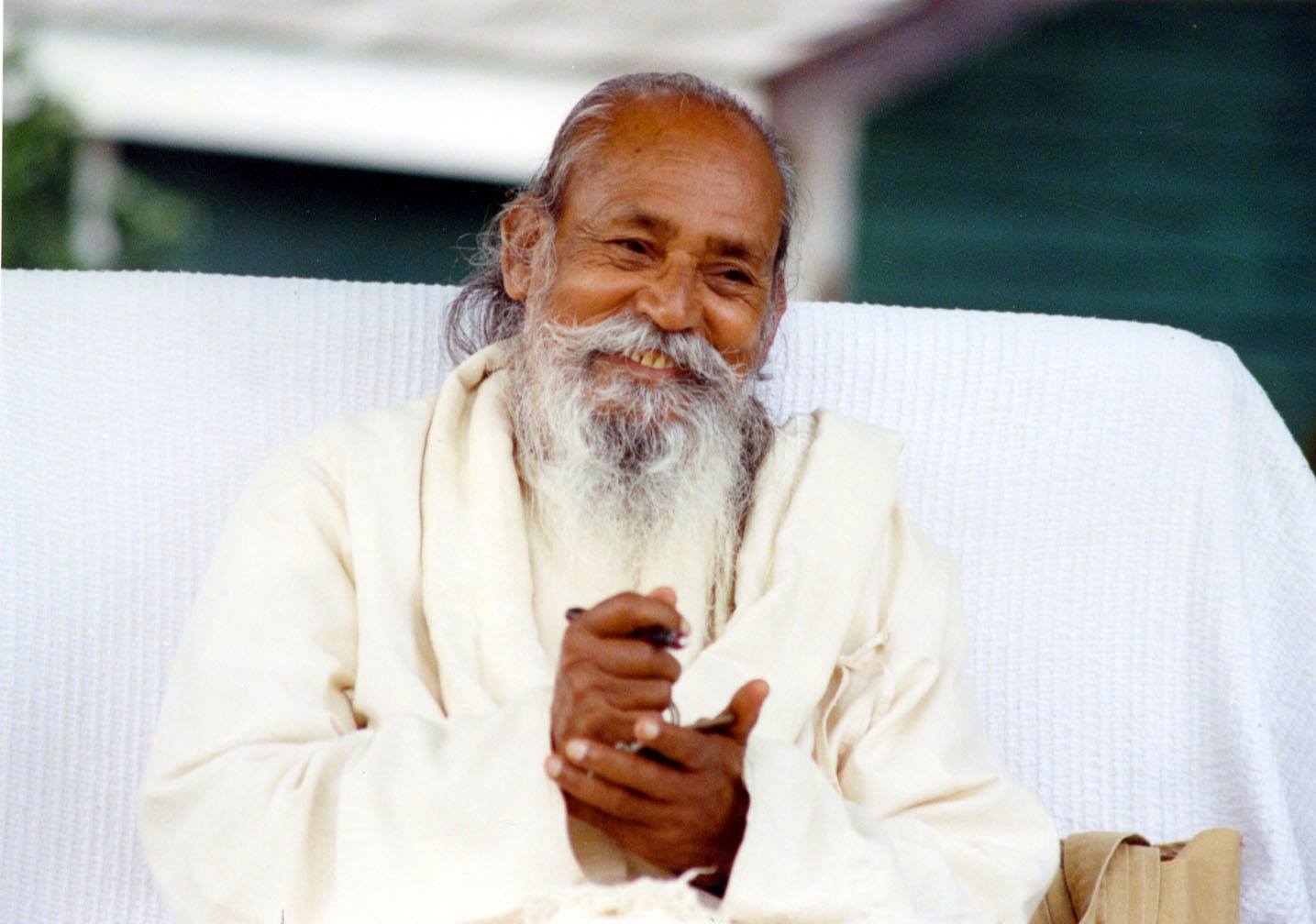
Srimad Bhagavad Gita, Ch. I-VI, 2013
Contexto: In this verse Lord Krishna advises Arjuna how to fight the battle he is trying to avoid. Life in the world functions by ego, attachment and desire, which gives the rise to the idea of “likes” and “dislikes”. In this way the mind starts identifying all experiences in the world in terms of opposites, such as pleasure and pain, gain and loss, victory and defeat... Here, Sri Krishna is saying that if Arjuna has neither desire for heaven nor for sovereignty over the earth, then he should achieve equanimity of the mind. With equanimity of the mind one can achieve success in the war of life. Without it, one cannot remain unaffected by the pairs of opposites and will be continually tossed about by the waves of egocentric likes and dislikes.
Baba Hari Dass: Frases en inglés
The Yellow Book, 1974
Contexto: Q: Did you start life like us with lots of demands, and what spurred you to give it up? A: When I was six or seven, I would feel I was inside a box of earth and sky, and I would weep. Once I asked my mother: "Take me out of this box of earth and sky." She said, "I can't." Then I said, "I'm going." (p.33)
“Creation is the product of bliss, and bliss is its sustainer; to bliss it returns.”
Fuente: Fire without Fuel - The Aphorisms of Baba Hari Dass, 1986, p.14
“The Self is beyond birth, death, gender, class, and religion - only the body wears those labels.”
Fuente: Fire without Fuel - The Aphorisms of Baba Hari Dass, 1986, p.27
“We cannot describe it. We cannot reveal it. And when we do, we disappear.”
Introduction
The Yellow Book, 1974
Desire: (p.23)
The Path to Enlightenment is not a Highway, 1996
“Contentment, compassion, and tolerance are the pillars of peace.”
Fuente: Ashtanga Yoga Primer, 1981, p.58
Fuente: Silence Speaks, from the chalkboard of Baba Hari Dass, 1977, p.15
“What is mind? A heap of thoughts.”
Fuente: Silence Speaks, from the chalkboard of Baba Hari Dass, 1977, p.14
“Don't think that you are carrying the whole world; make it easy. Make it play, make it a prayer.”
Fuente: Ashtanga Yoga Primer, 1981, p.2
Fuente: Silence Speaks, from the chalkboard of Baba Hari Dass, 1977, p.11
Fuente: Everyday Peace: Letters for Life, 2000, p.34
Fuente: Ashtanga Yoga Primer, 1981, p.9
“No matter how much we talk about universal unity, we end up making another group”
The Path to Enlightenment is not a Highway, 1996
Contexto: Making separate groups is human nature. No matter how much we talk about universal unity, we end up making another group. (p. 18)
“To overcome the fear of death it is necessary to accept that we all have to die”
Silence Speaks, from the chalkboard of Baba Hari Dass, 1977
Contexto: Q: What can I do to overcome my fear of death? A: Attachment to the body causes fear of death. It is the strongest attachment. Even a newborn infant has this attachment. To overcome the fear of death it is necessary to accept that we all have to die. (p.39)
165
Silence Speaks, from the chalkboard of Baba Hari Dass, 1977
Bhagavad Gita, Ch II, verse 38
Srimad Bhagavad Gita, Ch. I-VI, 2013
Ego: (p.49)
The Path to Enlightenment is not a Highway, 1996
Bhagavad Gita, Ch XVIII, verse 19
Srimad Bhagavad Gita, Ch. XIII-XVIII, 2015
Fuente: The Path to Enlightenment is not a Highway, 1996, Bondage, p.15
Family and Community: (p. 35)
The Path to Enlightenment is not a Highway, 1996
“I am the logic of all arguments - Arguments are of three kinds:”
1) jalpa (arrogant argument) – In this type of argument one tries to establish one's point of view by contradicting the opponent's argument without considering whether the opponent's argument is right or wrong.
2) vitanda (destructive criticism) – In this type of argument the person simply destroys the opponent's viewpoint by misleading argument.
3) vada (logical argument) – In this type of argument one uses a method of discussion with reasoning with an aim to find out what is truth and what is untruth. Reasoning is the best method of discussion to achieve the truth. This is why the Lord says, “Among arguments, I am vada or logical argument.”
Srimad Bhagavad Gita, Ch. VII-XII, 2014
Bhagavad Gita, Ch X, verse 32
Srimad Bhagavad Gita, Ch. VII-XII, 2014


