Daniel Dennett libro Darwin's Dangerous Idea
Darwin's Dangerous Idea (1995)
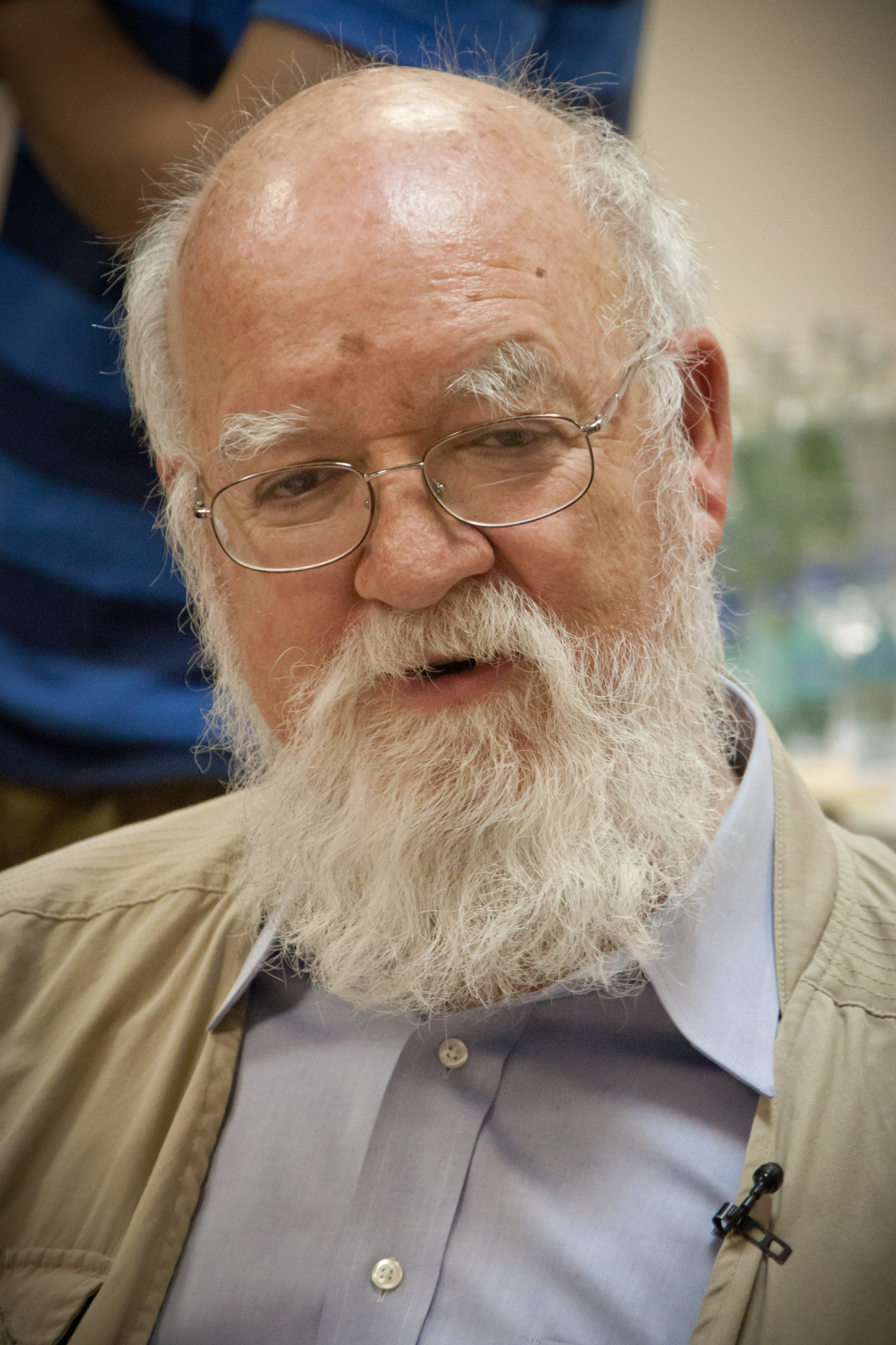
Daniel Clement Dennett es un filósofo y escritor estadounidense.[1] Es uno de los filósofos de la ciencia más destacados en el ámbito de las ciencias cognitivas, especialmente en el estudio de la conciencia, intencionalidad, inteligencia artificial y de la memética. También son significativas sus aportaciones acerca de la significación actual del darwinismo y la religión. Dirige el Centro de Estudios Cognitivos de la Universidad de Tufts, donde es catedrático de filosofía. Desde 1987 es miembro de la Academia Estadounidense de las Artes y las Ciencias y de la Academia Europea de Ciencias y Artes. Se le conoce también como parte de los Cuatro Jinetes del Nuevo Ateísmo, junto con Richard Dawkins, Sam Harris y Christopher Hitchens.[2] Wikipedia
Daniel Dennett libro Darwin's Dangerous Idea
Darwin's Dangerous Idea (1995)
Daniel Dennett libro Breaking the Spell: Religion as a Natural Phenomenon
Breaking the Spell (2006)
Daniel Dennett libro Darwin's Dangerous Idea
Darwin's Dangerous Idea (1995)
Kinds of Minds (1996)
Daniel Dennett libro Darwin's Dangerous Idea
Darwin's Dangerous Idea (1995)
Daniel Dennett libro Brainstorms
Fuente: Brainstorms (1978), p. xvi
Postmodernism and truth (1998)
“Not a single one of the cells that compose you knows who you are, or cares.”
Daniel Dennett libro Sweet Dreams
Sweet Dreams: Philosophical Obstacles to a Science of Consciousness (2005), p. 2
Daniel Dennett in a panel under the title "Can Rationality Be Taught?" https://www.youtube.com/watch?v=ImE6-3GuvhE at TAM 2014.
Daniel Dennett libro Breaking the Spell: Religion as a Natural Phenomenon
Breaking the Spell (2006)
Daniel Dennett libro Darwin's Dangerous Idea
Darwin's Dangerous Idea (1995)
Daniel Dennett libro Darwin's Dangerous Idea
citing the research of George Williams from "Huxley's Evolution and Ethics in Sociobiological Perspective" in Zygon (v.23/88)
Darwin's Dangerous Idea (1995)
“I think religion for many people is some sort of moral viagra.”
"Atheism Tapes, part 6", BBC TV documentation of Jonathan Miller, produced by Richard Denton, recorded 2003, broadcast 2004
Daniel Dennett libro Breaking the Spell: Religion as a Natural Phenomenon
An important task for religious people of all faiths in the twenty-first century will be spreading the conviction that there are no acts more dishonorable than harming "infidels" of one stripe or another for "disrespecting" a flag, a cross, a holy text.
Breaking the Spell (2006)
Daniel Dennett libro Consciousness Explained
I asked, and he replied, "No, I already told you — I hate rock music."</p>
Fuente: Consciousness Explained (1991), p. 58-59
Daniel Dennett libro Breaking the Spell: Religion as a Natural Phenomenon
Breaking the Spell (2006)
Daniel Dennett libro Breaking the Spell: Religion as a Natural Phenomenon
Breaking the Spell (2006)
Daniel Dennett libro Consciousness Explained
Consciousness Explained (1991)
Daniel Dennett libro Consciousness Explained
Fuente: Consciousness Explained (1991), p. 253–4.
Daniel Dennett libro Darwin's Dangerous Idea
Darwin's Dangerous Idea (1995)
“Evolution is all about processes that almost never happen.”
Daniel Dennett libro Breaking the Spell: Religion as a Natural Phenomenon
Every birth in every lineage is a potential speciation event, but speciation almost never happens, not once in a million births. Mutation in DNA almost never happens — not once in a trillion copings — but evolution depends on it. Take the set of infrequent accidents — things that almost never happen — and sort them into the happy accidents, the neutral accidents, and the fatal accidents; amplify the effects of the happy accidents — which happens automatically when you have replication and competition — and you get evolution.
Breaking the Spell (2006)
“It is commonly observed — but not commonly enough!”
that old folks removed from their homes to hospital settings are put at a tremendous disadvantage, even though their basic bodily needs are well provided for. They often appear to be quite demented — to be utterly incapable of feeding, clothing, and washing themselves, let alone engaging in any activities of greater interest. Often, however, if they are returned to their homes, they can manage quite well for themselves. How do they do this? Over the years, they have loaded their home environments with ultrafamiliar landmarks, triggers for habits, reminder of what to do, where to find the food, how to get dressed, where the telephone is, and so forth. An old person can be a veritable virtuoso of self-help in such a hugely overlearned world, in spite of his or her brain's increasing imperviousness to new bouts of learning... Taking them out of their homes is literally separating them from large parts of their minds — potentially just as devastating a development as undergoing brain surgery.
Kinds of Minds (1996)
Intuition Pumps and Other Tools for Thinking (2013)
Intuition Pumps and Other Tools for Thinking (2013)


