“Si yo pudiera recordar el nombre de todas estas partículas habría sido botánico.”
Fuente: Citado en: Helge Kragh, Quantum Generations (1999), 321.
Fuente: Michio Kaku: Hiperespacio.
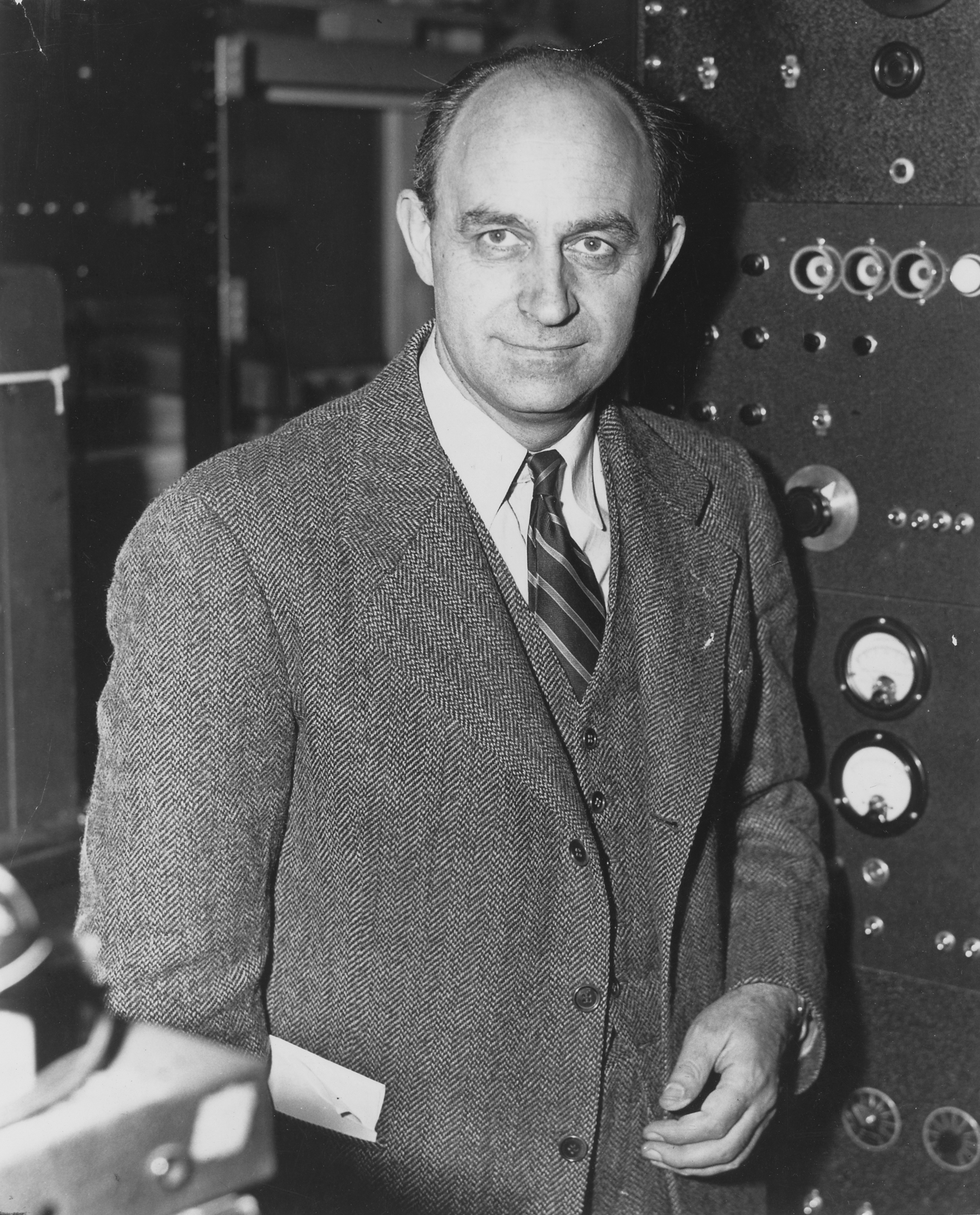
Enrico Fermi fue un físico italiano conocido por el desarrollo del primer reactor nuclear y sus contribuciones al desarrollo de la teoría cuántica, la física nuclear y de partículas, y la mecánica estadística. En 1938 Fermi recibió el Premio Nobel de Física por sus trabajos sobre radiactividad inducida y es considerado uno de los científicos más destacados del siglo XX.
Se lo reconoce como un físico con grandes capacidades tanto en el plano teórico como experimental. El elemento fermio, que fue producido en forma sintética en 1952, fue nombrado en su honor.
“Si yo pudiera recordar el nombre de todas estas partículas habría sido botánico.”
Fuente: Citado en: Helge Kragh, Quantum Generations (1999), 321.
Fuente: Michio Kaku: Hiperespacio.
Fuente: Citado en: Laura Fermi, Atoms in the family: My life with Enrico Fermi (1954), 244.
“Si los extraterrestres existen, ¿Dónde están?”
Esta frase dio origen a la paradoja de Fermi.
Fermi hablando con otros físicos sobre la falta de evidencia de la inteligencia extraterrestre.
Fuente: Citado en "Where are They? Maybe we are alone in the galaxy after all" escrito por Ian Crawford en la revista Scientific American, en julio de 2000, pág. 38-43; también en "Our Galaxy Should Be Teeming With Civilizations, But Where Are They?" escrito por Seth Shostak en Space.com (25 de octubre de 2001).
Fuente: Enrico Fermi: Atomic Energy for Power, Collected Papers (Note e Memorie) (1939-1945), Vol. 2, 556.
As quoted in Nuclear Principles in Engineering (2005) by Tatjana Jevremovic, p. 397
“I cannot think of a single one, not even intelligence.”
When asked what characteristics Nobel prize winning physicists had in common. As quoted in Physics Today (October 1994), p. 70.
On the Hydrogen bomb in a minority addendum http://honors.umd.edu/HONR269J/archive/GACReport491030.html (co-authored with I. I. Rabi) to an official General Advisory Committee report for the Atomic Energy Commission (30 October 1949) <br class="br">Contexto: Such a weapon goes far beyond any military objective and enters the range of very great natural catastrophes. By its very nature it cannot be confined to a military objective but becomes a weapon which in practical effect is almost one of genocide. It is clear that the use of such a weapon cannot be justified on any ethical ground which gives a human being a certain individuality and dignity even if he happens to be a resident of an enemy country... The fact that no limits exist to the destructiveness of this weapon makes its very existence and the knowledge of its construction a danger to humanity as a whole. It is necessarily an evil thing considered in any light.
On the Hydrogen bomb in a minority addendum http://honors.umd.edu/HONR269J/archive/GACReport491030.html (co-authored with I. I. Rabi) to an official General Advisory Committee report for the Atomic Energy Commission (30 October 1949) <br class="br">Contexto: Such a weapon goes far beyond any military objective and enters the range of very great natural catastrophes. By its very nature it cannot be confined to a military objective but becomes a weapon which in practical effect is almost one of genocide. It is clear that the use of such a weapon cannot be justified on any ethical ground which gives a human being a certain individuality and dignity even if he happens to be a resident of an enemy country... The fact that no limits exist to the destructiveness of this weapon makes its very existence and the knowledge of its construction a danger to humanity as a whole. It is necessarily an evil thing considered in any light.
“If I could remember the names of all these particles, I'd be a botanist.”
As quoted in Hyperspace (1995) by Michio Kaku
Comment to Eugene Wigner, ten days before his death from cancer, as quoted in The collected works of Eugene Paul Wigner (1992), p. 108
Nobel lecture (12 December 1938)
On the Hydrogen bomb in a minority annex http://web.archive.org/web/20080725010150/honors.umd.edu/HONR269J/archive/GACReport491030.html (co-authored with I. I. Rabi) to an official General Advisory Committee report for the Atomic Energy Commission (30 October 1949)


