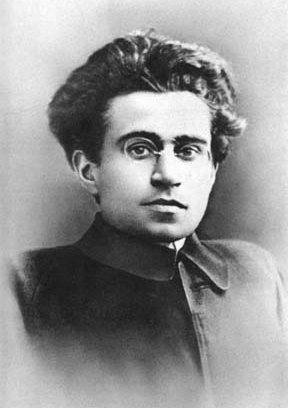
Frases célebres de Antonio Gramsci
“El viejo mundo se muere. El nuevo tarda en aparecer. Y en ese claroscuro surgen los monstruos.”
Fuente: Citado en Meneses, Juan Pablo. Una vuelta al tercer mundo: La ruta salvaje de la globalización. Editorial Penguin Random House Grupo Editorial España, 2015. ISBN 9788499925806.
Fuente: Citado en Funes, Patricia. Salvar la nación: intelectuales, cultura y política en los años veinte latinoamericanos. Editorial Prometeo Libros Editorial, 2006. ISBN 9789875740754. p. 44.
Frases sobre la historia de Antonio Gramsci
Fuente: Citado en Márquez García, Álex. Antonio Gramsci y el nuevo orden: Hacia la creación de una nueva hegemonía. Editorial Autografía, 2017. ISBN 9788417169190. p. 148.
Fuente: Citado en Dr. Rojas Soriano, Raúl. Reprobarían los científicos más famosos del mundo si se hubiesen sometido a los sistemas de evaluación como el del Conacyt (México). Kanankil Editorial. ISBN 9786079243098. p. 149.
Fuente: Cuadernos de la cárcel: El materialismo histórico y la filosofía de Benedetto Croce, páginas 120-121.
Antonio Gramsci Frases y Citas
Fuente: Amate Pou, Jordi. Paseando por una parte de la Historia: Antología de citas. Editorial Penguin Random House Grupo Editorial España, 2017. ISBN 9788417321871. p. 111.
Fuente: Citado en Della Rocca, Mario. Gramsci en la Argentina. Los desafios del kirchnerismo. Editorial Dunken, 2014. ISBN 9789870272342. p. 39.
Fuente: Citado en Margen izquierdo, números 2-8. Editor Cooperativa Margen Izquierdo Ltda., 1990.
“Soy un pesimista debido a mi inteligencia, pero un optimista debido a mi voluntad.”
Cartas desde la cárcel (19 de diciembre de 1929); pero en realidad citaba a Romain Rolland. <br class="br">Citas incorrectas <br class="br">Fuente: Falsa paternidad de frases célebres. ABC. http://www.abc.es/cultura/abci-falsa-paternidad-frases-celebres-201601030242_noticia.html
“Tomen la educación y la cultura, y el resto se dará por añadidura.”
Fuente: Citado en Moradiellos, Enrique; Royo, Alberto. La sociedad gaseosa. Editorial Plataforma, 2017. ISBN 9788417002091.
Fuente: Monasta, Attilio. Antonio Gramsci. http://www.ibe.unesco.org/sites/default/files/gramscis.pdf
“Cada movimiento revolucionario es romántico por definición.”
Fuente: Malnati, Isabella; Montel, Alessandro. Frases célebres. Editorial Parkstone International, 2013. ISBN 9788431554644.
“Adueñarnos del mundo de las ideas, para que las nuestras, sean las ideas del mundo.”
Fuente: Citado en Rego de Planas, Lucrecia. Ochocientos años, el paso de la cristiandad a la increencia. Editorial Lulu.com, 2010. ISBN 9780557015474. p. 32.
Antonio Gramsci: Frases en inglés
“I’m a pessimist because of intelligence, but an optimist because of will.”
Letter from Prison (19 December 1929); also attributed to Romain Rolland.
Fuente: Gramsci's Prison Letters
“To tell the truth, to arrive together at the truth, is a communist and revolutionary act.”
Letter from Prison (21 June 1919), translated by Hamish Henderson, Edinburgh University Student Publications.
Antonio Gramsci Prison Notebooks
Fuente: :s:Pagina:Gramsci - Quaderni del carcere, Einaudi, I.djvu/318 § (34). Passato e presente.
English translation Selections from the Prison Notebooks, “Wave of Materialism” and “Crisis of Authority” (NY: International Publishers), (1971), pp. 275-276.
Prison Notebooks Volume II, Notebook 3, 1930, (2011 edition) SS-34, Past and Present 32-33,
Gramsci cited in Davidson, 1977, p. 70.
“History is at once freedom and necessity.”
Selections from the Prison Notebooks (1971).
“All men are intellectuals: but not all men have in society the function of intellectuals.”
Fuente: Selections from the Prison Notebooks (1971).
“Pessimism of the intellect, optimism of the will.”
Variante: Pessimism of the spirit; optimism of the will.
“To tell the truth is revolutionary.”
The first number of L'Ordine Nuovo, edited by Gramsci, appeared in 1921 with this motto of Ferdinand Lassalle on the first page. It is often misattributed to Gramsci.
Misattributed
Selections from the Prison Notebooks (1971).
“The old world is dying, and the new world struggles to be born: now is the time of monsters.”
Loose translation, commonly attributed to Gramsci by Slavoj Žižek, presumably formulation by Žižek (see below). <br class="br">Presumably a translation from a loose French translation by Gustave Massiah; strict English with cognate terms and glosses: <br class="br">Le vieux monde se meurt, le nouveau monde tarde à apparaître et dans ce clair-obscur surgissent les monstres <br class="br">The old world is dying, the new world tardy (slow) to appear and in this chiaroscuro (light-dark) surge (emerge) monsters. <br class="br">“ Mongo Beti, une conscience noire, africaine, universelle http://www.liberationafrique.org/imprimersans.php3?id_article=16&nom_site=Lib%C3%A9ration”, Gustave Massiah, CEDETIM, août 2002 ( archive https://web.archive.org/web/20160304061734/http://www.liberationafrique.org/imprimersans.php3?id_article=16&nom_site=Lib%C3%A9ration, 2016-03-04) <br class="br">“Mongo Beti, a Black, African, Universal Conscience”, Gustave Massiah, CEDETIM, August 2002 <br class="br">Collected in: Remember Mongo Beti, Ambroise Kom, 2003, p. 149 https://books.google.com/books?id=6YgdAQAAIAAJ&q=%22Le+vieux+monde+se+meurt,+le+nouveau+monde+tarde+%C3%A0+appara%C3%AEtre+et+dans+ce+clair-obscur+surgissent+les+monstres%22. <br class="br">Original, with literal English translation (see above): <br class="br">La crisi consiste appunto nel fatto che il vecchio muore e il nuovo non può nascere: in questo interregno si verificano i fenomeni morbosi piú svariati. <br class="br">The crisis consists precisely in the fact that the old is dying and the new cannot be born; in this interregnum a great variety of morbid symptoms appear. <br class="br">Similar sentiments are widespread in revolutionary rhetoric; see: No, Žižek did not attribute a Goebbels quote to Gramsci http://thecharnelhouse.org/2015/07/03/no-zizek-did-not-attribute-a-goebbels-quote-to-gramsci/, Ross Wolfe, 2015-07-03 <br class="br">Misattributed <br class="br">Fuente: Selections from the Prison Notebooks
The Modern Prince and other Writings, quoting a letter to his sister
“History teaches, but it has no pupils.”
Letter from Prison (21 June 1919), translated by Hamish Henderson, Edinburgh University Student Publications.
“The long march through the institutions.”
Due to German student movement leader Rudi Dutschke, who coined it in 1967 as „Der lange Marsch durch die Institutionen“. <br class="br">See Strategy, Hegemony & ‘The Long March’: Gramsci’s Lessons for the Antiwar Movement http://carldavidson.blogspot.com/2006/04/strategy-hegemony-long-march.html, by Carl Davidson, April 06, 2006. <br class="br">It was popularized in the protests of 1968, and Dutschke’s posthumous 1980 work is titled Mein langer Marsch (My long March). <br class="br">See Marsch durch die Institutionen at German Wikipedia for extensive discussion. <br class="br">A reference to the Long March of the Chinese Communist Red Army in 1934 & 1935; note that Gramsci died in 1937. <br class="br">Various corruptions include “through the culture” or “slow march”. <br class="br">Widely attributed to Gramsci, Joseph A. Buttigieg http://english.nd.edu/faculty/profiles/joseph-a-buttigieg/, the editor of the English critical edition of Gramsci’s Prison Notebooks asserts that the phrase does not originate with Gramsci. <br class="br">Footnote 21, page 50, reads: [“long march through the institutions”<sup>21</sup>] “This phrase is not Gramsci’s, even though it is ubiquitously attributed to him.” <br class="br">[10.1215/01903659-32-1-33, 0190-3659, 32, 1, 33-52, Buttigieg, Joseph A., The Contemporary Discourse on Civil Society: A Gramscian Critique, boundary 2, 2010-06-30, 2005, http://boundary2.dukejournals.org/cgi/pdf_extract/32/1/33] <br class="br">The idea is connected with Gramsci's theory of cultural hegemony, but does not originate with him – he called the concept a “war of position”. <br class="br">Misattributed
Selections from the Prison Notebooks (1971).
Gramsci, 1965, p. 737 cited in Davidson, 1977, p. 35.
Gramsci cited in Garuglieri's Garuglieri, 'Ricordo di Gramsci.' Societa, 691-701., 1946, p. 700.
Cited in Davidson's (1977) Antonio Gramsci: Towards an Intellectual Biography. London: Merlin Press., p. 77.
Gramsci cited in Fiori, 1970, pp. 22-23.
revolution
Selections from the Prison Notebooks (1971).


