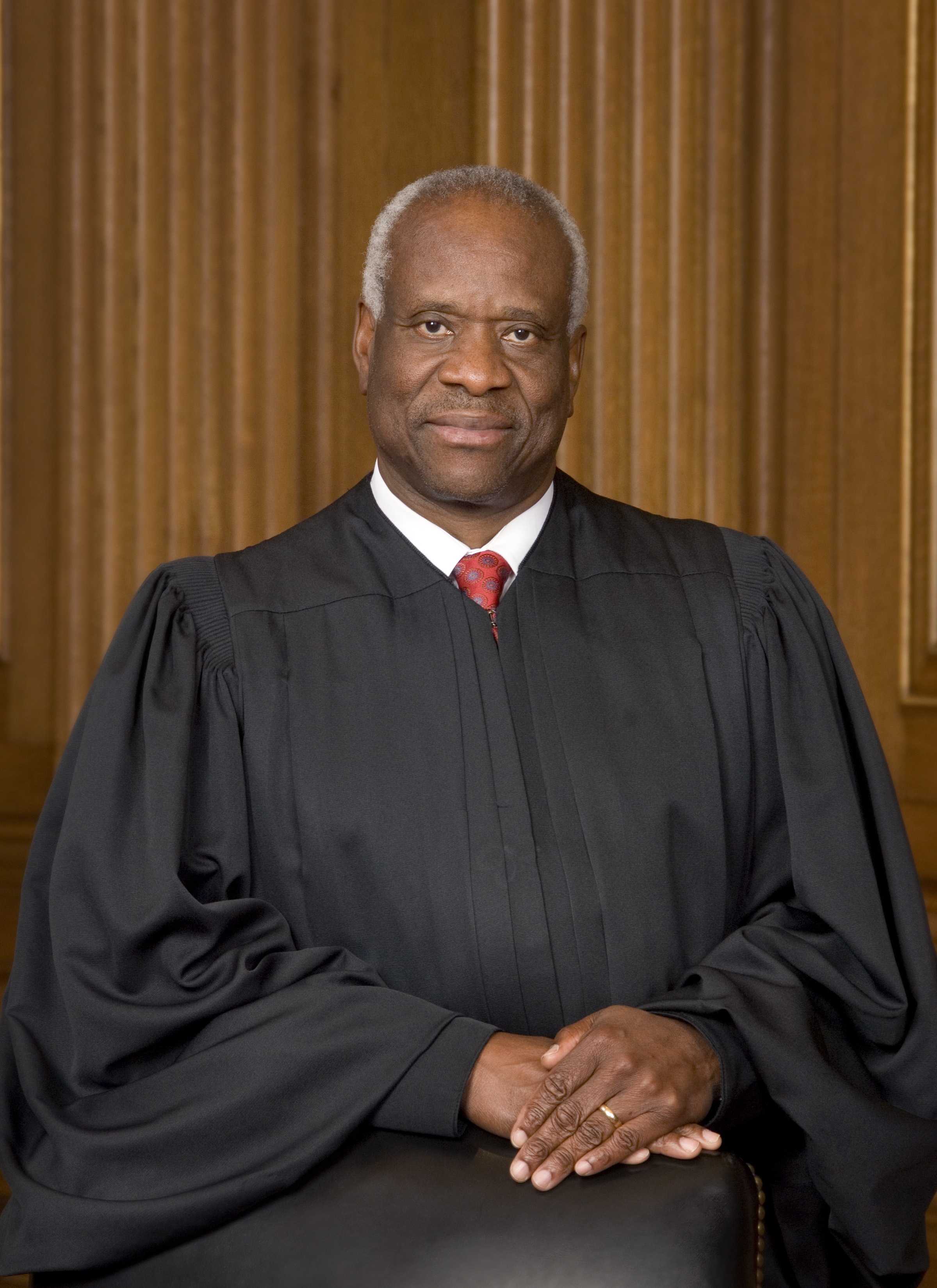
Frases de Clarence Thomas
página 3

Clarence Thomas es un jurista estadounidense. Desde 1991 ha sido Juez Asociado de la Corte Suprema de los Estados Unidos. Thomas es el segundo afro-estadounidense que ha sido juez del alto tribunal estadounidense. Debido a sus puntos de vista e interpretación de la constitución, Thomas es considerado miembro del ala conservadora de la Corte.

Fue acusado por Anita Hill por haberla acosado sexualmente cuando ella trabajaba para él.

Thomas comenzó su carrera judicial en 1990, cuando fue nombrado Juez del Tribunal de Apelaciones del Distrito de Columbia. Luego, tras el retiro del Juez Asociado Thurgood Marshall, el Presidente George H. W. Bush lo nomina a la Corte Suprema en 1991. Su nominación generó numerosas críticas luego de que una abogada, Anita Hill, lo denunciara por acoso sexual. Sin embargo, el Senado confirmó la nominación de Thomas con un voto final de 52-48 .

En la Corte Suprema, Thomas ha mantenido una filosofía legal llamada originalismo. Para Thomas, la Constitución de los Estados Unidos debe ser interpretada teniendo en cuenta el significado original de las palabras en el siglo XVIII. Debido a esto, el Juez Thomas se posiciona en contra de la legalización del aborto y de la concesión de derechos que desde su punto de vista no están fundamentados ni jurídica ni moral ni racionalmente a los homosexuales. Wikipedia  

✵ 23. junio 1948
Clarence Thomas Foto
Clarence Thomas: 100 citas0 Me gusta

Clarence Thomas: Frases en inglés

“No good comes from being in the woods.”

Clarence Thomas

On the occasion of his 25th anniversary as a Supreme Court Justice; reported in Robert Barnes, &quot; For 25 years, it has been Clarence Thomas v. Controversy https://www.washingtonpost.com/politics/courts_law/after-25-years-supporters-praise-clarence-thomas-but-controversy-is-always-near/2016/10/30/3fba40e4-9d24-11e6-a0ed-ab0774c1eaa5_story.html?wpisrc=nl_headlines&amp;wpmm=1&quot;, Washington Post (October 30, 2016). <br class="br">2010s

“To define each of us by our race is nothing short of a denial of our humanity.”

Clarence Thomas

As quoted in &quot;The New Republic Calls Out Harry Reid on Clarence Thomas&quot; http://www.dinocrat.com/archives/2004/12/08/the-new-republic-calls-out-harry-reid-on-clarence-thomas/ (December 2004), DinoCrat. <br class="br">1990s

“Something has gone seriously awry with this Court's interpretation of the Constitution.”

Clarence Thomas

Dissenting Kelo v. New London http://caselaw.lp.findlaw.com/cgi-bin/getcase.pl?court=US&amp;navby=case&amp;vol=000&amp;invol=04-108. <br class="br">2000s, Kelo v. New London (2005)

“[I claim] my right to think for myself, to refuse to have my ideas assigned to me as though I was an intellectual slave because I'm black.”

Clarence Thomas

Reported in Ellis Cose, &quot; Justice: Still Keeping Score http://web.archive.org/web/20070605123712/http://www.msnbc.msn.com/id/18248548/site/newsweek/page/2/&quot;, Newsweek (April 30, 2007). <br class="br">1990s

“Those incentives have made the legacy of this Courts public purpose test an unhappy one. In the 1950s, no doubt emboldened in part by the expansive understanding of public use this Court adopted in Berman, cities rushed to draw plans for downtown development. Of all the families displaced by urban renewal from 1949 through 1963, 63 percent of those whose race was known were nonwhite, and of these families, 56 percent of nonwhites and 38 percent of whites had incomes low enough to qualify for public housing, which, however, was seldom available to them. Public works projects in the 1950s and 1960s destroyed predominantly minority communities in St. Paul, Minnesota, and Baltimore, Maryland. In 1981, urban planners in Detroit, Michigan, uprooted the largely lower-income and elderly Poletown neighborhood for the benefit of the General Motors Corporation. Urban renewal projects have long been associated with the displacement of blacks; [i]n cities across the country, urban renewal came to be known as Negro removal. Over 97 percent of the individuals forcibly removed from their homes by the slum-clearance project upheld by this Court in Berman were black. Regrettably, the predictable consequence of the Court’s decision will be to exacerbate these effects.”

Clarence Thomas

Dissenting Kelo v. New London http://caselaw.lp.findlaw.com/cgi-bin/getcase.pl?court=US&amp;navby=case&amp;vol=000&amp;invol=04-108. <br class="br">2000s, Kelo v. New London (2005)

Autores similares

Max Weber Foto
Max Weber13
filósofo, economista, jurista, historiador, politólogo y so… None
Friedrich August von Hayek Foto
Friedrich August von Hayek26
economista y y filósofo británico None
Arthur Miller Foto
Arthur Miller15
dramaturgo estadounidense None
Robert Lee Frost Foto
Robert Lee Frost19
poeta estadounidense None
Arthur Compton Foto
Arthur Compton2
Físico estadounidense None
Frank Herbert Foto
Frank Herbert8
escritor estadounidense None
Will Rogers Foto
Will Rogers17
actor estadounidense None
Groucho Marx Foto
Groucho Marx103
humorista estadounidense None
Jack London Foto
Jack London22
escritor estadounidense None
John Steinbeck Foto
John Steinbeck84
escritor estadounidense None