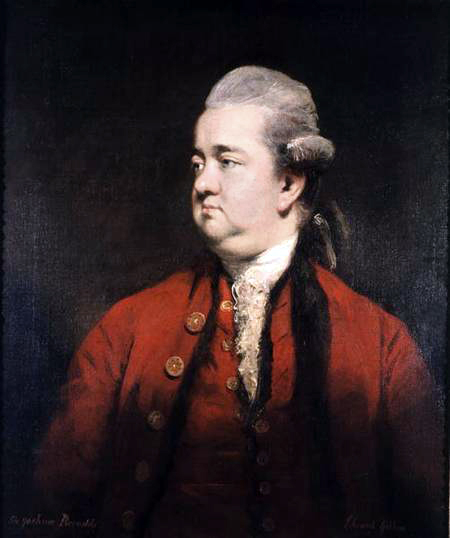
Edward Gibbon: Frases en inglés
“The winds and waves are always on the side of the ablest navigators.”
Vol. 1, Chap. 68. Compare: "On dit que Dieu est toujours pour les gros bataillons" (translated: "It is said that God is always on the side of the heaviest battalions"), Voltaire, Letter to M. le Riche. 1770; "J'ai toujours vu Dieu du coté des gros bataillons (translated: "I have always noticed that God is on the side of the heaviest battalions"), De la Ferté to Anne of Austria.
The Decline And Fall Of The Roman Empire: Volume 1 (1776)
Memoirs (1796)
Edward Gibbon The History of the Decline and Fall of the Roman Empire
Volume 1, Chapter 2 "Of the Union and Internal Prosperity of the Roman Empire, in the Age of the Antonines" http://www.ccel.org/ccel/gibbon/decline/files/volume1/chap2.htm. The portion regarding the views of the religions of the time taken by various constituencies has been misreported as Gibbon's own assessment of religion generally. See Paul F. Boller, John George, They Never Said It: A Book of Fake Quotes, Misquotes, and Misleading Attributions (1990), pp. 34–35.<br>The bold text has been misattributed to Lucretius and Seneca the Younger. <br class="br">The Decline And Fall Of The Roman Empire (1776) <br class="br">Fuente: The Decline and Fall of the Roman Empire <br class="br">Contexto: The various modes of worship, which prevailed in the Roman world, were all considered by the people, as equally true; by the philosopher, as equally false; and by the magistrate, as equally useful. And thus toleration produced not only mutual indulgence, but even religious concord. <br class="br">Contexto: The policy of the emperors and the senate, as far as it concerned religion, was happily seconded by the reflections of the enlightened, and by the habits of the superstitious, part of their subjects. The various modes of worship, which prevailed in the Roman world, were all considered by the people, as equally true; by the philosopher, as equally false; and by the magistrate, as equally useful. And thus toleration produced not only mutual indulgence, but even religious concord.<br>The superstition of the people was not embittered by any mixture of theological rancour; nor was it confined by the chains of any speculative system. The devout polytheist, though fondly attached to his national rites, admitted with implicit faith the different religions of the earth. Fear, gratitude, and curiosity, a dream or an omen, a singular disorder, or a distant journey, perpetually disposed him to multiply the articles of his belief, and to enlarge the list of his protectors. The thin texture of the Pagan mythology was interwoven with various but not discordant materials.
Edward Gibbon The History of the Decline and Fall of the Roman Empire
Fuente: The Decline and Fall of the Roman Empire
“Revenge is profitable, gratitude is expensive.”
Edward Gibbon The History of the Decline and Fall of the Roman Empire
Vol. 1, Chap. 11.
The Decline And Fall Of The Roman Empire: Volume 1 (1776)
Fuente: The Decline and Fall of the Roman Empire
“War, in its fairest form, implies a perpetual violation of humanity and justice.”
Edward Gibbon The History of the Decline and Fall of the Roman Empire
Fuente: The Decline and Fall of the Roman Empire
Fuente: The History of the Decline and Fall of the Roman Empire Volume I
Vol. 5, pages:391–392.
The Decline And Fall Of The Roman Empire: Volume 1 (1776)
Vol. 1, Chap. 3. Compare: "L'histoire n'est que le tableau des crimes et des malheurs" (translated: "History is but the record of crimes and misfortunes"), Voltaire, L'Ingénu, chap. x.
The Decline And Fall Of The Roman Empire: Volume 1 (1776)
“Wit and valor are qualities that are more easily ascertained than virtue, or the love of wisdom.”
Vol. 1, Chap. 1.
The Decline And Fall Of The Roman Empire: Volume 1 (1776)
EGPaIV" Edward Gibbon, [1788], Decline and Fall of the Roman Empire http://www.sacred-texts.com/cla/gibbon/05/daf05010.htm, Vol. 5, Chapter L: Description Of Arabia And Its Inhabitants. Part IV. <br class="br">The Decline And Fall Of The Roman Empire: Volume 1 (1776)
Vol. 1, Chap. 71.
The Decline And Fall Of The Roman Empire: Volume 1 (1776)
This quotation appeared in an article by Margaret Thatcher, "The Moral Foundations of Society" ( Imprimis, March 1995 https://imprimis.hillsdale.edu/the-moral-foundations-of-society/), which was an edited version of a lecture Thatcher had given at Hillsdale College in November 1994. Here is the actual passage from Thatcher's article:<br><blockquote>[M]ore than they wanted freedom, the Athenians wanted security. Yet they lost everything—security, comfort, and freedom. This was because they wanted not to give to society, but for society to give to them. The freedom they were seeking was freedom from responsibility. It is no wonder, then, that they ceased to be free. In the modern world, we should recall the Athenians' dire fate whenever we confront demands for increased state paternalism.</blockquote><br>The italicized passage above originated with Thatcher. In characterizing the Athenians in the article she cited Sir Edward Gibbon, but she seems to have been paraphrasing statements in "Athens' Failure," a chapter of classicist Edith Hamilton's book The Echo of Greece (1957), pp. 47–48 http://www.ergo-sum.net/books/Hamilton_EchoOfGreece_pp.47-48.jpg). <br class="br">Misattributed
“Our sympathy is cold to the relation of distant misery.”
Vol. 1, Chap. 49.
The Decline And Fall Of The Roman Empire: Volume 1 (1776)
“Amiable weaknesses of human nature.”
Vol. 1, Chap. 14. Compare: "Amiable weakness", Henry Fielding, Tom Jones, Book x, Chapter viii.
The Decline And Fall Of The Roman Empire: Volume 1 (1776)
Edward Gibbon The History of the Decline and Fall of the Roman Empire
Vol. 1, Chap. 5 http://books.google.com/books?id=aLcWAAAAQAAJ&q=&quot;It+has+been&quot;+&quot;calculated+by+the+ablest+politicians+that+no+State+without+being+soon+exhausted+can+maintain+above+the+hundredth+part+of+its+members+in+arms+and+idleness&quot;&pg=PA106#v=onepage <br class="br">The Decline And Fall Of The Roman Empire: Volume 1 (1776)


