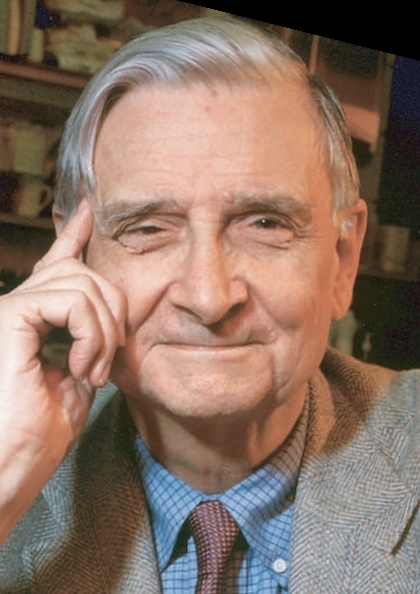
Frases célebres de Edward Osborne Wilson
Fuente: Edward O. Wilson: The Diversity of Life (1999), 259
Edward Osborne Wilson libro On Human Nature
Fuente: Edward O. Wilson: Dilemma'. On Human Nature (1978, 1979), 2.
“Este planeta puede ser un paraíso en el siglo XXII.”
Fuente: Declaración cuando le concedieron el "TED Prize" http://ted.com/tedprize/winners2007.cfm, que ganó en 2007.
Edward Osborne Wilson libro Consilience
Fuente: Consilience: The Unity of Knowledge (1998, 1999), 286. Citado en: Citas de Edward O. Wilson (en inglés) http://www.todayinsci.com/W/Wilson_Edward/WilsonEdward-Quotations.htm. Today in Science History.
Edward Osborne Wilson Frases y Citas
Fuente: Citado en: R.Z. Sheppard, Nature: Splendor in The Grass, Time (3 de septiembre de 1990).
“Teoría maravillosa, especie equivocada.”
Sobre el marxismo, que consideraba más adecuado para las hormigas que para los humanos. <br class="br">Fuente: http://arts.independent.co.uk/books/news/article2886394.ece
Fuente: Citado en: Jamie Murphy y Andrea Dorfman, The Quiet Apocalypse, Time (13 de octubre de 1986).
Fuente: Can biology do better than faith? http://www.newscientist.com/article/dn8254-can-biology-do-better-than-faith.html. NewScientist.com, 02 de noviembre de 2005. Consultado el 26-10-2010.
Edward Osborne Wilson: Frases en inglés
Edward O. Wilson libro On Human Nature
On Human Nature (1978), Ch.3 Development
Edward O. Wilson libro On Human Nature
On Human Nature (1978), Ch.4 Emergence
Edward O. Wilson libro On Human Nature
On Human Nature (1978), Ch.4 Emergence
“The ideal scientist thinks like a poet and only later works like a bookkeeper.”
Fuente: Letters to a Young Scientist (2013), chapter 5, "The Creative Process", page 74.
Edward O. Wilson libro On Human Nature
On Human Nature (1978), Ch.4 Emergence
Edward O. Wilson libro On Human Nature
On Human Nature (1978), Ch.4 Emergence
“In early history phobias might have provided the extra margin needed to insure survival…”
Edward O. Wilson libro On Human Nature
On Human Nature (1978), Ch.3 Development
Edward O. Wilson libro On Human Nature
On Human Nature (1978), Ch.4 Emergence
Edward O. Wilson libro On Human Nature
On Human Nature (1978), Ch.4 Emergence
Edward O. Wilson libro On Human Nature
On Human Nature (1978), Ch.3 Development
“Old beliefs die hard even when demonstrably false.”
Fuente: Consilience: The Unity of Knowledge (1998), p. 256.
Edward O. Wilson libro On Human Nature
On Human Nature (1978), Ch.3 Development
Edward O. Wilson libro On Human Nature
On Human Nature (1978)
Edward O. Wilson libro On Human Nature
On Human Nature (1978), Ch.4 Emergence
Edward O. Wilson libro On Human Nature
Wilson cites Goffman's Frame Analysis (1974) as a reference here.
On Human Nature (1978), Ch.4 Emergence
Edward O. Wilson libro On Human Nature
On Human Nature (1978), Ch.4 Emergence
Edward O. Wilson libro On Human Nature
On Human Nature (1978), Ch.3 Development
Fuente: Letters to a Young Scientist (2013), chapter 5, "The Creative Process", page 69.
“Nothing fundamental separates the course of human history from the course of physical history.”
Consilience: The Unity of Knowledge (1998)
Quoted in Harvard Magazine http://harvardmagazine.com/breaking-news/james-watson-edward-o-wilson-intellectual-entente from a public discussion between Wilson and James Watson moderated by NPR correspondent Robert Krulwich, September 9, 2009.
Edward O. Wilson libro On Human Nature
On Human Nature (1978), Ch.4 Emergence
Edward O. Wilson libro On Human Nature
On Human Nature (1978), Ch.4 Emergence
Half-Earth: Our Planet's Fight for Life (2016)


.jpg)