“Pictures are spiritual beings. The soul of the painter lives within them.”
from: Years of Struggle 1902-14' Autobiography Berlin 1934
1921 - 1956
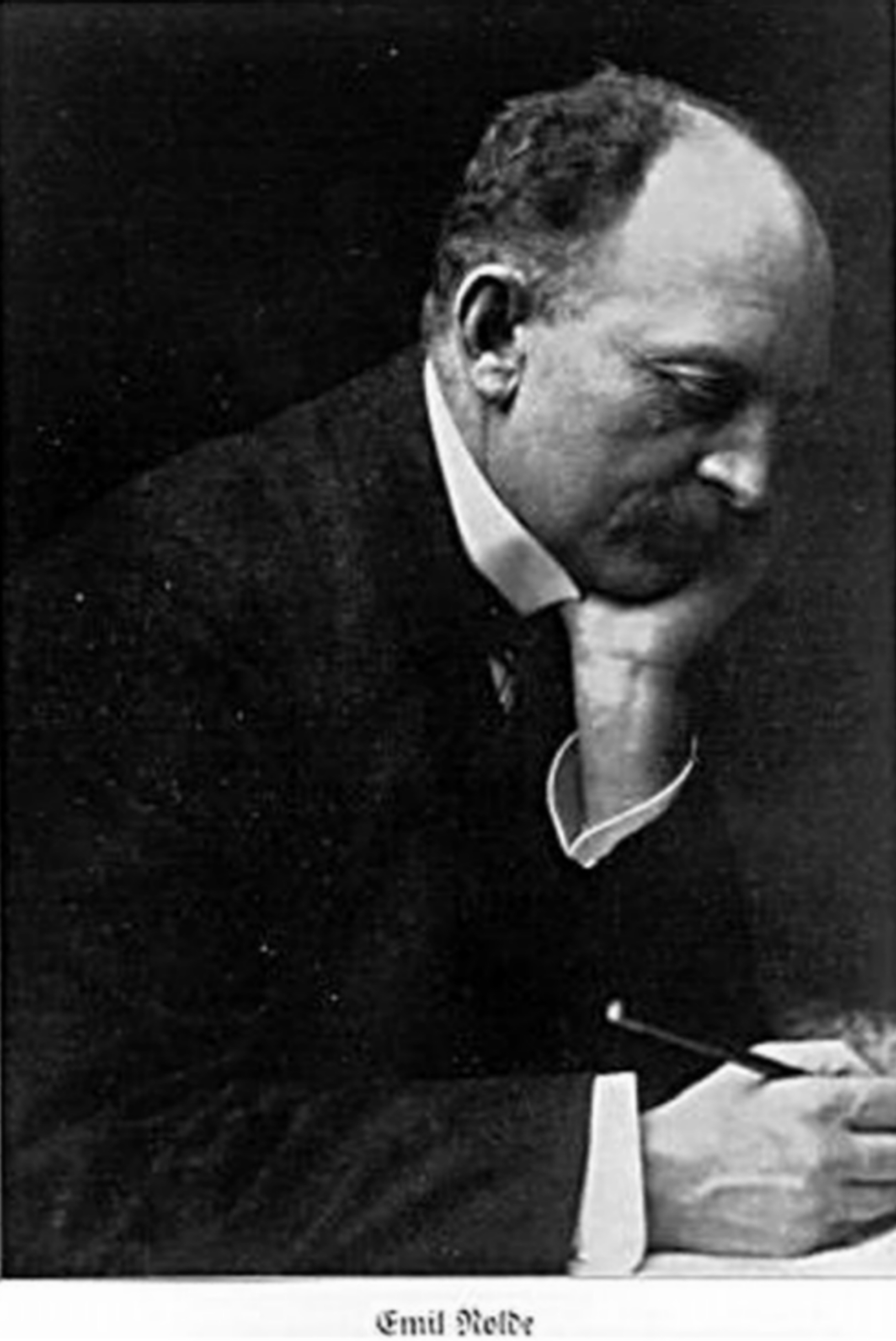
Emil Nolde fue uno de los más destacados pintores expresionistas alemanes.[1] Su verdadero nombre era Hans Emil Hansen. Estuvo muy influido por Vincent van Gogh, Edvard Munch, y James Ensor.
“Pictures are spiritual beings. The soul of the painter lives within them.”
from: Years of Struggle 1902-14' Autobiography Berlin 1934
1921 - 1956
1900 - 1920
in a letter to his friend Gustav Schiefler, 1906, in 'Gustav Schiefler and Christel Mosel', Emil Nolde: Das graphische Werk, vol. 2.; M. DuMont Schauberg, Cologne, 1966-67, p. 8; as quoted in 'The Revival of Printmaking in Germany', I. K. Rigby; in German Expressionist Prints and Drawings - Essays Vol 1.; published by Museum Associates, Los Angeles County Museum of Art, California & Prestel-Verlag, Germany, 1986, p.50
Nolde described how the exhilarating new sense of collaboration with the medium had freed him from the constraints of traditional etching techniques and encouraged a bolder, freer expression
1900 - 1920
Quote of Nolde's letter, 1902, to Hans Fehr; as cited in Expressionism, a German intuition, 1905-1920, Neugroschel, Joachim; Vogt, Paul; Keller, Horst; Urban, Martin; Dube, Wolf Dieter; (transl. Joachim Neugroschel); publisher: Solomon R. Guggenheim Foundation, New York, 1980, p. 35
During the next few years, Nolde virtually commuted between Copenhagen and Berlin; in the fishing village of Lildstand on Jutland's northern coast, he produced strange pencil drawings, as he wrote to Fehr
1900 - 1920
c. 1918; in Aus dem Palau-Tagebuch, 'Das Kunstblatt 2', no. 6, p. 179; as quoted in 'The Revival of Printmaking in Germany', I. K. Rigby; in German Expressionist Prints and Drawings - Essays Vol 1.; published by Museum Associates, Los Angeles County Museum of Art, California & Prestel-Verlag, Germany, 1986, p. 43
1900 - 1920
1.
1900 - 1920, On Primitive Art – Emil Nolde, 1912
in two letters, to Hans Fehr, 23 October and 22 November, 1905; as quoted by Hans Fehr, in: 'Aus Leben und Werkstatt', 'Das Kunstblatt' no. 7 (1919), pp. 205-6; as quoted in 'The Revival of Printmaking in Germany', I. K. Rigby; in German Expressionist Prints and Drawings - Essays Vol 1.; published by Museum Associates, Los Angeles County Museum of Art, California & Prestel-Verlag, Germany, 1986, p. 5
Nolde described in 1905 the role his experiments played in etching - in generating a subjective imagery and unorthodox surfaces that unlocked his own inner world
1900 - 1920
in Nolde's letter, c. 1910; in Alois J. Schardt, 'Nolde als Graphiker', Das Kunstblatt 11, no. 8., 1927, p. 289; as quoted in 'The Revival of Printmaking in Germany', I. K. Rigby; in German Expressionist Prints and Drawings - Essays Vol 1.; published by Museum Associates, Los Angeles County Museum of Art, California & Prestel-Verlag, Germany, 1986, p. 52
1900 - 1920
Quote of Nolde, 1906 in Jahre der Kämpfe (The years of struggles); as cited by Francesco Mazzaferro in 'The Diaries of Paul Klee' - Part Three: Klee as a Secessionist and a Neo-Impressionist Artist http://letteraturaartistica.blogspot.nl/2015/05/paul-klee-ev.html <br class="br">1900 - 1920
note of 13 March 1947; as quoted in Expressionism, a German intuition, 1905-1920, Neugroschel, Joachim; Vogt, Paul; Keller, Horst; Urban, Martin; Dube, Wolf Dieter; (transl. Joachim Neugroschel); publisher: Solomon R. Guggenheim Foundation, New York, 1980, p. 32
1921 - 1956
undated quotes
in a letter to Nolde's friend, 1902; as quoted in Expressionism, a German intuition, 1905-1920, Neugroschel, Joachim; Vogt, Paul; Keller, Horst; Urban, Martin; Dube, Wolf Dieter; (transl. Joachim Neugroschel); publisher: Solomon R. Guggenheim Foundation, New York, 1980, p. 36
1900 - 1920
“Dualism is particularly important in both my paintings and my graphics.”
from: Years of Struggle 1902-14' Autobiography Berlin 1934
1921 - 1956
Quote of Nolde's letter to Hans Fehr, 1905; published in 'Aus Leben und Werkstatt Emil Noldes', 'Das Kunstblatt' no. 7 (1919), p. 208; as cited in 'The Revival of Printmaking in Germany', I. K. Rigby; in German Expressionist Prints and Drawings - Essays Vol 1.; published by Museum Associates, Los Angeles County Museum of Art, California & Prestel-Verlag, Germany, 1986, p. 40
Hans Fehr expressed in a letter to Nolde his concern about the 'recklessness' and 'licentiousness' of some prints by Nolde. Fehr published Nolde's response in 1919
1900 - 1920
6.
1900 - 1920, On Primitive Art – Emil Nolde, 1912
Nolde's quote c. 1909; as cited by de:Wolf-Dieter Dube, in Expressionism, de:Wolf-Dieter Dube; Praeger Publishers, New York, 1973, p. 81
1900 - 1920
quote c. 1906-07; as quoted by de:Wolf-Dieter Dube, in Expressionism; Praeger Publishers, New York, 1973, p. 78
Nolde is explaining his technique of surface-etching to the other Brücke-artists
1900 - 1920
2.
1900 - 1920, On Primitive Art – Emil Nolde, 1912
Nolde's written note in 1942; as quoted in Nolde: Forbidden Pictures [exhibition catalog], Marlsborough Fine Art Ltd., London, 1970, p. 9
1921 - 1956
“.. colors are my notes for fashioning sounds and chords with and against one another.”
as quoted in Expressionism, a German intuition, 1905-1920, Neugroschel, Joachim; Vogt, Paul; Keller, Horst; Urban, Martin; Dube, Wolf Dieter; (transl. Joachim Neugroschel); publisher: Solomon R. Guggenheim Foundation, New York, 1980, p. 35
3 short quotes in which Nolde expresses the evocative power of color, which became with his garden and flower paintings from 1906-07 the chief medium of his art.
undated quotes
4.
1900 - 1920, On Primitive Art – Emil Nolde, 1912
“The most perfect art was Greek art. Raphael is the greatest of all masters in painting.”
Such were the doctrines of every art teacher only twenty or thirty years ago.
1.
1900 - 1920, On Primitive Art – Emil Nolde, 1912


