“I will make you shorter by the head.”
Response to Parliament (October 1566).
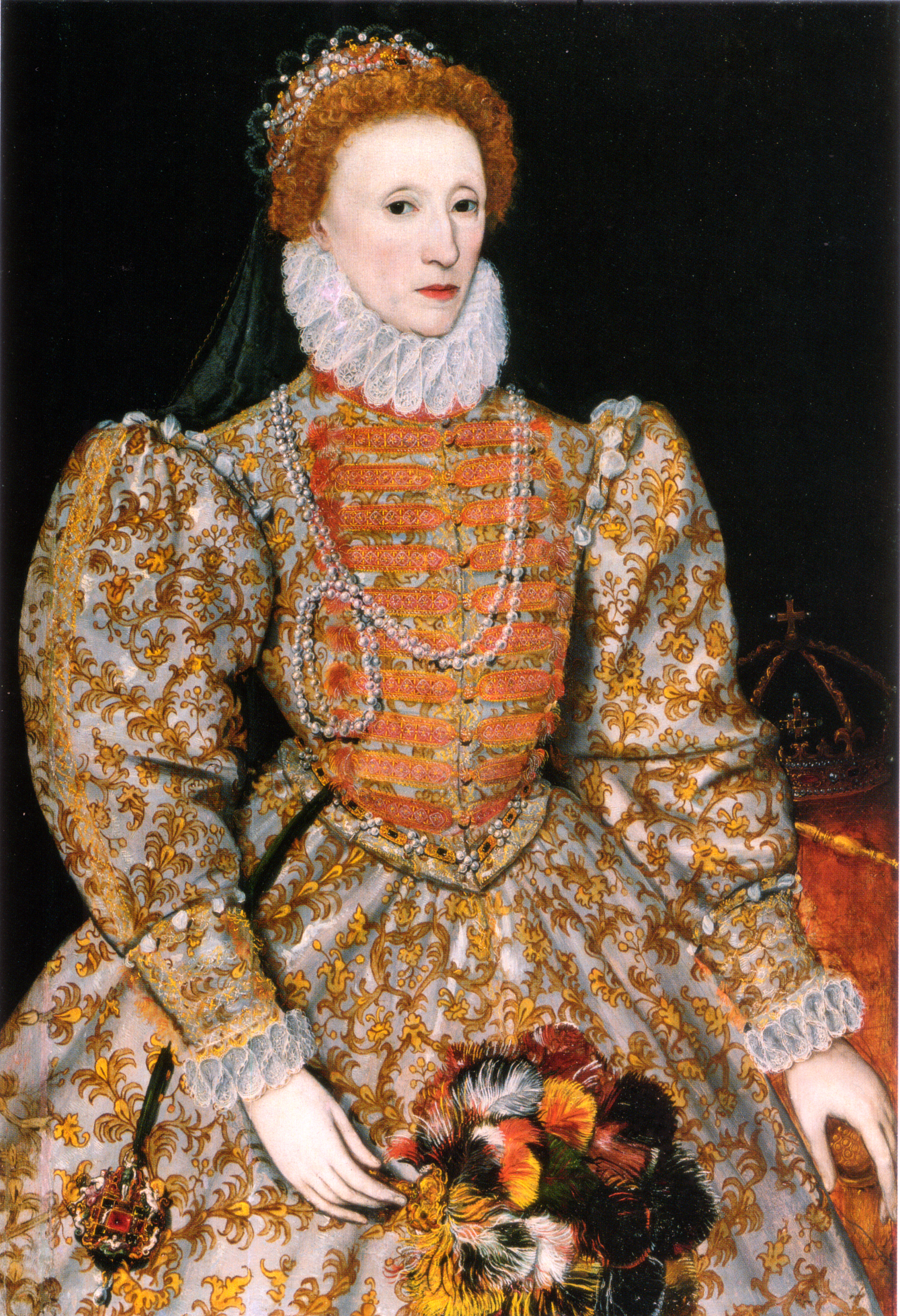
Isabel I de Inglaterra , a menudo referida como la Reina Virgen, Gloriana o la Buena Reina Bess fue reina de Inglaterra e Irlanda desde el 17 de noviembre de 1558 hasta el día de su muerte. Isabel fue la quinta y última monarca de la dinastía Tudor. Hija de Enrique VIII, nació como princesa, pero su madre, Ana Bolena, fue ejecutada cuando ella tenía tres años, con lo que Isabel fue declarada hija ilegítima. Sin embargo, tras la muerte de sus hermanos Eduardo VI y María I, Isabel asumió el trono.[nota 2][nota 3]
Una de las primeras medidas que tomó fue establecer una Iglesia protestante independiente de Roma, que luego evolucionaría en la actual Iglesia de Inglaterra, de la que se convirtió en la máxima autoridad.
Se esperaba que Isabel contrajera matrimonio pero, pese a varias peticiones del Parlamento, nunca lo hizo.[1] Se desconocen las razones para esta decisión y han sido ampliamente debatidas. A medida que Isabel fue envejeciendo, su virginidad la volvió famosa y un culto creció alrededor de ella, celebrado en retratos, desfiles y literatura de la época.
La reina se hizo cargo de un país dividido por cuestiones religiosas en la segunda mitad del siglo XVI. Durante su reinado, Inglaterra tuvo un gran esplendor cultural, con figuras como William Shakespeare y Christopher Marlowe; también fueron importantes personajes como Francis Drake y John Hawkins. Mantuvo gélidas relaciones con Felipe II de España, con quien libró una guerra que arruinó económicamente a ambos países. Su reinado de 44 años y 127 días ha sido el quinto más largo de la historia inglesa, por detrás de los de Isabel II, Victoria I, Jorge III y Eduardo III.
Wikipedia
“I will make you shorter by the head.”
Response to Parliament (October 1566).
Speech to the Troops at Tilbury (1588)
Contexto: I know I have the body but of a weak and feeble woman; but I have the heart and stomach of a king, and of a king of England too, and think foul scorn that Parma or Spain, or any prince of Europe, should dare to invade the borders of my realm.
Response to Parliament (October 1566).
“God may forgive you, but I never can.”
To the Countess of Nottingham, as quoted in The History of England Under the House of Tudor (1759) by David Hume, Vol. II, Ch. 7.
“[I] would rather be a beggar and single than a queen and married.”
Statement to the envoy of Ulrich, Duke of Württemberg while discussing a proposal of marriage to the duke's son, Christoph. (26 January 1563), quoted by J. Horace Round in "A Visit to Queen Elizabeth," http://books.google.com/books?id=iP0CAAAAIAAJ&q=%22would+rather+be+a+beggar+and+single+than+a+queen+and+married%22&pg=PA629#v=onepage The Nineteenth Century magazine (October 1896)
The Golden Speech (1601)
To Robert Cecil when he said, in her final illness (March 1603), that she must go to bed.
The Golden Speech (1601)
Speech to a joint delegation of the House of Lords and the House of Commons (5 November 1566), quoted in Leah Marcus, Janel Mueller and Mary Rose (eds.), Elizabeth I: Collected Works (The University of Chicago Press, 2002), p. 95.
“This is the Lord's doing, and it is marvellous in our eyes.”
Her reaction when she was told she was Queen (17 November 1558).
The Golden Speech (1601)
Response to Parliament (October 1566).
Speech to Parliament (10 April 1593), quoted in Leah Marcus, Janel Mueller and Mary Rose (eds.), Elizabeth I: Collected Works (The University of Chicago Press, 2002), p. 332.
Elizabeth I of England On Monsieur's Departure
"On Monsieur's Departure" (February 1582).
Speech to the Troops at Tilbury (1588)
Letter to Edward Seymour, Lord Protector (28 January 1549), quoted in Leah Marcus, Janel Mueller and Mary Rose (eds.), Elizabeth I: Collected Works (The University of Chicago Press, 2002), p. 24.
Elizabeth I of England On Monsieur's Departure
"On Monsieur's Departure" (February 1582).
“I would not open windows into men's souls.”
Oral tradition, possibly originating in a letter drafted for her by Francis Bacon. http://books.google.co.uk/books?id=nkJad0EYVxIC&pg=PA104#v=onepage&q&f=false http://books.google.co,/books?id=0yA-MQLwOtEC&pg=PA104#v=onepage&q&f=false
Letter to Amias Paulet (August 1586), the gaoler of Mary, Queen of Scots, quoted in Leah Marcus, Janel Mueller and Mary Rose (eds.), Elizabeth I: Collected Works (The University of Chicago Press, 2002), p. 284.
“Anger makes dull men witty, but it keeps them poor.”
To Sir Edward Dyer, as quoted in Apophthegms (1625) by Francis Bacon
“Much suspected by me,
Nothing proved can be,
Quoth Elizabeth prisoner.”
Written with a diamond on her window at Woodstock (1555), published in Acts and Monuments (1563) by John Foxe.
“If thy heart fails thee, climb not at all.”
Rhyming response written on a windowpane beneath Sir Walter Raleigh's writing: "Fain would I climb, yet fear I to fall." As quoted in The History of the Worthies of England (1662) by Thomas Fuller
“Those who touch the sceptres of princes deserve no pity.”
Remarks to the French ambassador on Charles de Gontaut, duc de Biron's rebellion against Henry IV of France (c. July 1602), quoted in J. E. Neale, Queen Elizabeth [1934] (1942), p. 364


