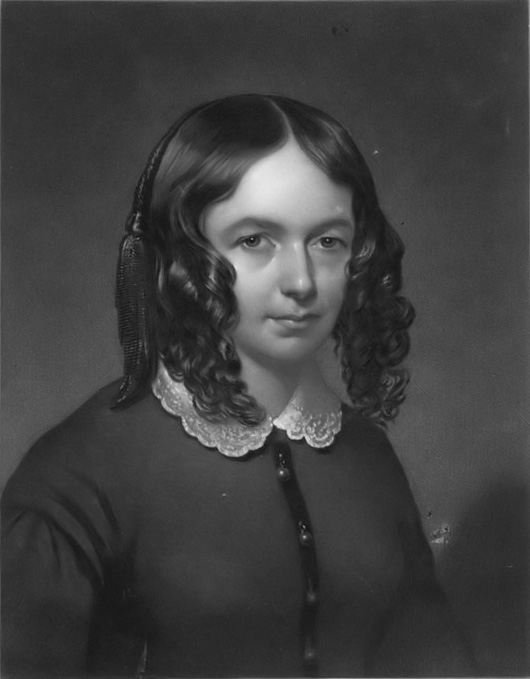
Frases célebres de Elizabeth Barrett Browning
“La esperanza vieja es la más dura de perder.”
Fuente: Pumarega, Manuel. Frases célebres de hombres célebres, 3ª Edición. Editorial México, 1949, p. 94.
Elizabeth Barrett Browning: Frases en inglés
Aurora Leigh http://digital.library.upenn.edu/women/barrett/aurora/aurora.html (1857) <br class="br">Contexto: And truly, I reiterate,.. nothing's small!<br>No lily-muffled hum of a summer-bee,<br>But finds some coupling with the spinning stars;<br>No pebble at your foot, but proves a sphere;<br>No chaffinch, but implies the cherubim:<br>And, — glancing on my own thin, veined wrist, —<br>In such a little tremour of the blood<br>The whole strong clamour of a vehement soul<br>Doth utter itself distinct. Earth's crammed with heaven,<br>And every common bush afire with God:<br>But only he who sees, takes off his shoes,<br>The rest sit round it, and pluck blackberries,<br>And daub their natural faces unaware<br>More and more, from the first similitude.<br><br>Bk. VII, l. 812-826.
“Whoso loves
Believes the impossible.”
Book V. <br class="br"> Aurora Leigh http://digital.library.upenn.edu/women/barrett/aurora/aurora.html (1857) <br class="br">Variante: Whoso loves<br>Believes the impossible.
Fuente: The Letters of Robert Browning and Elizabeth Barret Barrett 1845-1846 Vol I
“Quick-loving hearts… may quickly loathe.”
Elizabeth Barrett Browning libro Sonnets from the Portuguese
Fuente: Sonnets from the Portuguese
“If thou must love me, let it be for nought
Except for love's sake only.”
Elizabeth Barrett Browning libro Sonnets from the Portuguese
No. XIV
Fuente: Sonnets from the Portuguese (1850)
Contexto: If thou must love me, let it be for nought
Except for love's sake only. Do not say
"I love her for her smile —her look —her way
Of speaking gently,—for a trick of thought
That falls in well with mine, and certes brought
A sense of pleasant ease on such a day" -
For these things in themselves, Beloved, may
Be changed, or change for thee,—and love, so wrought,
May be unwrought so. Neither love me for
Thine own dear pity's wiping my cheeks dry,—
A creature might forget to weep, who bore
Thy comfort long, and lose thy love thereby!
But love me for love's sake, that evermore
Thou may'st love on, through love's eternity.
Fuente: Browning: Poems
“I love thee to the depth and breadth and height my soul can reach.”
Elizabeth Barrett Browning libro Sonnets from the Portuguese
No. LXIII
Sonnets from the Portuguese (1850)
Variante: How do I love thee? Let me count the ways.
I love thee to the depth and breadth and height
My soul can reach
Contexto: How do I love thee? Let me count the ways.
I love thee to the depth and breadth and height
My soul can reach, when feeling out of sight
For the ends of Being and ideal Grace.
Contexto: How do I love thee? Let me count the ways.
I love thee to the depth and breadth and height
My soul can reach, when feeling out of sight
For the ends of Being and ideal Grace.
I love thee to the level of everyday's
Most quiet need, by sun and candlelight.
I love thee freely, as men strive for Right;
I love thee purely, as they turn from Praise.
I love thee with the passion put to use
In my old griefs, and with my childhood's faith.
I love thee with a love I seemed to lose
With my lost saints,—I love thee with the breath,
Smiles, tears, of all my life! —and, if God choose,
I shall but love thee better after death.
Fuente: A Little Book Of Love Poems
Elizabeth Barrett Browning libro Sonnets from the Portuguese
No. LXIII
Sonnets from the Portuguese (1850)
Contexto: How do I love thee? Let me count the ways.
I love thee to the depth and breadth and height
My soul can reach, when feeling out of sight
For the ends of Being and ideal Grace.
I love thee to the level of everyday's
Most quiet need, by sun and candlelight.
I love thee freely, as men strive for Right;
I love thee purely, as they turn from Praise.
I love thee with the passion put to use
In my old griefs, and with my childhood's faith.
I love thee with a love I seemed to lose
With my lost saints,—I love thee with the breath,
Smiles, tears, of all my life! —and, if God choose,
I shall but love thee better after death.
“Earth's crammed with heaven…
But only he who sees, takes off his shoes.”
Elizabeth Barrett Browning libro Aurora Leigh
Fuente: Aurora Leigh
“But love me for love's sake, that evermore
Thou may'st love on, through love's eternity”
Elizabeth Barrett Browning libro Sonnets from the Portuguese
No. XIV
Sonnets from the Portuguese (1850)
Contexto: If thou must love me, let it be for nought
Except for love's sake only. Do not say
"I love her for her smile —her look —her way
Of speaking gently,—for a trick of thought
That falls in well with mine, and certes brought
A sense of pleasant ease on such a day" -
For these things in themselves, Beloved, may
Be changed, or change for thee,—and love, so wrought,
May be unwrought so. Neither love me for
Thine own dear pity's wiping my cheeks dry,—
A creature might forget to weep, who bore
Thy comfort long, and lose thy love thereby!
But love me for love's sake, that evermore
Thou may'st love on, through love's eternity.
“To hold together what he was and is.”
Bk. I, l. 1-8. <br class="br"> Aurora Leigh http://digital.library.upenn.edu/women/barrett/aurora/aurora.html (1857) <br class="br">Contexto: Of writing many books there is no end;<br>And I who have written much in prose and verse<br>For others' uses, will write now for mine,—<br>Will write my story for my better self,<br>As when you paint your portrait for a friend,<br>Who keeps it in a drawer and looks at it<br>Long after he has ceased to love you, just<br>To hold together what he was and is.
“I praise Thee while my days go on;
I love Thee while my days go on”
St. 23 -24.
De Profundis (1862)
Contexto: p>I praise Thee while my days go on;
I love Thee while my days go on:
Through dark and dearth, through fire and frost,
With emptied arms and treasure lost,
I thank Thee while my days go on.And having in thy life-depth thrown
Being and suffering (which are one),
As a child drops his pebble small
Down some deep well, and hears it fall
Smiling — so I. THY DAYS GO ON.</p
“Unless you can die when the dream is past —
Oh, never call it loving!”
A Woman's Shortcomings http://www.poetryconnection.net/poets/Elizabeth_Barrett_Browning/14908, st. 5 (1850). <br class="br">Contexto: Unless you can muse in a crowd all day<br>On the absent face that fixed you;<br>Unless you can love, as the angels may,<br>With the breadth of heaven betwixt you;<br>Unless you can dream that his faith is fast,<br>Through behoving and unbehoving;<br>Unless you can die when the dream is past —<br>Oh, never call it loving!
“And truly, I reiterate, . . nothing's small!”
Bk. VII, l. 812-826. <br class="br"> Aurora Leigh http://digital.library.upenn.edu/women/barrett/aurora/aurora.html (1857) <br class="br">Contexto: And truly, I reiterate,.. nothing's small!<br>No lily-muffled hum of a summer-bee,<br>But finds some coupling with the spinning stars;<br>No pebble at your foot, but proves a sphere;<br>No chaffinch, but implies the cherubim:<br>And, — glancing on my own thin, veined wrist, —<br>In such a little tremour of the blood<br>The whole strong clamour of a vehement soul<br>Doth utter itself distinct. Earth's crammed with heaven,<br>And every common bush afire with God:<br>But only he who sees, takes off his shoes,<br>The rest sit round it, and pluck blackberries,<br>And daub their natural faces unaware<br>More and more, from the first similitude.
“I cannot speak
In happy tones”
Reported in Josiah Hotchkiss Gilbert, Dictionary of Burning Words of Brilliant Writers (1895), p. 514.
Contexto: I cannot speak
In happy tones; the tear drops on my cheek
Show I am sad;
But I can speak
Of grace to suffer with submission meek,
Until made glad.
I cannot feel
That all is well, when dark'ning clouds conceal
The shining sun;
But then I know
God lives and loves; and say, since it is so,
"Thy will be done."
“Life, struck sharp on death,
Makes awful lightning.”
Bk. I, l. 210-214. <br class="br"> Aurora Leigh http://digital.library.upenn.edu/women/barrett/aurora/aurora.html (1857) <br class="br">Contexto: Life, struck sharp on death,<br>Makes awful lightning. His last word was, 'Love–'<br>'Love, my child, love, love!'–(then he had done with grief)<br>'Love, my child.' Ere I answered he was gone,<br>And none was left to love in all the world.
“Instruct thine eyes to keep their colours true,
And tell thy soul, their roots are left in mine.”
Elizabeth Barrett Browning libro Sonnets from the Portuguese
No. LXIV
Sonnets from the Portuguese (1850)
Contexto: Here's ivy! — take them, as I used to do
Thy flowers, and keep them where they shall not pine.
Instruct thine eyes to keep their colours true,
And tell thy soul, their roots are left in mine.
Reported in Josiah Hotchkiss Gilbert, Dictionary of Burning Words of Brilliant Writers (1895), p. 514.
Contexto: I cannot speak
In happy tones; the tear drops on my cheek
Show I am sad;
But I can speak
Of grace to suffer with submission meek,
Until made glad.
I cannot feel
That all is well, when dark'ning clouds conceal
The shining sun;
But then I know
God lives and loves; and say, since it is so,
"Thy will be done."
“What was he doing, the great god Pan,
Down in the reeds by the river?”
A Musical Instrument http://www.webterrace.com/browning/A%20Musical%20Instrument.htm, st. 1 (1860). <br class="br">Contexto: What was he doing, the great god Pan,<br>Down in the reeds by the river?<br>Spreading ruin and scattering ban,<br>Splashing and paddling with hoofs of a goat,<br>And breaking the golden lilies afloat<br>With the dragon-fly on the river.


