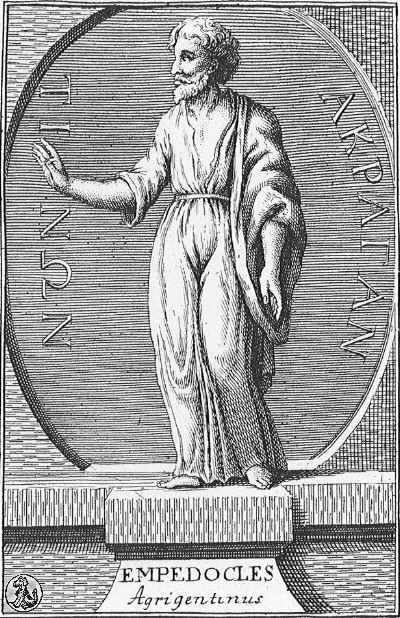
Empédocles: 20 citas5 Me gusta
Empédocles Frases y Citas
Empédocles: Frases en inglés
Empedocles libro On Nature
fr. 6
On Nature
Fuente: Aidoneus corresponds to Hades.
Fuente: Nestis corresponds to Persephone.
Empedocles libro On Nature
from fr. 17
Variant translations:
But come! but hear my words! For knowledge gained/Makes strong thy soul. For as before I spake/Naming the utter goal of these my words/I will report a twofold truth. Now grows/The One from Many into being, now/Even from one disparting come the Many--/Fire, Water, Earth, and awful heights of Air;/And shut from them apart, the deadly Strife/In equipoise, and Love within their midst/In all her being in length and breadth the same/Behold her now with mind, and sit not there/With eyes astonished, for 'tis she inborn/Abides established in the limbs of men/Through her they cherish thoughts of love, through her/Perfect the works of concord, calling her/By name Delight, or Aphrodite clear.
tr. William E. Leonard
On Nature
Contexto: But come, hear my words, since indeed learning improves the spirit. Now as I said before, setting out the bounds of my words, I shall speak twice over. As upon a time One came to be alone out of many, so at another time it divided to be many out of One: fire and water and earth and the limitless vault of air, and wretched Strife apart from these, in equal measure to everything, and Love among them, equal in length and breadth. Consider [Love] in mind, you, and don't sit there with eyes glazing over. It is a thing considered inborn in mortals, to their very bones; through it they form affections and accomplish peaceful acts, calling it Joy or Aphrodite by name.
fr. 132 <br class="br">Variant translations: <br class="br">Blessed is he who has acquired a wealth of divine wisdom, but miserable is he in whom there rests a dim opinion concerning the gods. <br class="br">tr. Arthur Fairbanks <br class="br">Purifications <br class="br">Fuente: Fairbanks, Arthur. (1898). The First Philosophers of Greece https://archive.org/stream/cu31924029013162. Kegan Paul, Trench, Trübner & Co. Ltd. p. 201.
“Far from the Blest; such is the path I tread,”
tr. Phillip H. De Lacy and Benedict Einarson. Cf. full quotation at Leonard p. 54-55 https://books.google.com/books?id=omUTAAAAYAAJ&pg=PA54#v=onepage&q&f=false<br>fr. 115, as paraphrased in Plutarch's Moralia <br class="br">Purifications <br class="br">Contexto: A law there is, an oracle of Doom, Of old enacted by the assembled gods, That if a Daemon—such as live for ages— Defile himself with foul and sinful murder, He must for seasons thrice ten thousand roam Far from the Blest; such is the path I tread, I too a wanderer and exile from heaven.
“He must for seasons thrice ten thousand roam”
tr. Phillip H. De Lacy and Benedict Einarson. Cf. full quotation at Leonard p. 54-55 https://books.google.com/books?id=omUTAAAAYAAJ&pg=PA54#v=onepage&q&f=false<br>fr. 115, as paraphrased in Plutarch's Moralia <br class="br">Purifications <br class="br">Contexto: A law there is, an oracle of Doom, Of old enacted by the assembled gods, That if a Daemon—such as live for ages— Defile himself with foul and sinful murder, He must for seasons thrice ten thousand roam Far from the Blest; such is the path I tread, I too a wanderer and exile from heaven.
“I too a wanderer and exile from heaven.”
tr. Phillip H. De Lacy and Benedict Einarson. Cf. full quotation at Leonard p. 54-55 https://books.google.com/books?id=omUTAAAAYAAJ&pg=PA54#v=onepage&q&f=false<br>fr. 115, as paraphrased in Plutarch's Moralia <br class="br">Purifications <br class="br">Contexto: A law there is, an oracle of Doom, Of old enacted by the assembled gods, That if a Daemon—such as live for ages— Defile himself with foul and sinful murder, He must for seasons thrice ten thousand roam Far from the Blest; such is the path I tread, I too a wanderer and exile from heaven.
fr. 117
Variant translations:
Once on a time a youth was I, and I was a maiden/A bush, a bird, and a fish with scales that gleam in the ocean.
tr. Jane Ellen Harrison
Purifications
Fuente: Harrison, Jane Ellen. (1903). Prolegomena to the Study of Greek Religion. Princeton University Press. p. 590.
fr. 135, as quoted in Aristotle's Rhetoric, 1373 b16
Purifications
“As it has long been and shall be, not ever, I think, will unfathomable time be emptied of either.”
Empedocles libro On Nature
This quote refers to Love and Strife, the fundamental opposing and ordering forces in Empedocles' model of the cosmos.
fr. 16
On Nature
“For one by one did quake the limbs of God.”
Empedocles libro On Nature
tr. William Leonard
fr. 31
On Nature
Fuente: Leonard, William E. (1908). The Fragments of Empedocles. The Open Court Publishing Company. p. 30.


