Esta traducción está esperando su revisión. ¿Es correcto?
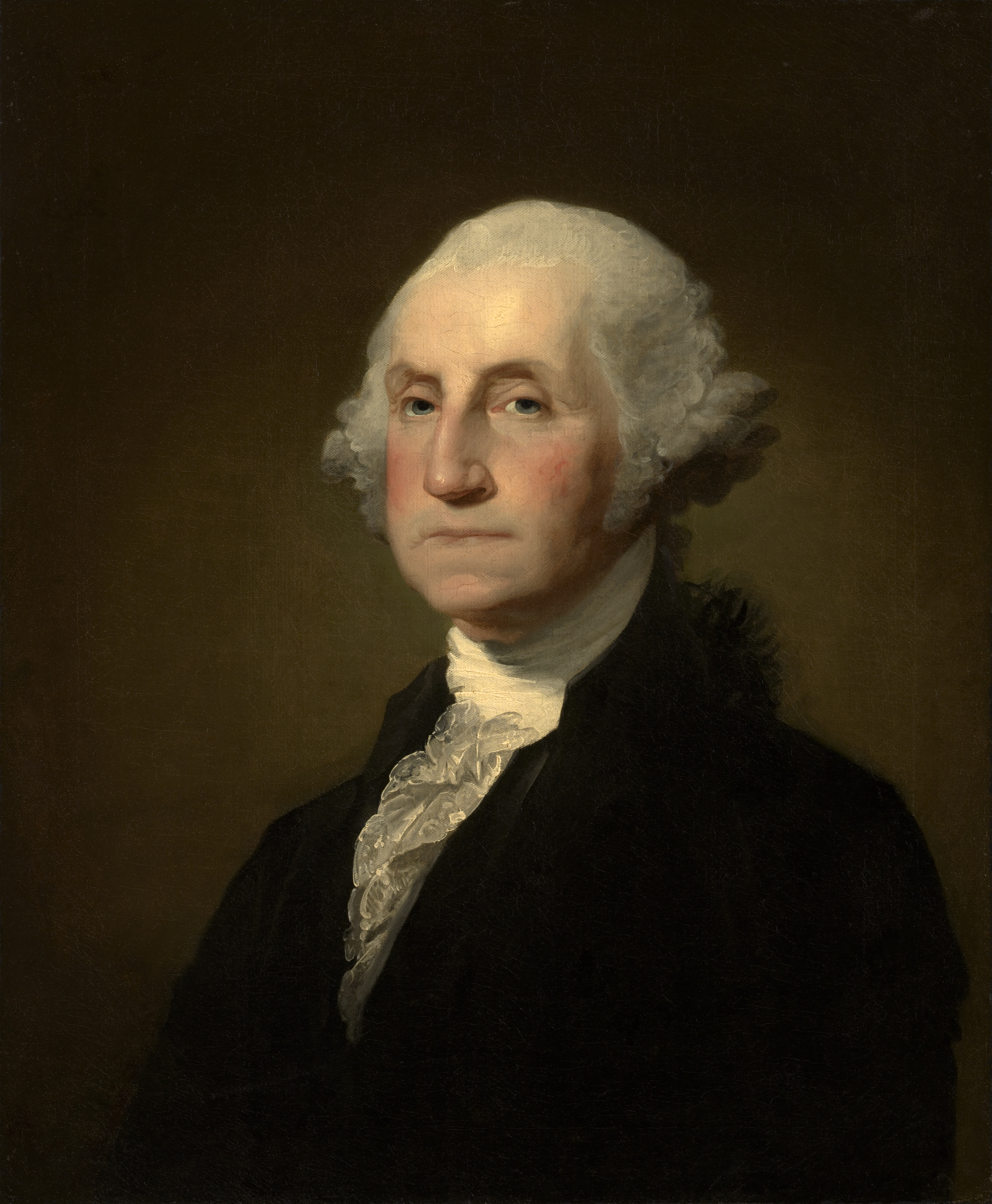
George Washington: 203 citas22 Me gusta
Frases célebres de George Washington
George Washington Frases y Citas
Esta traducción está esperando su revisión. ¿Es correcto?
Sin fuentes
“La religión y la moralidad son pilares esenciales de la sociedad civil.”
Fuente: El libro que dio forma al mundo. Mangalwadi, Vishal. Página 405. Grupo Nelson. 2011.
George Washington: Frases en inglés
Attributed to "The First President of the United States" in "Liberty and Government" by W. M., in The Christian Science Journal, Vol. XX, No. 8 (November 1902) edited by Mary Baker Eddy, p. 465; no earlier or original source for this statement is cited; later quoted in The Cry for Justice : An Anthology of the Literature of Social Protest (1915) edited by Upton Sinclair, p. 305, from which it became far more widely quoted and in Frank J. Wilstach, A Dictionary of Similes, 2d ed., p. 526 (1924). In The Great Thoughts (1985), George Seldes says, p. 441, col. 2, footnote, this paragraph “although credited to the ‘Farewell’ [address] cannot be found in it. Lawson Hamblin, who owns a facsimile, and Horace Peck, America’s foremost authority on quotations, informed me this paragraph is apocryphal.” It is listed as spurious at the Mount Vernon website http://www.mountvernon.org/research-collections/digital-encyclopedia/article/spurious-quotations/ <br class="br">Unsourced variant : Government is not reason, it is not eloquence, it is force; like fire, a troublesome servant and a fearful master. Never for a moment should it be left to irresponsible action. <br class="br">Misattributed, Spurious attributions <br class="br">Variante: Government is not reason, it is not eloquence, it is force; like fire, a troublesome servant and a fearful master. Never for a moment should it be left to irresponsible action.
Letter to Governor Dinwiddie (29 May 1754)
1750s
General Orders (18 April 1783)
1780s
“To be prepared for war is one of the most effectual means of preserving peace.”
First Annual Address, to both Houses of Congress (8 January 1790).
Compare: "Qui desiderat pacem præparet bellum" (translated: "Who would desire peace should be prepared for war"), Vegetius, Rei Militari 3, Prolog.; "In pace, ut sapiens, aptarit idonea bello" (translated: "In peace, as a wise man, he should make suitable preparation for war"), Horace, Book ii. satire ii.
1790s
Letter to Benjamin Harrison V (9 March 1789), published in Washington's Writings: Being His Correspondence, Addresses, Messages, and Other Papers, Official and Private, Selected and Published from the Original Manuscripts https://play.google.com/store/books/details?id=DTlEAQAAMAAJ&rdid=book-DTlEAQAAMAAJ&rdot=1, Volume IX, p. 475. <br class="br">1780s
George Washington in a letter to William Pearce at Mount Vernon (Philadelphia 24th Feby 1794), The Writings of George Washington, Bicentennial Edition 1939, p.279 books.google https://books.google.de/books?id=WIGyAwAAQBAJ&pg=PA279&dq=hemp, and founders.archives.gov https://founders.archives.gov/documents/Washington/05-15-02-0210 <br class="br">This quote is often confused with Make the most of the Indian hemp seed, and sow it everywhere! George Washington Spurious Quotations http://www.mountvernon.org/research-collections/digital-encyclopedia/article/spurious-quotations/ <br class="br">1790s
Upon visiting the grave of Johann de Kalb, some years after his death, as quoted in "Baron De Kalb" https://books.google.com/books?id=40wyAQAAMAAJ&pg=PA96&dq=%22Would+to+God+he+had+lived+to+share+its+fruits%22&hl=en&sa=X&ei=2IoZVa3XLuyasQTXiIDoCg&ved=0CB0Q6AEwAA#v=onepage&q=%22Would%20to%20God%20he%20had%20lived%20to%20share%20its%20fruits%22&f=false (1827), by George R. Graham and Edgar Allan Poe, Graham's Illustrated Magazine of Literature, Romance, Art, and Fashion, Volume 2, Watson, p. 96. <br class="br">Posthumous attributions
This is the conclusion to an article entitled "Older Ideas of Firearms" by C. S. Wheatley; it was published in the September 1926 issue of Hunter, Trader, Trapper (vol. 53, no. 3), p. 34. Wheatley had referred to George Washington's address to the second session of the first Congress immediately before this passage, which may have given rise to the mistaken attribution. See this piece http://quoteinvestigator.com/2015/02/26/firearm/ at Quote Investigator <br class="br">Misattributed
Comment to General Henry Knox on the delay in assuming office (March 1789)
1780s
Letter to Mr. George William Fairfax (31 May 1775) George Washington Papers http://memory.loc.gov/cgi-bin/query/r?ammem/mgw:@field(DOCID+@lit(gw030206)) at the Library of Congress <br class="br">1770s
Circular Letter to the Governours of the several States (18 June 1783). Misreported as "I make it my constant prayer that God would most graciously be pleased to dispose us all to do justice, to love mercy, and to demean ourselves with that charity, humility, and pacific temper of mind, which were the characteristics of the Divine Author of our blessed religion; without a humble imitation of whose example in these things, we can never hope to be a happy nation", in Josiah Hotchkiss Gilbert, Dictionary of Burning Words of Brilliant Writers (1895), p. 315
1780s
Letter to James Madison, 30 November 1785 https://books.google.com/books?id=64MTAQAAMAAJ&pg=PA25 <br class="br">1780s
First Inaugural Address (30 April 1789), published in The Writings of George Washington, edited by John C. Fitzpatrick, Vol. 30, pp. 294-5
1780s
“What students would learn in American schools above all is the religion of Jesus Christ.”
A modern fabrication, possibly derived from David Barton's claim (Original Intent, p. 85) that "By George Washington’s own words, what youths learned in America’s schools 'above all' was 'the religion of Jesus Christ.'”. Washington did use the phrase "above all the religion of Jesus Christ" on 12 May 1779 in a reply to a petition from a Lenape delegation asking for assistance in promoting the missionary activities of David Zeisberger among their people: "You do well to wish to learn our arts and ways of life, and above all, the religion of Jesus Christ. These will make you a greater and happier people than you are. Congress will do every thing they can to assist you in this wise intention..." He did not say anything about "What students would learn in American schools," though earlier in the same reply he did say "I am glad you have brought three of the Children of your principal Chiefs to be educated with us." While there's nothing in the reply about how those "Children" might be educated (in fact Congress put two of them through Princeton) it's possible that suggested the fabricated portion. See Louise Phelps Kellogg, Frontier Advance on the Upper Ohio 1778-1779 (Madison WI, 1916), pp. 317-324, for the episode. Washington's reply is also found in John C. Fitzpatrick, The Writings of George Washington from the Original Manuscript Sources, 1745-1799, vol. 15 (Washington D.C., 1936), p. 55
Misattributed, Spurious attributions
Letter to the Roman Catholics in America http://teachingamericanhistory.org/library/document/letter-to-the-roman-catholics/ (15 March 1790) <br class="br">1790s <br class="br">Variante: As mankind become more liberal they will be more apt to allow that all those who conduct themselves as worthy members of the community are equally entitled to the protection of civil government. I hope ever to see America among the foremost nations in examples of justice and liberality.
1770s, Letter to Phyllis Wheatley (1776)
Oliver Cromwell, letter to Walter Dundas, 12 September 1650; this is also a recent misattribution.
Misattributed
Letter to the President of Congress (9 February 1776)
1770s
Letter to the Grand Lodge of Free Masons of Massachusetts (27 December 1792) https://www.beliefnet.com/resourcelib/docs/86/Letter_from_George_Washington_to_the_Grand_Master_of_Free_Mas_1.html, published in The Writings Of George Washington (1835) by Jared Sparks, p. 201 <br class="br">1790s
US Senator William Edgar Borah, writing in The Reader's Digest, Vol. 8, Issue 2 (1929), p. 776; this has only rarely begun to be attributed to Washington, since about 2010.
Misattributed
“It is infinitely better to have a few good men than many indifferent ones.”
Letter to James McHenry (10 August 1798)
1790s
Letter to John Armstrong, 11 March 1782, in Ford's Writings of George Washington (1891), vol. XII, p. 111. This is frequently attached to part of a letter to Brigadier-General Nelson of 20 August 1778, as in this 1864 example from B. F. Morris, The Christian Life and Character of the Civil Institutions of the United States, pp. 33-34:
I am sure that there never was a people who had more reason to acknowledge a divine interposition in their affairs than those of the United States; and I should be pained to believe that they have forgotten that agency which was so often manifested during the Revolution, or that they failed to consider the omnipotence of that God who is alone able to protect them. He must be worse than an infidel that lacks faith, and more than wicked that has not gratitude enough to acknowledge his obligations.
1780s
Letter to General Armstrong (26 March 1781) http://www.greatseal.com/mottoes/coeptis.html, as quoted in The Religious Opinions and Character of Washington (1836) by Edward Charles McGuire, p. 122 <br class="br">1780s
To John Hancock https://web.archive.org/web/20141008220806/http://amrevmuseum.org/reflections/african-americans-continental-army-and-state-militias-during-american-war-independence (31 December 1775) <br class="br">1770s, Letter to John Hancock (1775)
“We had quitters during the Revolution too… we called them "Kentuckians."”
This attribution apparently originated with a statement of a cartoon version of Washington on an episode http://www.imdb.com/title/tt0701155/quotes of The Simpsons. Though not initially presented as a genuine quote this has sometimes been attributed to Washington. <br class="br">Misattributed, Spurious attributions
Message to the U.S. Congress (9 July 1789); The Writings of George Washington: Being His Correspondence, Addresses, Messages, and Other Papers, Official and Private (1837) edited by Jared Sparks, p. 159 (PDF) http://books.google.com/books?vid=OCLC29437768&id=qy2nqT6FnLMC&pg=RA1-PA159&lpg=RA1-PA159&dq=%22carrying+these+into+effect,+fidelity+and+diligence%22&num=100 <br class="br">1780s
1790s, Farewell Address (1796)
First Annual Address, to both House of Congress (8 January 1790)
1790s
1780s, The Newburgh Address (1783)


