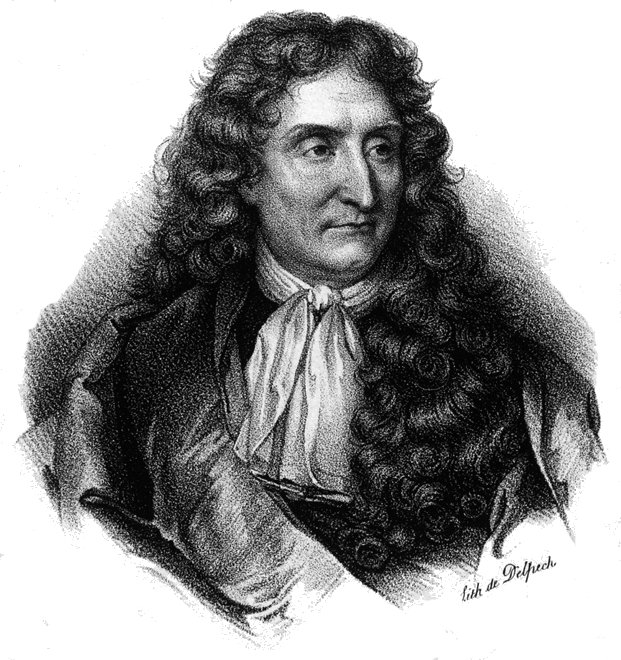
Frases célebres de Jean De La Fontaine
Jean De La Fontaine Frases y Citas
“Ningún camino de flores conduce a la gloria.”
Fuente: Fábulas.
Fuente: "Aucun chemin de fleurs ne conduit à la gloire". Fables; libro X; fábula XIV.
Fuente: [Goicoechea] (1952), p. 207.
Jean De La Fontaine: Frases en inglés
“Man is so made that when anything fires his soul, impossibilities vanish.”
L'homme est ainsi bâti: Quand un sujet l'enflamme
L'impossibilité disparaît à son âme.
Book VIII (1678-1679), fable 25.
Fables (1668–1679)
“Beware, as long as you live, of judging people by appearances.”
Garde-toi, tant que tu vivras,
De juger les gens sur la mine.
Book VI (1668), fable 5.
Fables (1668–1679)
“Patience and time do more than strength or passion.”
Patience et longueur de temps
Font plus que force ni que rage.
Book II (1668), fable 11.
Fables (1668–1679)
“He knows the universe, and himself he does not know.”
Il connaît l’univers, et ne se connaît pas.
Book VIII (1678–1679), fable 26.
Fables (1668–1679)
Book I (1668), Dedication "To Monseigneur the Dauphin".
Fables (1668–1679)
“There's nothing useless to a man of sense.”
Il n'est rien d'inutile aux personnes de sens.
Book V (1668), fable 19.
Fables (1668–1679)
Jean De La Fontaine libro Parole de Socrate
"Parole de Socrate", as quoted in The Wordsworth Book of Humorous Quotations (1998), edited by C. Robertson
“On the wings of Time grief flies away.”
Sur les ailes du Temps la tristesse s'envole.
Book VI (1668), fable 21.
Fables (1668–1679)
Variante: Sadness flies away on the wings of time.
“Everyone believes very easily whatever they fear or desire.”
As quoted in Subcontact : Slap the Face of Fear and Wake Up Your Subconscious (2001) by Dian Benson, p. 149
Variante: Everyone believes very easily whatever he fears or desires.
“It is a double pleasure to deceive the deceiver.”
C'est double plaisir de tromper le trompeur.
Book II (1668), fable 15 (The Cock and the Fox).
Fables (1668–1679)
Variante: It is twice the pleasure to deceive the deceiver.
“No path of flowers leads to glory.”
Book X, fable 14; reported in Bartlett's Familiar Quotations, 10th ed. (1919).
Fables (1668–1679)
“Our destiny is frequently met in the very paths we take to avoid it.”
On rencontre sa destinée
Souvent par des chemins qu’on prend pour l’éviter.
Book VIII (1678–1679), fable 16 (The Horoscope)
Fables (1668–1679)
Variante: A person often meets his destiny on the road he took to avoid it.
“Death never takes the wise man by surprise, he is always ready to go.”
La mort ne surprend point le sage:
Il est toujours prêt à partir.
Book VIII (1678-1679), fable 1.
Fables (1668–1679)
“People must help one another; it is nature's law.”
"L'Ane et le Chien", as quoted in On a Darkling Plain (1995) by Richard Lee Byers, p. 94.
“In short, luck's always to blame.”
Bref, la fortune a toujours tort. <br class="br">Book V (1688), fable 11 ( Luck and the Young Child http://books.google.com/books?id=onoa71F7TJ4C&q=%22bref+la+fortune+a+toujours+tort%22&pg=PA141#v=onepage) <br class="br">Fables (1668–1679)
“The ant is no lender; that is the least of her faults.”
La fourmi n'est pas prêteuse;
C'est là son moindre défaut.
Book I (1668), fable 1.
Fables (1668–1679)
Mémoires pour servir à l'histoire de Port-Royal (1752), as cited by M. A. Screech in Laughter at the Foot of the Cross (1997), p. 69
“People who make no noise are dangerous.”
Les gens sans bruit sont dangereux.
Book VIII (1678–1679), fable 23.
Fables (1668–1679)
“By the work one knows the workman.”
A l'oeuvre on connaît l'artisan.
Book I (1668), fable 21 (The Hornets And The Bees)
Fables (1668–1679)
Variante: The artist by his work is known.
As quoted in From Grandmother with Love (2005) by Becky Kelly and Patrick Regan, p. 53.
Je vais t'entretenir de moindres aventures,
Te tracer en ces vers de légères peintures;
Et si de t'agréer je n'emporte le prix,
J'aurai du moins d'honneur de l'avoir entrepris.
Book I (1668), Dedication "To Monseigneur the Dauphin".
Fables (1668–1679)
“Nothing is as dangerous as an ignorant friend; a wise enemy is to be preferred.”
Rien n'est si dangereux qu'un ignorant ami;
Mieux vaudrait un sage ennemi.
Book VIII (1678-1679), fable 10.
Fables (1668–1679)
Variante: Nothing is more dangerous than a friend without discretion; even a prudent enemy is preferable.
L’enseigne fait la chalandise.
Book VII (1678–1679), fable 16 (The Fortune-Tellers).
Fables (1668–1679)
Il faut, autant qu'on peut, obliger tout le monde:
On a souvent besoin d'un plus petit que soi.
Book II (1668), fable 11.
Fables (1668–1679)
Variante: One often has need of one inferior to himself.
“The fastidious are unfortunate; nothing satisfies them.”
Les délicats sont malheureux:
Rien ne saurait les satisfaire.
Book II (1668), fable 1.
Fables (1668–1679)
“Love is a cruel conqueror.
Happy is he who knows him through stories
And not by his blows!”
Amour est un étrange maître!
Heureux qui peut ne le connaître
Que par récit, lui ni ses coups!
Book IV (1668), fable 1 (Le lion amoureux).
Fables (1668–1679)


