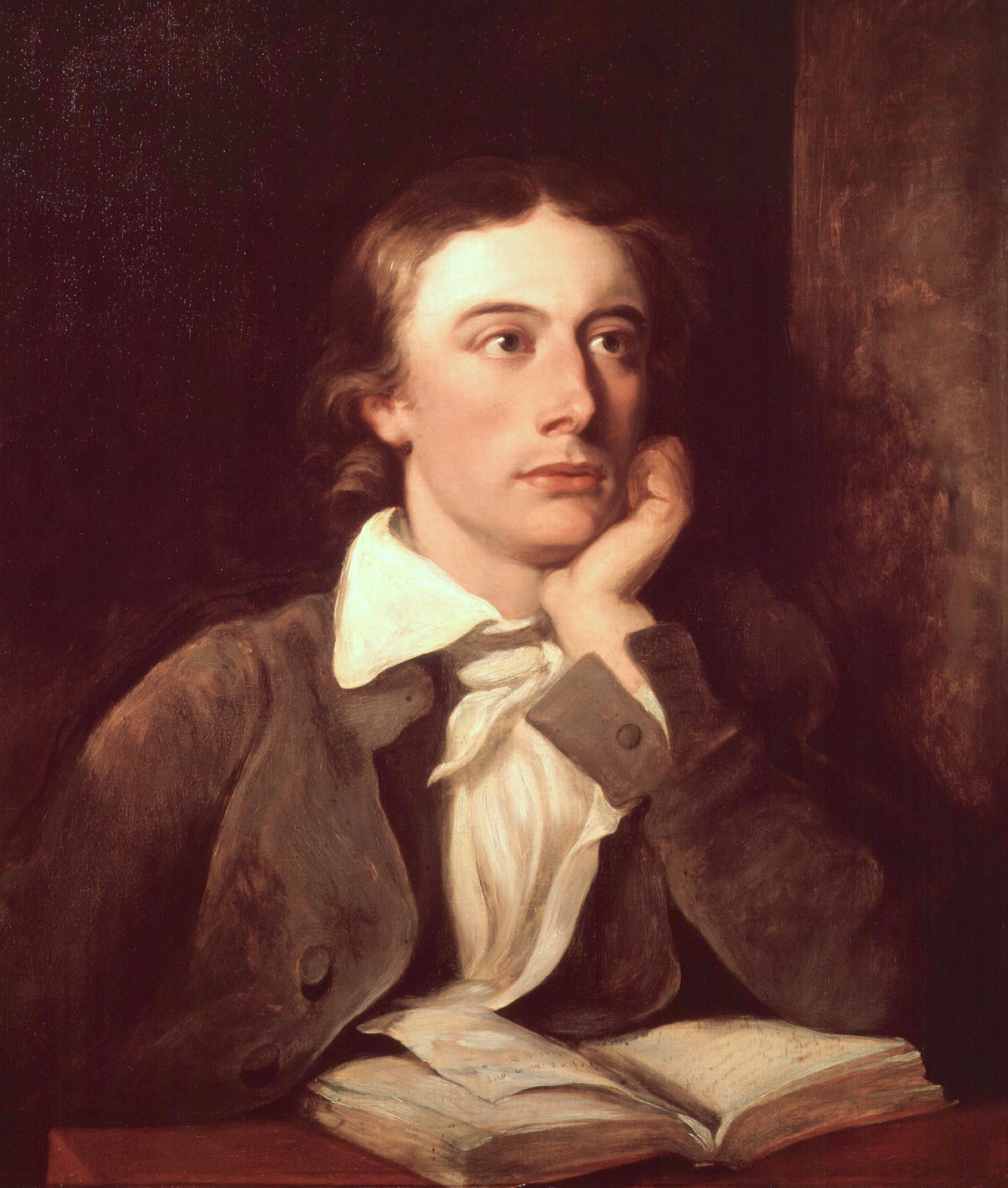
Frases célebres de John Keats
John Keats Frases y Citas
John Keats: Frases en inglés
“And how they kist each other's tremulous eyes.”
Fuente: Bright Star: Love Letters and Poems of John Keats to Fanny Brawne
“I find I cannot exist without Poetry”
Fuente: Letters of John Keats to His Family and Friends
“Scenery is fine — but human nature is finer.”
Letter to Benjamin Bailey (March 13, 1818)
Letters (1817–1820)
Letter to John Taylor (February 27, 1818)
Letters (1817–1820)
Contexto: In Poetry I have a few axioms, and you will see how far I am from their centre. I think Poetry should surprise by a fine excess and not by singularity — it should strike the reader as a wording of his own highest thoughts, and appear almost a remembrance — Its touches of Beauty should never be halfway thereby making the reader breathless instead of content: the rise, the progress, the setting of imagery should like the Sun come natural to him — shine over him and set soberly although in magnificence leaving him in the luxury of twilight — but it is easier to think what Poetry should be than to write it — and this leads me on to another axiom. That if Poetry comes not as naturally as the leaves to a tree it had better not come at all.
"Bright Star" (1819)
Contexto: Bright star! would I were stedfast as thou art-
Not in lone splendour hung aloft the night
And watching with eternal lids apart,
Like nature's patient, sleepless Eremite,
The moving waters at their priestlike task
Of pure ablution round earth's human shores.
Letter to G. and F. Keats (December 21, 1817)
Letters (1817–1820)
“Can death be sleep, when life is but a dream,
And scenes of bliss pass as a phantom by?
---"On death”
Fuente: Complete Poems and Selected Letters
“I am sailing with thee through the dizzy sky!
How beautiful thou art!”
Fuente: Bright Star: Love Letters and Poems of John Keats to Fanny Brawne
“When it is moving on luxurious wings,
The soul is lost in pleasant smotherings.”
Fuente: Bright Star: Love Letters and Poems of John Keats to Fanny Brawne
John Keats Ode to a Nightingale
Stanza 6
Poems (1820), Ode to a Nightingale
Fuente: Complete Poems and Selected Letters
Fuente: Bright Star: Love Letters and Poems of John Keats to Fanny Brawne
“Sweet are the pleasures that to verse belong,
And doubly sweet a brotherhood in song.”
John Keats To George Felton Mathew
"To George Felton Mathew" http://www.bartleby.com/126/11.html (November 1815)
Letter to Percy Bysshe Shelley (August 1820)
Letters (1817–1820)
“Music's golden tongue
Flatter'd to tears this aged man and poor.”
John Keats The Eve of St. Agnes
Stanza 3
Poems (1820), The Eve of St. Agnes
“As though a rose should shut and be a bud again.”
John Keats The Eve of St. Agnes
Stanza 27
Poems (1820), The Eve of St. Agnes
John Keats The Eve of St. Agnes
Stanza 25
Poems (1820), The Eve of St. Agnes
Letter to George and Georgiana Keats (March 19, 1819)
Letters (1817–1820)
“There is not a fiercer hell than the failure in a great object.”
John Keats Endymion
Preface
Endymion (1818)
John Keats Endymion
Bk. I, l. 453
Endymion (1818)
Letter to George Keats (September 21, 1819)
Letters (1817–1820)
Bk. II, l. 203
Hyperion: A Fragment (1819)
“Woman! when I behold thee flippant, vain,
Inconstant, childish, proud, and full of fancies.”
" Woman! When I Behold Thee Flippant, Vain http://www.bartleby.com/126/10.html", st. 1 <br class="br">Poems (1817)
John Keats Endymion
Bk. I, l. 25
Endymion (1818)
Letter to Benjamin Bailey (November 22, 1817)
Letters (1817–1820)
“E’en like the passage of an angel’s tear
That falls through the clear ether silently.”
"Sonnet. To One Who Has Been Long in City Pent"
Poems (1817)
Sonnet, The Day is gone; reported in Bartlett's Familiar Quotations, 10th ed. (1919)


