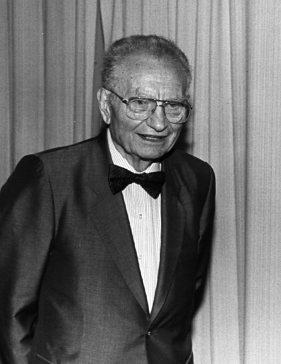
Frases célebres de Paul Samuelson
Paul Samuelson Frases y Citas
Paul Samuelson: Frases en inglés
New millennium, An Enjoyable Life Puzzling Over Modern Finance Theory, 2009
Kotaro Suzumura, An interview with Paul Samuelson: welfare economics,“old” and “new”, and social choice theory (2005)
New millennium
New millennium, An Interview with Paul A. Samuelson, 2003
New millennium, An Enjoyable Life Puzzling Over Modern Finance Theory, 2009
New millennium, An Enjoyable Life Puzzling Over Modern Finance Theory, 2009
1980s–1990s
Fuente: Paul Anthony Samuelson, Kate Crowley (1986), The Collected Scientific Papers, Volume 5, p. 561
Fuente: 1950s–1970s, Maximum Principles in Analytical Economics, 1970, p. 69
Contexto: There is really nothing more pathetic than to have an economist or a retired engineer try to force analogies between the concepts of physics and the concepts of economics. How many dreary papers have I had to referee in which the author is looking for something that corresponds to entropy or to one or another form of energy. Nonsensical laws, such as the law of conservation of purchasing power, represent spurious social science imitations of the important physical law of the conservation of energy; and when an economist makes reference to a Heisenberg Principle of indeterminacy in the social world, at best this must be regarded as a figure of speech or a play on words, rather than a valid application of the relations of quantum mechanics.
February 1985, in William Breit and Roger W. Spencer (ed.) Lives of the laureates
1980s–1990s
Contexto: I can claim that in talking about modern economics I am talking about me. My finger has been in every pie. I once claimed to be the last generalist in economics, writing about and teaching such diverse subjects as international trade and econometrics, economic theory and business cycles, demography and labor economics, finance and monopolistic competition, history of doctrines and locational economics.
Samuelson (1985; p, 6) as cited in: Klein, Daniel B., and Ryan Daza. " Paul A. Samuelson (Ideological Profiles of the Economics Laureates). http://econjwatch.org/file_download/767/schultzipel.pdf" Econ Journal Watch 10.3 (2013): 561-569. <br class="br">1980s–1990s
Coeditor's Forword in Inside the economist’s mind: conversations with eminent economists (2007)
New millennium
“The stock market has forecast nine of the last five recessions.”
Paul Samuelson (1966), quoted in: John C Bluedorn et al. Do Asset Price Drops Foreshadow Recessions? (2013), p. 4
1950s–1970s
New millennium, An Interview with Paul A. Samuelson, 2003
Paul Samuelson in: Louis Uchitelle. " Franco Modigliani, 85, Nobel-Winning Economist, Dies http://www.nytimes.com/2003/09/26/obituaries/26MODI.html" in New York Times, September 26, 2003. <br class="br">New millennium
Fuente: 1950s–1970s, Maximum Principles in Analytical Economics, 1970, p. 76
New millennium, An Enjoyable Life Puzzling Over Modern Finance Theory, 2009
Paul A. Samuelson libro Foundations of Economic Analysis
Fuente: 1940s, Foundations of Economic Analysis, 1947, Ch. 5 : Theory of Consumer’s Behavior
Paul A. Samuelson libro Foundations of Economic Analysis
Fuente: 1940s, Foundations of Economic Analysis, 1947, Ch. 2 : The Theory of Maximizing Behavior
“My Life Philosophy: Policy Credos and Working Ways,” in M. Szenberg (ed.) Eminent Economists: Their Life Philosophies (1992)
1980s–1990s
Paul A. Samuelson libro Foundations of Economic Analysis
Fuente: 1940s, Foundations of Economic Analysis, 1947, Ch. 1 : Introduction
Fuente: 1950s–1970s, Maximum Principles in Analytical Economics, 1970, p. 62: Lead paragraph
Kotaro Suzumura, An interview with Paul Samuelson: welfare economics,“old” and “new”, and social choice theory (2005)
New millennium
February 1985, in William Breit and Roger W. Spencer (ed.) Lives of the laureates
1980s–1990s
“I tell no secret when I repeat that fame and reputation are much a matter of luck and chance.”
Samuelson's Economics at Fifty: Remarks on the Occasion of the Anniversary of Publication (1998)
1980s–1990s
"Foreword: Eavesdropping on the Future?" in New Frontiers in Economics (2004)
New millennium
Paul Samuelson, Tjalling Koopmans, and Richard Stone. "Report of the evaluative committee for Econometrica." Econometrica- journal of the Econometric Society. (1954): 141-146.
1950s–1970s
Conor Clarke, An Interview With Paul Samuelson http://www.theatlantic.com/politics/archive/2009/06/an-interview-with-paul-samuelson-part-two/19627/, Part Two (2009) <br class="br">New millennium
Conor Clarke, An Interview With Paul Samuelson, Part One http://www.theatlantic.com/politics/archive/2009/06/an-interview-with-paul-samuelson-part-one/19572/ (2009) <br class="br">New millennium
Samuelson's Economics at Fifty: Remarks on the Occasion of the Anniversary of Publication (1998)
1980s–1990s
Kotaro Suzumura, An interview with Paul Samuelson: welfare economics,“old” and “new”, and social choice theory (2005)
New millennium
New millennium, An Interview with Paul A. Samuelson, 2003


