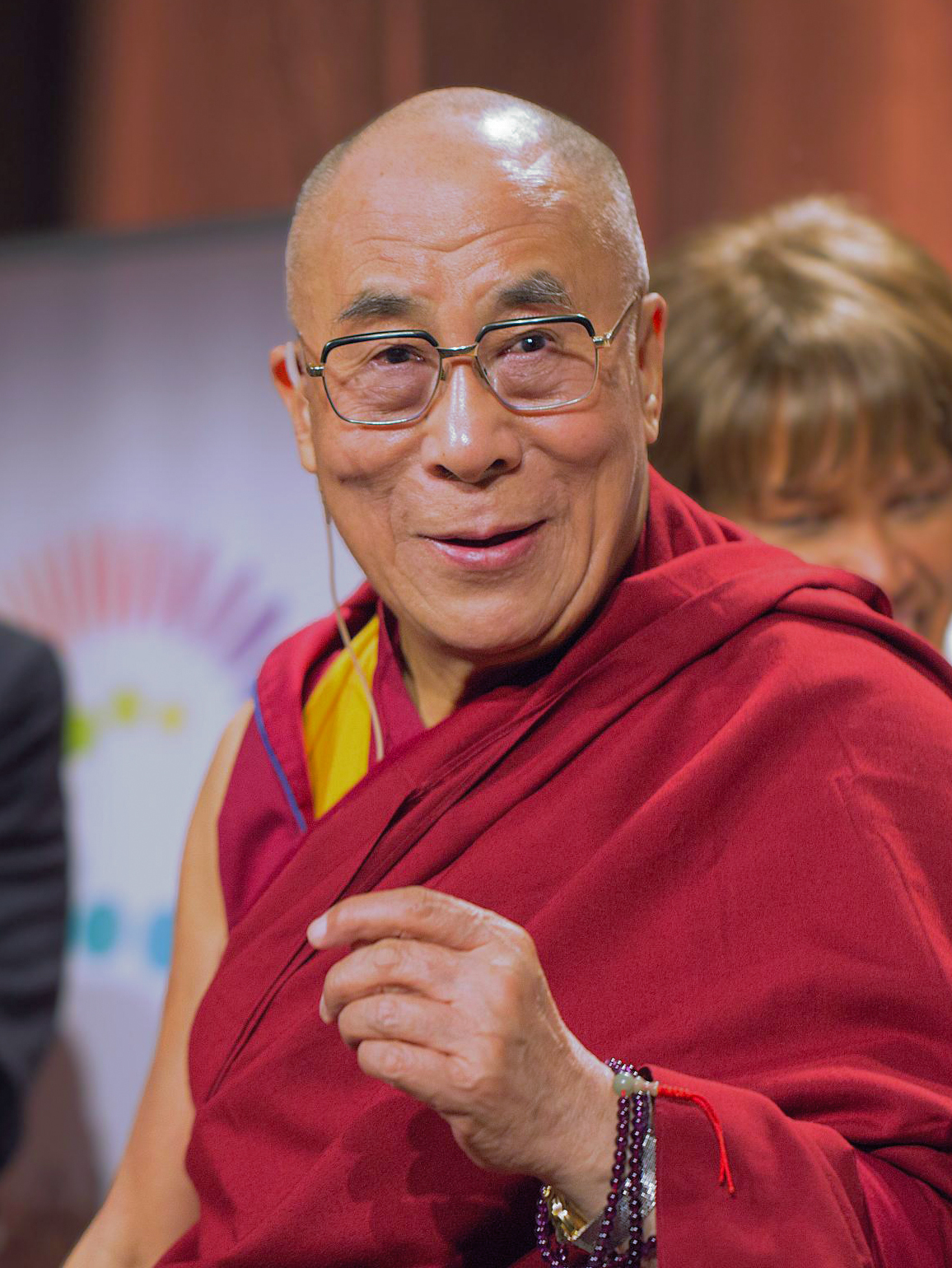
Frases célebres de Dalai Lama
Frases de fe de Dalai Lama
Fuente: Palomo Triguero, Eduardo. Cita-logía. Editorial Punto Rojo Libros, 2013; p. 133. https://books.google.es/books?id=He9BAwAAQBAJ&pg=PA133&dq=cita-logia+dalai+lama&hl=es&sa=X&ved=0ahUKEwj24dD8wd7hAhUDKBoKHXL9DvwQ6AEIKTAA#v=onepage&q=dalai%20&f=false ISBN 9781629346847.
Fuente: Citado en Meditations for Living In Balance: Daily Solutions for People Who Do Too Much (2000), de Anne Wilson Schaef; p. 11.
Dalai Lama Frases y Citas
“La existencia es una realidad para vivir, más que un problema para resolver.”
Respuesta de Gyatso a la pregunta '¿Su exilio es una tragedia?'. La respuesta completa: «La existencia es una realidad para vivir, más que un problema para resolver. A lo mejor, si me quedaba en el Tibet, me habría corrompido. De todos modos es bueno que esté fuera, porque así no corro riesgo alguno». (op.cit. p. 194)
Fuente: Wolpin, Samuel. Los Maestros del Sendero. Ed. Kier. Entrevista con el Dalai Lama: p. 194. https://books.google.es/books?hl=es&id=eTKQ5mrVbYkC&dq=La+existencia+es+una+realidad+para+vivir%2C+m%C3%A1s+que+un+problema+para+resolver.+dalai+lama&q=dalai#v=snippet&q=dalai&f=false ISBN 9789501710267.
sin fuentes
“Comprender el vacío no es nada fácil.”
Fuente: Dalai Lama: El arte de la compasión.
Fuente: [‘Dalai Lama’] (2002), p. 99.
Discurso en el Central Park de Nueva York, el 15 de agosto de 1999.
Fuente: Dalai Lama: El arte de la compasión.
Fuente: [‘Dalai Lama’] (2002), p. 13.
Dalai Lama: Frases en inglés
Letter to Deng Xiaoping (1981)
Contexto: I agree with and believe in the Communist ideology which seeks the well being of human beings in general and the proletariat in particular, and in Lenin's policy of the equality of nationalities. Similarly, I was pleased with the discussions I had with Chairman Mao on ideology and the policy towards nationalities.
If that same ideology and policy were implemented it would have brought much admiration and happiness. However, if one is to make a general comment on the developments during the past two decades, there has been a lapse in economic and educational progress, the basis of human happiness. Moreover, on account of the hardships caused by the unbearable disruptions, there has been a loss of trust between the Party and the masses, between the officials and the masses, among the officials themselves, and also among the masses themselves.
By deceiving one another through false assumptions and misrepresentations there has been, in reality, a great lapse and delay in achieving the real goals.
Nobel lecture (1989)
Contexto: Peace can only last where human rights are respected, where the people are fed, and where individuals and nations are free. True peace with oneself and with the world around us can only be achieved through the development of mental peace.
"The Nobel Evening Address" p. 115.
The Dalai Lama: A Policy of Kindness (1990)
Contexto: Buddhism does not accept a theory of God, or a creator. According to Buddhism, one's own actions are the creator, ultimately. Some people say that, from a certain angle, Buddhism is not a religion but rather a science of mind. Religion has much involvement with faith. Sometimes it seems that there is quite a distance between a way of thinking based on faith and one entirely based on experiment, remaining skeptical. Unless you find something through investigation, you do not want to accept it as fact. From one viewpoint, Buddhism is a religion, from another viewpoint Buddhism is a science of mind and not a religion. Buddhism can be a bridge between these two sides. Therefore, with this conviction I try to have closer ties with scientists, mainly in the fields of cosmology, psychology, neurobiology and physics. In these fields there are insights to share, and to a certain extent we can work together.
“Human happiness and human satisfaction must ultimately come from within oneself.”
The Path to Tranquility: Daily Wisdom (1998) edited by Renuka Singh
Contexto: Human happiness and human satisfaction must ultimately come from within oneself. It is wrong to expect some final satisfaction to come from money or from a computer.
Nobel lecture (1989)
Contexto: Inner peace is the key: if you have inner peace, the external problems do not affect your deep sense of peace and tranquility. In that state of mind you can deal with situations with calmness and reason, while keeping your inner happiness. That is very important. Without this inner peace, no matter how comfortable your life is materially, you may still be worried, disturbed or unhappy because of circumstances.
Nobel lecture (1989)
“Today, we are truly a global family. What happens in one part of the world may affect us all.”
Nobel lecture (1989)
Contexto: Today, we are truly a global family. What happens in one part of the world may affect us all. This, of course, is not only true of the negative things that happen, but is equally valid for the positive developments. We not only know what happens elsewhere, thanks to the extraordinary modern communications technology. We are also directly affected by events that occur far away.
"A Talk to Western Buddhists" p. 87.
The Dalai Lama: A Policy of Kindness (1990)
Contexto: To study Buddhism and then use it as a weapon in order to criticize others' theories or ideologies is wrong. The very purpose of religion is to control yourself, not to criticize others. Rather, we must criticize ourselves. How much am I doing about my anger? About my attachment, about my hatred, about my pride, my jealousy? These are the things which we must check in daily life with the knowledge of the Buddhist teachings.
"The Nobel Evening Address" p. 115.
The Dalai Lama: A Policy of Kindness (1990)
Contexto: As a result of more contact with people from other traditions, as time passes I have firmed my conviction that all religions can work together despite fundamental differences in philosophy. Every religion aims at serving humanity. Therefore, it is possible for the various religions to work together to serve humanity and contribute to world peace. So, during these last few years, at every opportunity I try to develop closer relations with other religions.
“It is very important to generate a good attitude, a good heart, as much as possible.”
Kindness, Clarity, and Insight (1984).
Contexto: It is very important to generate a good attitude, a good heart, as much as possible. From this, happiness in both the short term and the long term for both yourself and others will come.
Interview in The New York Times (28 November 1993).
Contexto: I believe that in the 20th century, humanity has learned from many, many experiences. Some positive, and many negative. What misery, what destruction! The greatest number of human beings were killed in the two world wars of this century. But human nature is such that when we face a tremendous critical situation, the human mind can wake up and find some other alternative. That is a human capacity.
“Our own brain, our own heart is our temple; the philosophy is kindness.”
"Kindness and Compassion" p. 52
The Dalai Lama: A Policy of Kindness (1990)
Contexto: This is my simple religion. There is no need for temples; no need for complicated philosophy. Our own brain, our own heart is our temple; the philosophy is kindness.
The Dalai Lama's Book of Wisdom (2000).
Contexto: Within the body there are billions of different particles. Similarly, there are many different thoughts and a variety of states of mind. It is wise to take a close look into the world of your mind and to make the distinction between beneficial and harmful states of mind. Once you can recognize the value of good states of mind, you can increase or foster them.
Letter to Deng Xiaoping (1981)
Contexto: I agree with and believe in the Communist ideology which seeks the well being of human beings in general and the proletariat in particular, and in Lenin's policy of the equality of nationalities. Similarly, I was pleased with the discussions I had with Chairman Mao on ideology and the policy towards nationalities.
If that same ideology and policy were implemented it would have brought much admiration and happiness. However, if one is to make a general comment on the developments during the past two decades, there has been a lapse in economic and educational progress, the basis of human happiness. Moreover, on account of the hardships caused by the unbearable disruptions, there has been a loss of trust between the Party and the masses, between the officials and the masses, among the officials themselves, and also among the masses themselves.
By deceiving one another through false assumptions and misrepresentations there has been, in reality, a great lapse and delay in achieving the real goals.
The Dalai Lama at Harvard: Lectures on the Buddhist Path to Peace (1988) by Jeffrey Hopkins.
Contexto: What is the Great Vehicle? What is the mode of procedure of the Bodhisattva path? We begin with the topic of the altruistic intention to achieve enlightenment in which one values others more than oneself. The Great Vehicle path requires the vast motivation of a Bodhisattva, who, not seeking just his or her welfare, takes on the burden of bringing about the welfare of all sentient beings. When a person generate this attitude, they enter within the Great Vehicle, and as long as it has not been generated, one cannot be counted among those of the Great Vehicle. This attitude really has great power; it, of course, is helpful for people practicing religion, but it also is helpful for those who are just concerned with the affairs of this lifetime. The root of happiness is altruism — the wish to be of service to others.
Letter to Deng Xiaoping (1981)
The Path to Enlightenment (1994) ISBN 1559390328
Misattributed, "What surprises you most about humanity?"
“Compassion without attachment is possible.”
The Compassionate Life (2001), Ch. 2 "How to Develop Compassion" p. 21
Contexto: Compassion without attachment is possible. Therefore, we need to clarify the distinctions between compassion and attachment. True compassion is not just an emotional response but a firm commitment founded on reason. Therefore, a truly compassionate attitude towards others does not change even if they behave negatively. Genuine compassion is based not on our own projections and expectations, but rather on the needs of the other...
"The Nobel Evening Address" p. 115.
The Dalai Lama: A Policy of Kindness (1990)
Contexto: Buddhism does not accept a theory of God, or a creator. According to Buddhism, one's own actions are the creator, ultimately. Some people say that, from a certain angle, Buddhism is not a religion but rather a science of mind. Religion has much involvement with faith. Sometimes it seems that there is quite a distance between a way of thinking based on faith and one entirely based on experiment, remaining skeptical. Unless you find something through investigation, you do not want to accept it as fact. From one viewpoint, Buddhism is a religion, from another viewpoint Buddhism is a science of mind and not a religion. Buddhism can be a bridge between these two sides. Therefore, with this conviction I try to have closer ties with scientists, mainly in the fields of cosmology, psychology, neurobiology and physics. In these fields there are insights to share, and to a certain extent we can work together.
The Path to Tranquility: Daily Wisdom (1998) edited by Renuka Singh
Contexto: Bodhicitta is the medicine which revives and gives life to every sentient being who even hears of it. When you engage in fulfilling the needs of others, your own needs are fulfilled as a by-product.
Letter to Deng Xiaoping (1981)
Contexto: We must improve the relationship between China and Tibet as well as between Tibetans in and outside Tibet. With truth and equality as our foundation, we must try to develop friendship between Tibetans and Chinese through better understanding in the future. The time has come to apply our common wisdom in a spirit of tolerance and broadmindedness to achieve genuine happiness for the Tibetan people with a sense of urgency.
On my part, I remain committed to contribute my efforts for the welfare of all human beings, and in particular the poor and the weak to the best of my ability without any distinction based on national boundaries.
“If there are sound reasons or bases for the points you demand, then there is no need for violence.”
"The Nobel Evening Address" p. 115.
The Dalai Lama: A Policy of Kindness (1990)
Contexto: If there are sound reasons or bases for the points you demand, then there is no need for violence. On the other hand, when there is no sound reason that concessions should be made to you but mainly your own desire, then reason cannot work and you have to rely on force. Thus using force is not a sign of strength but rather a sign of weakness.
“The root of happiness is altruism — the wish to be of service to others.”
The Dalai Lama at Harvard: Lectures on the Buddhist Path to Peace (1988) by Jeffrey Hopkins.
Contexto: What is the Great Vehicle? What is the mode of procedure of the Bodhisattva path? We begin with the topic of the altruistic intention to achieve enlightenment in which one values others more than oneself. The Great Vehicle path requires the vast motivation of a Bodhisattva, who, not seeking just his or her welfare, takes on the burden of bringing about the welfare of all sentient beings. When a person generate this attitude, they enter within the Great Vehicle, and as long as it has not been generated, one cannot be counted among those of the Great Vehicle. This attitude really has great power; it, of course, is helpful for people practicing religion, but it also is helpful for those who are just concerned with the affairs of this lifetime. The root of happiness is altruism — the wish to be of service to others.
“I feel that the essence of spiritual practice is your attitude toward others.”
Answering the question "Your Holiness, there are many people in the West who want to combine their spiritual practice with social and political responsibility. Do you feel that these two aspects are connected?" in an interview with Catherine Ingram, Dharamsala, India (2 November 1988).
Contexto: I feel that the essence of spiritual practice is your attitude toward others. When you have a pure, sincere motivation, then you have right attitude toward others based on kindness, compassion, love and respect. Practice brings the clear realisation of the oneness of all human beings and the importance of others benefiting by your actions.


.jpg)