“And hand in hand, on the edge of the sand,
They danced by the light of the moon.”
Edward Lear The Owl and the Pussycat
Fuente: The Owl and the Pussycat
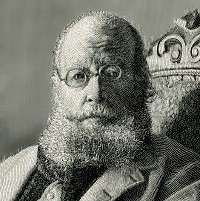
Edward Lear fue un escritor, ilustrador y artista inglés conocido por su poesía absurda y sus limericks .
Nació en Holloway, por aquel entonces un pueblo del norte de Londres, siendo el vigésimo hijo. Fue criado por una hermana veintidós años mayor que él. A la edad de 15 años, él y su hermana dejaron la casa familiar para independizarse. Autodidacta, Lear empezó a trabajar como ilustrador de la anatomía para médicos y, más tarde se especializaría en ilustraciones de animales. Su primera publicación, a la edad de 19 años, fue Illustrations of the Family of Psittacidae, or Parrots en 1830. Sus dibujos tuvieron buena acogida, comparándolos con los de Audubon.[cita requerida] A raíz de la publicación de Parrots, fue invitado a vivir en la finca del conde de Derby, por aquel entonces el presidente de la Sociedad Linneana de Londres, para dibujar a los animales del zoológico privado que allí tenía, tarea que le duró casi cinco años[1] A partir de 1837, apenas visitó Inglaterra, dedicando gran parte de su tiempo a viajar por Europa, la Tierra Santa y luego a la India, a escribir, dibujar y pintar, y finalmente, decidió vivir permanentemente en San Remo, donde falleció.[1] Durante sus viajes, publicaba libros de viajes ilustrados y cuadros de paisajes. En 1846, dio clases particulares de dibujo topográfico a la reina Victoria de Inglaterra.[1]
Durante el resto de su vida realizó dibujos serios aunque se hizo famoso por sus obras humorísticas. En 1846 publicó A Book of Nonsense, un volumen de limericks que sería reeditado 25 veces a lo largo de su vida.[1] En 1865 publicó The History of the Seven Families of the Lake Pipple-Popple, y en 1867 publicó su más famosa obra absurda, The Owl and the Pussycat, que escribió para los hijos de su jefe, Edward Stanley, conde de Derby.[cita requerida]Lear nunca tuvo buena salud. Desde los 17 años hasta su muerte sufrió epilepsia así como bronquitis, asma y, en la vejez, ceguera parcial.
En 1886, el destacado crítico inglés, John Ruskin, escribiría en un artículo sobre sus 100 autores preferidos para la revista Pall Mall Magazine, que:
Realmente no conozco ningún otro autor a quien le estoy la mitad de agradecido por mi vida ociosa que a Edward Lear. Le pondré en el primer lugar de mis autores preferidos.[1]
En el mismo artículo, respecto al libro Book of Nonsense, escribe:
... es el libro más benéfico e inocente de todos los libros jamás producidos.[1] Wikipedia
“And hand in hand, on the edge of the sand,
They danced by the light of the moon.”
Edward Lear The Owl and the Pussycat
Fuente: The Owl and the Pussycat
Book of Nonsense http://www.gutenberg.org/dirs/etext97/nnsns10.txt, Limerick 1 (1846).
" The Jumblies http://www.nonsenselit.org/Lear/ns/jumblies.html", st. 1, in Nonsense Songs, Stories, Botany, and Alphabets (1871).
Edward Lear The Owl and the Pussycat
St. 3.
Fuente: The Owl and the Pussycat (1871)
The Dong with the Luminous Nose http://www.nonsenselit.org/Lear/ll/dln.html, st. 1 (1877).
“They sailed away for a year and a day
To the land where the bong-tree grows.”
Edward Lear The Owl and the Pussycat
St. 2.
The Owl and the Pussycat (1871)
The Pobble Who Has No Toes http://www.nonsenselit.org/Lear/ll/pobble.html, st. 1 (1877).
St. 1. <br class="br"> The Courtship of the Yonghy-Bongy-Bò http://www.nonsenselit.org/Lear/ll/ybb.html (1877)
St. 5. <br class="br"> The Courtship of the Yonghy-Bongy-Bò http://www.nonsenselit.org/Lear/ll/ybb.html (1877)
St. 2. <br class="br"> The Courtship of the Yonghy-Bongy-Bò http://www.nonsenselit.org/Lear/ll/ybb.html (1877)
How Pleasant to Know Mr. Lear http://www.nonsenselit.org/Lear/pw/mrlear.html, st. 1 (1871).
But his shoes were far too tight. <br class="br"> Incidents in the Life of my Uncle Arly http://www.nonsenselit.org/Lear/pw/arly.html, st. 7 (1895).
The Quangle Wangle's Hat http://www.nonsenselit.org/Lear/ll/quangle.html, st. 1 (1877).
" The Jumblies http://www.nonsenselit.org/Lear/ns/jumblies.html", st. 1, in Nonsense Songs, Stories, Botany, and Alphabets (1871).
“Who, or why, or which, or what,
Is the Akond of Swat?”
The Akond of Swat http://www.nonsenselit.org/Lear/ll/akond.html, l. 1 (1877).
Calico Pie http://www.nonsenselit.org/Lear/ns/calico.html, st. 1 (1871).
“It's a fact the whole world knows,
That Pebbles are happier without their toes.”
The Pobble Who Has No Toes, st. 6.
The Pelican Chorus http://www.nonsenselit.org/Lear/ll/pelican.html, chorus (1877).
“"Dear pig, are you willing to sell for one shilling
Your ring?" Said the Piggy, "I will."”
Edward Lear The Owl and the Pussycat
St. 3.
The Owl and the Pussycat (1871)


