Germaine de Staël libro Corinne
Fuente: Corinne (Libro XII).
Fuente: [Goicoechea] (1952), p. 474.
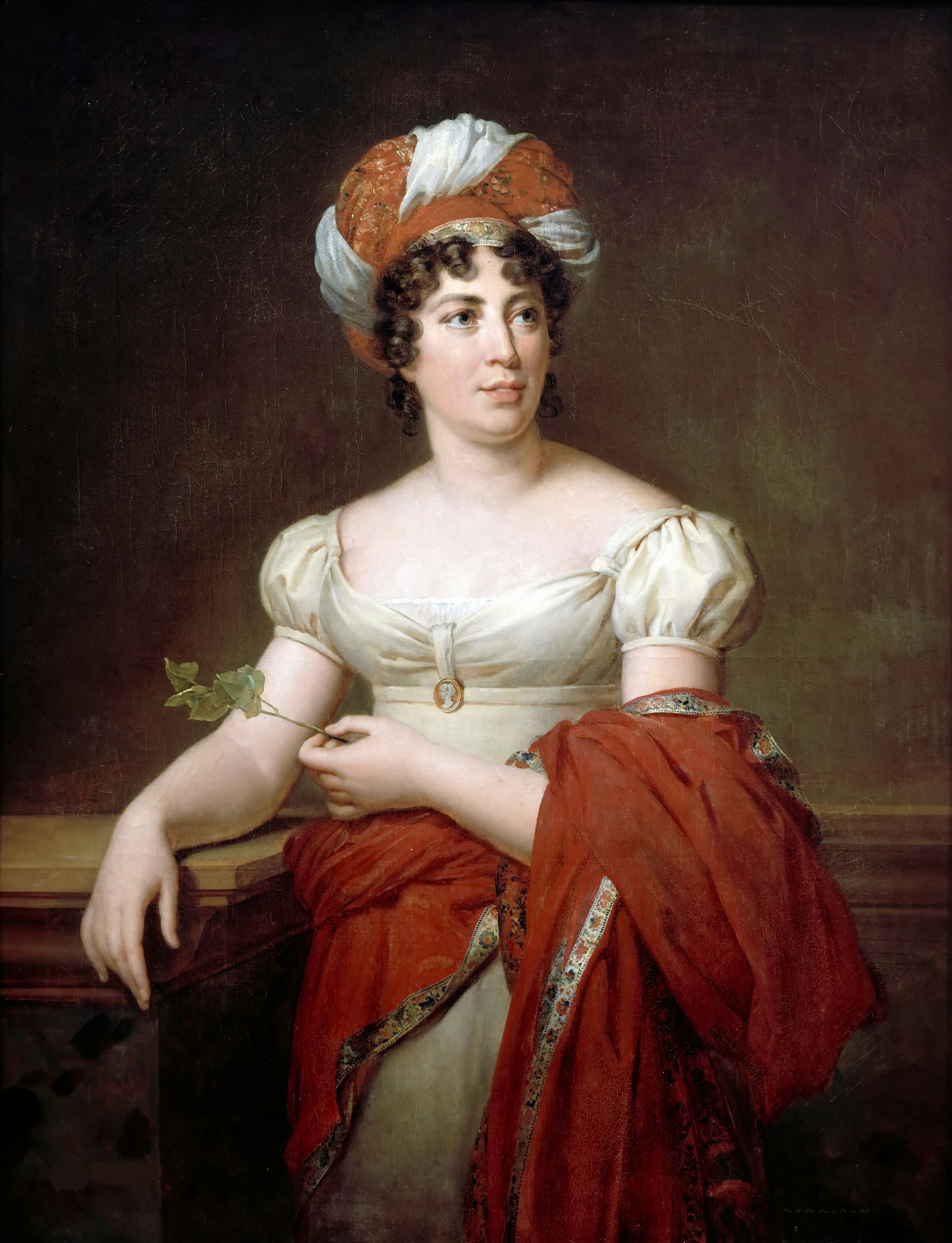
Anne-Louise Germaine Necker , Baronesa de Staël Holstein, más conocida como Madame de Staël [stal], fue una escritora suiza, considerada francesa por su vida e influencia en la vida cultural parisina.
Germaine de Staël libro Corinne
Fuente: Corinne (Libro XII).
Fuente: [Goicoechea] (1952), p. 474.
“Al inteligente se le puede convencer; al tonto, persuadir.”
Fuente: [Amate Pou] (2017), p. 133.
Fuente: [Señor] (1997), p. 48.
Fuente: De l'influence des passions, etc., 1820.
Germaine de Staël libro Corinne
Fuente: Corinne (XII, cap. 1).
Fuente: [Goicoechea] (1952), p. 127.
Reflexiones
Fuente: Politics, Literature and national Character, Nueva York, 1964. [ref. incompleta]
Reflexiones
Fuente: Acerca de la literatura, 1800. [ref. incompleta]
Reflexiones
Fuente: Alemania, 1810. [ref. incompleta]
“¿Qués es, pues, la felicidad sino el desarrollo de nuestras facultades?”
Germaine de Staël libro Corinne
Fuente: [Ortega Blake] (2013), p. 1672.
Fuente: Corinne (XIV, cap. 1).
Fuente: [Goicoechea] (1952), p. 29.
Germaine de Staël libro Corinne
Fuente: Corinne (VII, cap. 2).
Fuente: [Goicoechea] (1952), p. 29.
“La negligencia de los deberes menudos sirve de aprendizaje para las faltas grandes.”
Fuente: [Ortega Blake] (2013), p. 2861.
“Ser totalmente comprensiva la hace a una indulgente.”
Germaine de Staël libro Corinne
Fuente: [Ortega Blake] (2013), p. 2256.
Fuente: Corinne (Libro XVIII, cap. 5).
Fuente: [Goicoechea] (1952), p. 388.
“Viajar es uno de los placeres más tristes de la vida.”
Germaine de Staël libro Corinne
Fuente: Corinne (Libro I, cap. 1).
Fuente: [Goicoechea] (1952), p. 487.
“Saber y sentir, he aquí toda la educación.”
Fuente: [Ortega Blake] (2013), p. 1405.
“Matrimonio, es decir, la asociación de todos los sentimientos y todos los pensamientos.”
Germaine de Staël libro Corinne
Fuente: Corinne (VI, cap. 2).
Fuente: [Goicoechea] (1952), p. 294.
“Los placeres del pensamiento son un eficaz remedio para las heridas del corazón.”
Fuente: [Ortega Blake] (2013), p. 3131.
“Los hombres se empeñan en creer que lo que es seguirá siendo.”
Fuente: [Ortega Blake] (2013), p. 3784.
“La murmuración se parece al humo porque se disipa pronto, pero ennegrece todo lo que toca.”
Fuente: [Señor] (1997), p. 111.
“La inteligencia humana hace continuos progreso, pero estos progresos son en espiral.”
Fuente: [Goicoechea] (1952), p. 253.
“La filosofía debe descansar sobre dos bases: la moral y el cálculo.”
Fuente: [Ortega Blake] (2013), p. 1816.
“Es fácil ser mujer cuando se es insensible.”
Fuente: [Ortega Blake] (2013), p. 2777.
“El talento no impide tener manías, pero las hace más notables.”
Fuente: [Señor] (1997), p. 502.
Fuente: [Ortega Blake] (2013), p. 2560.
Fuente: Germanie (p. 3ª, cap. VIII).
Fuente: [Goicoechea] (1952), p. 247.
“El hombre celoso no es el amante que ama; es el propietario que se enfada.”
Fuente: [Ortega Blake] (2013), p. 721.
“When men do wrong, it is out of hardness; when women do wrong, it is out of weakness.”
Anne Louise Germaine de Staël libro Corinne
Bk. 6, ch. 3
Corinne (1807)
“Either morality is a fable, or the more enlightened we are, the more attached to it we become.”
The Influence of Literature upon Society (De la littérature considérée dans ses rapports avec les istitutions sociales, 1800) , Pt. 2, ch. 4
Contexto: The evil arising from mental improvement can be corrected only by a still further progress in that very improvement. Either morality is a fable, or the more enlightened we are, the more attached to it we become.
The Influence of Literature upon Society (De la littérature considérée dans ses rapports avec les istitutions sociales, 1800) , Pt. 2, ch. 4
Contexto: The evil arising from mental improvement can be corrected only by a still further progress in that very improvement. Either morality is a fable, or the more enlightened we are, the more attached to it we become.
Anne Louise Germaine de Staël libro Corinne
Bk. 8, ch. 2, as translated by Isabel Hill (1833)
Variant translation: It is certainly through love that eternity can be understood; it confuses all thoughts about time; it destroys the ideas of beginning and end; one thinks one has always been in love with the person one loves, so difficult is it to conceive that one could live without him.
As translated by Sylvia Raphael (1998)
Corinne (1807)
“Men do not change; they unmask themselves.”
Quoted in Invasion of the Party Snatchers : How the Holy-Rollers and the Neo-Cons Destroyed the GOP (2008) by Victor Gold
“Be happy, but be so by piety.”
Anne Louise Germaine de Staël libro Corinne
Bk. 20, ch. 3
Corinne (1807)
“A man must know how to fly in the face of opinion; a woman to submit to it.”
Anne Louise Germaine de Staël libro Delphine
Un homme doit savoir braver l'opinion; une femme s'y soumettre.
Delphine (1802), epigraph
The epigraph is taken from the writings of de Staël's mother, Suzanne Necker.
“The search for the truth is the noblest of occupations, and its publication a duty.”
La recherche de la vérité est la plus noble des occupations, et sa publication un devoir.
Pt. 4, ch. 2
De l’Allemagne [Germany] (1813)
Pt. 4, ch. 10
De l’Allemagne [Germany] (1813)
“Sow good services: sweet remembrances will grow from them.”
Quoted in A Thousand Flashes of French Wit, Wisdom, and Wickedness (1880) collected and translated by J. D. Finod, p. 138
“When once enthusiasm has been turned into ridicule, everything is undone except money and power.”
Anne Louise Germaine de Staël libro Corinne
Bk. 4, ch. 3
Corinne (1807)
“In matters of the heart, nothing is true except the improbable.”
Letter to Juliette Récamier (October 5, 1810), quoted in J. Christopher Herold, Mistress to an Age: A Life of Madame de Staël (New York: Grove Press, 1958), p. 401
“Atheism exists only in coldness, selfishness, and baseness.”
Anne Louise Germaine de Staël libro Corinne
Bk. 10, ch. 5
Corinne (1807)
“Innocence in genius, and candor in power, are both noble qualities.”
Pt. 2, ch. 8
De l’Allemagne [Germany] (1813)
“Let us then blend everything: love, religion, genius, with sunshine, perfume, music, and poetry.”
Anne Louise Germaine de Staël libro Corinne
Bk. 10, ch. 5
Corinne (1807)
Original: (fr) La voix de la conscience est si délicate, qu'il est facile d'étouffer; mais elle est si pure, qu'il est impossible de la méconnaître.
Fuente: De l’Allemagne [Germany] (1813), Pt. 3, ch. 13
Anne Louise Germaine de Staël libro Delphine
Delphine (1802), Preface
“Life often seems like a long shipwreck, of which the débris are friendship, fame, and love.”
Reflections on Suicide (Réflexions sur le suicide, 1813), Section 1
“The rules are only barriers to keep children from falling.”
Ces règles ne sont que des barrières pour empêcher les enfants de tomber.
Pt. 4, ch. 9
De l’Allemagne [Germany] (1813)
The Influence of Literature upon Society (1800), Pt. 2, ch. 5
“One must, in one's life, make a choice between boredom and suffering.”
Letter to Claude Hochet (Summer 1800), quoted in J. Christopher Herold, Mistress to an Age: A Life of Madame de Staël (New York: Grove Press, 1958), p. 223
Herold comments: "Her decision was emphatically in favor of suffering, which after all was a pleasure compared to boredom." (p. 224)
The actual quotation is from a letter from Mme de Staël to Claude Hochet dated October 1, 1800 : «Il faut choisir dans la vie entre l’ennui et le tourment : je donne l’un et l’hiver l’autre» (Germaine de Staël, Correspondance générale. Tome IV. Première partie. Du directoire au Consulat. 1er décembre 1796-15 décembre 1800, texte établi et présenté par Béatrice W. Jasinski, Paris, Chez Jean-Jacques Pauvert, 1976, xii/337 p., p. 326).
Sketch of the Life, Character, and Writings of Baroness de Staël-Holstein (1820) by Albertine-Adrienne Necker de Saussure, p. 349; often misquoted as, "I desire no other evidence of the truth of Christianity than the Lord's Prayer."
Anne Louise Germaine de Staël libro Corinne
Bk. 4, ch. 3
Corinne (1807)
“Love is the whole history of a woman's life; it is an episode in a man's.”
L'amour est l'histoire de la vie des femmes; c'est un épisode dans celle des hommes.
A Treatise on the Influence of the Passions (De l'influence des passions, 1796), Section 1, ch. 4
“Understanding everything makes one very indulgent.”
Anne Louise Germaine de Staël libro Corinne
Tout comprendre rend très-indulgent.
Bk. 18, ch. 5
Corinne (1807)
“Genius is essentially creative; it bears the stamp of the individual who possesses it.”
Anne Louise Germaine de Staël libro Corinne
Bk. 7, ch. 1
Corinne (1807)
“A religious life is a struggle and not a hymn.”
Anne Louise Germaine de Staël libro Corinne
Bk. 10, ch. 5
Corinne (1807)
Ten Years' Exile (Dix années d'exil, written 1810–1813, posthumously published 1821), ch. 16


