“No hagas reír hasta el punto de dar motivo a la risa.”
Fuente: Ortega Blake, Arturo. El gran libro de las frases célebres. Editorial Penguin Random House Grupo Editorial México, 2013 ISBN 978-60-7311-631-2.
Heráclito de Éfeso , conocido también como «El Oscuro de Éfeso», fue un filósofo griego. Nació hacia el año 535 a. C. y falleció hacia el 484 a. C..
Era natural de Éfeso, ciudad de la Jonia, en la costa occidental del Asia Menor . Como los demás filósofos anteriores a Platón, no quedan más que fragmentos de sus obras, y en gran parte se conocen sus aportes gracias a testimonios posteriores.
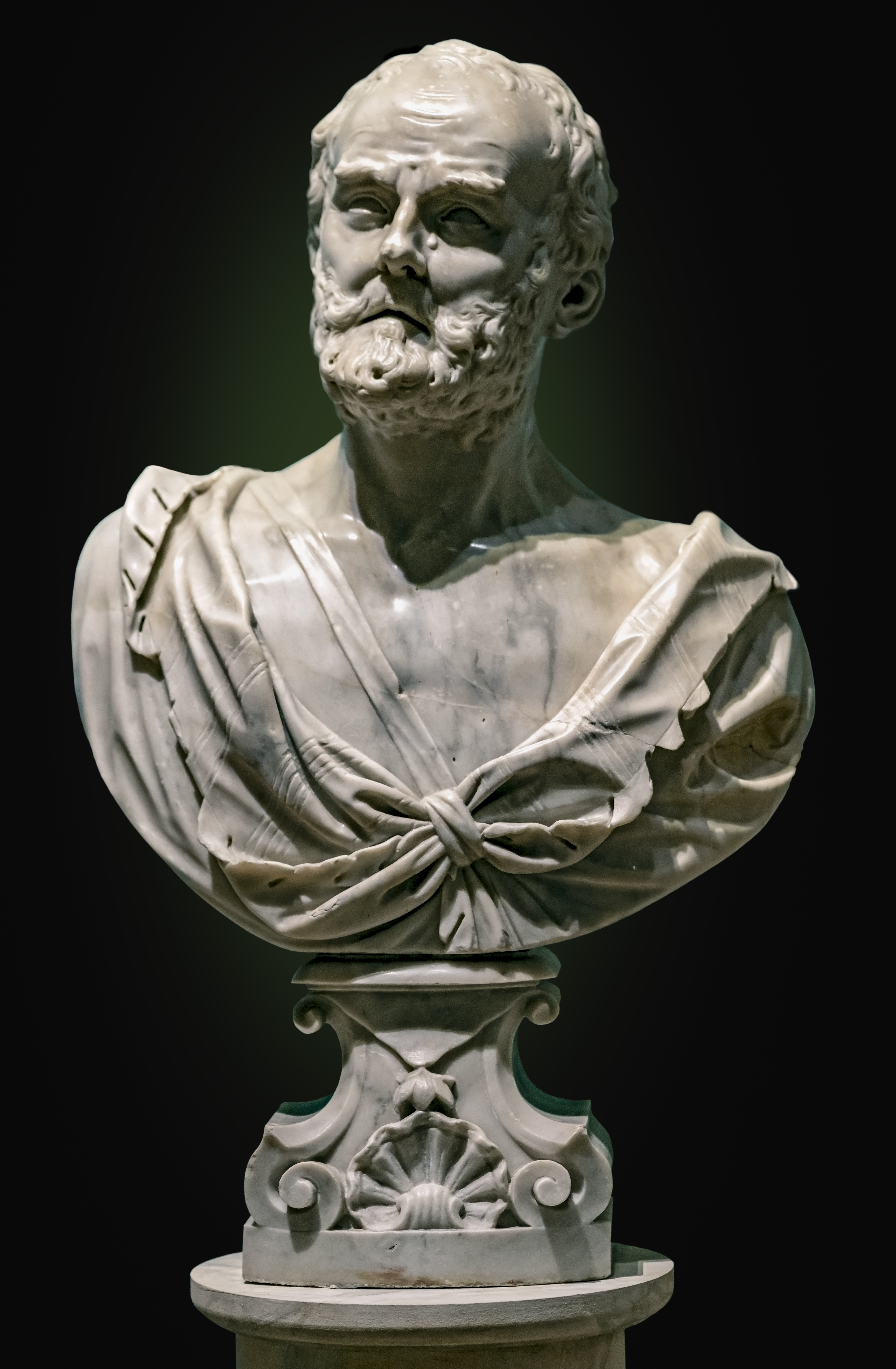
“No hagas reír hasta el punto de dar motivo a la risa.”
Fuente: Ortega Blake, Arturo. El gran libro de las frases célebres. Editorial Penguin Random House Grupo Editorial México, 2013 ISBN 978-60-7311-631-2.
Fuente: Citado en Álvarez, Jorge. El poder de la conciencia y la receptividad: Cómo lograr el cambio: Enseñanzas prácticas. Editorial Penguin Random House Grupo Editorial México, 2016. ISBN 9786073145824.
“Muerte es cuantas cosas vemos al despertar, sueño cuantas vemos al dormir.”
Fuente: Citado en Gómez de Liaño, Ignacio. Filósofos griegos, videntes judíos. Edición ilustrada. Editorial Siruela, 2000. ISBN 9788478445011. p. 53.
“Al mismo río entras y no entras, pues eres y no eres.”
Fuente: Citado en Girón, María Eugenia. Secretos de lujo. LID Editorial, 2011. ISBN 9788483563700.
“A todo hombre le es concedido conocerse a sí mismo y meditar sabiamente.”
Fuente: Citado en Perez Campos, Franck; Pérez, Franck. La Profemocionalidad – Sé feliz en tu profesión. Editorial Bubok, 2015. ISBN 9788468663708.
“Camino arriba, camino abajo, uno y el mismo.”
Fuente: Citado en Gadamer, Hans-Georg. El inicio de la sabiduría. Editorial Grupo Planeta (GBS), 2001. ISBN 9788449310256. p. 15.
“El dios es día-noche, invierno-verano, guerra-paz, saciedad-hambre. Y muda como el fuego.”
Fuente: Citado en Mauro, Ernesto di. El Dios genético. Traducido por Miguel Beato. Edición ilustrada. Ediciones de la Torre, 1996. ISBN 9788479601355. p. 104.
Fuente: Heráclito, en D.-K., fragmento B67.
Fuente: Citado en Conflictos bélicos y nuevo orden mundial. Autor y editor Bernat Riutort. Edición ilustrada. Icaria Editorial, 2003. ISBN 9788474266610. p. 52.
Fuente: Fragmento 28.
“La guerra es el origen de todo.”
Fuente: Citado en Panorama de la teología latinoamericana, volumen 1. Ediciones Sígueme, 1975. ISBN 9788430106233. p. 197.
“El alma seca es la más sabia y la mejor.”
Fuente: Citado en Mondolfo, Rodolfo. Heráclito: textos y problemas de su interpretación. Edición reimpresa. Editorial Siglo XXI, 1981. ISBN 9789682302770. p. 78.
Fuente: Fragmento 118.
“Ha de luchar el pueblo por su ley, igual que por su muralla.”
Fuente: Citado en Goñi, Carlos. Las narices de los filósofos: Una historia de la filosofía a través de 50 pensadores esenciales. Editorial Grupo Planeta Spain, 2010. ISBN 9788434468375.
Fuente: Fragmento 44.
“Si uno no espera lo inesperado nunca lo encontrará, pues es imposible de encontrar e impenetrable.”
Fuente: Citado en Mondolfo, Rodolfo. Heráclito: textos y problemas de su interpretación. Edición reimpresa. Editorial Siglo XXI, 1981. ISBN 9789682302770. p. 33.
Fuente: Fragmento 18.
Fuente: Citado en Mondolfo, Rodolfo. Heráclito: textos y problemas de su interpretación. Edición reimpresa. Editorial Siglo XXI, 1981. ISBN 9789682302770. p. 36.
Fuente: Fragmento 50.
“El carácter es para el hombre su demonio.”
Griego: «Ethos antrophos daimon.»
Fuente: Citado en Reflexiones sobre el pensamiento italiano contemporáneo. Contribuidores Ariadna Cheroni, José Portillo. Ediciones Trilce, 2010. ISBN 9789974325616- p. 19.
Fuente: Citado en Bernstein, Richard J. Perfiles filosóficos: ensayos a la manera pragmática. Traducido por Martí Mur Ubasart. Editorial Siglo XXI, 1991. ISBN 9789682317255. p. 245.
“El modo de ser humano no comporta capacidad de juicio; el divino sí la comporta.”
Fuente: Citado en Revista española de pedagogía, volumen 63. Contribuidores Instituto "San José de Calasanz.", Instituto "San José de Calasanz" de Pedagogía, Consejo Superior de Investigaciones Científicas (Spain). Editorial Instituto "San José de Calasanz", 2005. p. 227.
Fuente: Fragmento 90.
“El nombre del arco es vida; su función es dar muerte.”
Fuente: Boletín de la Academia Chilena de la Historia, número 107. Editorial La Academia, 1997. p. 266.
“El parecer de uno, enfermedad sagrada.”
Fuente: Citado en Palazzo, Sandro. Heráclito y Parménides: El uno y lo múltiple. Editorial EMSE, 2017. ISBN 9788416940370.
Fuente: Fragmento 114.
Fuente: Citado en Mondolfo, Rodolfo. Heráclito: textos y problemas de su interpretación. Edición reimpresa. Editorial Siglo XXI, 1981. ISBN 9789682302770. p. 97.
Fuente: Fragmento 6.
“Homero merecía que lo expulsaran de los certámenes y que lo apalearan, y Arquíloco, otro tanto.”
Fuente: Citado en Rojas Osorio, Carlos. El asombro del pensar: la filosofía en el ámbito de las humanidades. Editorial Isla Negra Editores, 2000. ISBN 9781881715771. p. 42.
Fuente: Fragmento 42.
Fuente: Citado en Heidegger, Martin; Fink, Eugen. Heráclito: Seminario del semestre de invierno 1966-1967. Traducido por Raúl Torres Martínez, Ángel Xolocotzi Yáñez. Colaborador Ángel Xolocotzi Yáñez. Editorial Fondo de Cultura Económica, 2018. ISBN 9786071653482. p. 132.
Fuente: Fragmento 62.
“La enfermedad hace buena y agradable la salud, el hambre a la saciedad, el trabajo al reposo.”
Fuente: Citado en Herakleitos. Editorial Universidad Nacional del Litoral, Facultad de Filosofía, Letras y Ciencias de la Educación, Instituto de Lenguas Clásicas, 1957. p. 39.
Fuente: Fragmento 111.
Fuente: Citado en Barredo, Pablo A. Diario de un cuidador. Editorial Plataforma, 2013. ISBN 9788416096305.
“Los cuerpos muertos han de desecharse con mayor motivo que el estiércol.”
Fuente: Fragmento 96.
“Los ojos son testigos más exactos que los oídos.”
Según Mondolfo "existiendo, pues, en nosotros por naturaleza dos órganos — en tanto tenemos algunos mediante los cuales podemos aprender las cosas e informarnos de todas — , el oído y la vista, y siendo no poco más veraz la vista, de acuerdo con Heráclito" «los ojos, pues, son testigos más exactos».
Fuente: Citado en Platón. La República. Ediciones AKAL, 2009. ISBN 9788446023784. p. 447.
Fuente: Fragmento 101a según Diels-Kranz.
Fuente: Citado en Mondolfo, Rodolfo. Heráclito: textos y problemas de su interpretación. Edición reimpresa. Editorial Siglo XXI, 1981. ISBN 9789682302770. p. 42.
“Los perros, de cierto, ladran a quien no conocen.”
Fuente: Citado en Mondolfo, Rodolfo. Heráclito: textos y problemas de su interpretación. Edición reimpresa. Editorial Siglo XXI, 1981. ISBN 9789682302770. p. 329.
Fuente: Fragmento 97.
“Los que buscan oro excavan mucha tierra y encuentran poco.”
Fuente: Citado en Sphinx, volúmenes 3-4. Publicado en 1939. Procedencia del original: la Universidad de California. Digitalizado el 25 de junio de 2010. p. 96.
Fuente: Fragmento 23.
“Nada es permanente a excepción del cambio.”
Fuente: Citado en Prize, Walter L. 700 Pensamientos para desarrollar una mentalidad ganadora. Editorial Mestas Ediciones, 2016. ISBN 9788416669110.
“No encontrarás los confines del alma ni aún recorriendo todos los caminos; tal es su profundidad.”
Fuente: Citado en Prampolini, Giacomo. Historia universal de la literatura ...: Versión en español ... Editor José Pijoán. Traducido por Dante Ponzanelli, Julio Jiménez Rueda. Editorial Unión tipográfica editorial hispano americana, 1940. p. 361.
“No es posible descender dos veces el mismo río.”
fragmento 91) es la versión que da Platón de "Al mismo río entras y no entras, pues eres y no eres.
“Sin esperanza se encuentra lo inesperado.”
Fuente: Palomo Triguero, Eduardo. Cita-logía. Editorial Punto Rojo Libros,S.L. ISBN 978-84-16068-10-4. p. 119.
“Todas las leyes humanas se alimentan de la ley divina.”
Para entender el concepto que da aquí a 2divino Heráclito véase a Rodolfo Mondolfo (Las leyes humanas y la ley divina en B 114). <br class="br">Fuente: Palomo Triguero, Eduardo. Cita-logía. Editorial Punto Rojo Libros,S.L. ISBN 978-84-16068-10-4. p. 180. <br class="br">Fuente: Fragmento 114. <br class="br">Fuente: Citado en Mondolfo, Rodolfo. Heráclito: textos y problemas de su interpretación. Edición reimpresa. Editorial Siglo XXI, 1981. ISBN 9789682302770. pp. 227 y ss. https://books.google.es/books?id=srHErm3e7gUC&pg=PA227&dq=Todas+las+leyes+humanas+se+alimentan+de+la+ley+divina.&hl=es&sa=X&ved=0ahUKEwiji97f_rzaAhXMchQKHWIkBmQQ6AEIKDAA#v=onepage&q=Todas%20las%20leyes%20humanas%20se%20alimentan%20de%20la%20ley%20divina.&f=false
Fragment 92, as translated by G.W.T. Patrick, trans.
Numbered fragments
“The wise is one only. It is unwilling and willing to be called by the name of Zeus.”
Fragment 32
Numbered fragments
“The waking have one world in common; sleepers have each a private world of his own.”
Fragment 89
Plutarch, Of Superstition
Numbered fragments
“You cannot step twice into the same rivers.”
ποταμῷ γὰρ οὐκ ἔστιν ἐμβῆναι δὶς τῷ αὐτῷ
Fragment 91
Plutarch, On the EI at Delphi
Numbered fragments
Variante: You cannot step twice into the same rivers.
“Man, like a light in the night, is kindled and put out.”
Fragment 26
Numbered fragments
“Nature is wont to hide herself.”
Fragment 123
Numbered fragments
Fragment 30
Variant translations:
The world, an entity out of everything, was created by neither gods nor men, but was, is and will be eternally living fire, regularly becoming ignited and regularly becoming extinguished.
This world . . . ever was, and is, and shall be, ever-living Fire, in measures being kindled and in measure going out.
That which always was,
and is, and will be everlasting fire,
the same for all, the cosmos,
made neither by god nor man,
replenishes in measure
as it burns away.
Translated by Brooks Haxton
Numbered fragments
“Greater fates gain greater rewards”
As quoted by The Fragments of the Work of Heraclitus of Ephesus on Nature; Translated from the Greek Text of Bywater, with an Introduction Historical and Critical, by G. T. W. Patrick. Page 108 https://books.google.com/books?id=gLxQZb3TMYgC&lpg=PA108&ots=RUCu2BIyRB&dq=Greater%20fates%20gain%20greater%20rewards.&pg=PA108#v=onepage&q=Greater%20fates%20gain%20greater%20rewards.&f=false <br class="br">Alternative translation: Big results require big ambitions.
“Everything changes and nothing stands still.”
As quoted by Plato in Cratylus, 402a
Variants and variant translations:
Everything flows and nothing stays.
Everything flows and nothing abides.
Everything gives way and nothing stays fixed.
Everything flows; nothing remains.
All is flux, nothing is stationary.
All is flux, nothing stays still.
All flows, nothing stays.
Πάντα ῥεῖ
Everything flows.
This statement occurs in Simplicius' Commentary on Aristotle's Physics, 1313.11; while some sources attribute to Simplicius the coining of the specific phrase "πάντα ῥεῖ (panta rhei)", meaning "everything flows/is in a state of flux", to characterize the concept in the philosophy of Heraclitus, the essential phrasing "everything changes" and variations on it, in contexts where Heraclitus's thought is being alluded to, was current in both Plato and Aristotle's writings.
“It is harder to fight against pleasure than against anger.”
As quoted by Aristotle in Nicomachean Ethics, Book II (1105a)
Fragment 10
Variant translation: From out of all the many particulars comes oneness, and out of oneness come all the many particulars.
Numbered fragments
“It would not be better if things happened to people just as they wish.”
Fragment 110
Variant translation: It would not be better if things happened to men just as they wish.
Numbered fragments
“The many are mean; only the few are noble.”
in Eric Hoffer, Between the Devil and the Dragon (New York: 1982), p. 108
“He who does not expect will not find out the unexpected, for it is trackless and unexplored.”
Fragment 18, as quoted in The Art and Thought of Heraclitus: An Edition of the Fragments (1981) edited by Charles H. Kahn, p. 105
Variants:
He who does not expect the unexpected will not find it out.
The Art and Thought of Heraclitus: An Edition of the Fragments (1981) edited by Charles H. Kahn, p. 129
He who does not expect the unexpected will not find it, since it is trackless and unexplored.
As quoted in Helen by Euripides, edited by William Allan (2008), p. 278
Unless you expect the unexpected, you will not find it, for it is hidden and thickly tangled.
Rendering ἐὰν μή "unless" is more English-friendly without being inaccurate. As for the last clause, the point is that you can neither find it nor navigate your way through it. The alpha-privatives suggest using similar metaphoric adjectives to keep the Greek 'feel.' (S. N. Jenks, 2014)
Numbered fragments
“It is better to conceal ignorance than to expose it.”
Fragment 109
Variant translation: Hide our ignorance as we will, an evening of wine soon reveals it.
Numbered fragments
“Men that love wisdom must be acquainted with very many things indeed.”
As quoted Clement of Alexandria, Stromata, V, 140, 6 (Fragment 35)
Disputed
“Opposition brings concord. Out of discord comes the fairest harmony.”
As translated by Philip Wheelwright in Heraclitus (1959) https://archive.org/details/heraclitus00whee <br class="br">Disputed
“Change he called a pathway up and down, and this determines the birth of the world.”
From Lives and Opinions of Eminent Philosophers by Diogenes Laërtius, Book IX, section 8
G.T.W. Patrick, 1889 http://www.classicpersuasion.org/pw/heraclitus/herpatu.htm <br class="br">Variante: For what sense or understanding have they? They follow minstrels and take the multitude for a teacher, not knowing that many are bad and few good. For the best men choose one thing above all – immortal glory among mortals; but the masses stuff themselves like cattle.
“Though wisdom is common, yet the many live as if they had a wisdom of their own.”
Fragment 2, as quoted in Against the Mathematicians by Sextus Empiricus
Variant translation: So we must follow the common, yet the many live as if they had a wisdom of their own.
Numbered fragments
“It is wise to listen, not to me but to the Word, and to confess that all things are one.”
Fragment 50, as translated in the Loeb Classics edition http://www.loebclassics.com/view/heracleitus_philospher-universe/1931/pb_LCL150.471.xml?rskey=IyhfrN&result=8 <br class="br">Variant translations:<br>Listening not to me but to reason, it is wise to agree that all is one.<br>Listening not to me but to the Word it is wise to agree that all things are one.<br>He who hears not me but the logos will say: All is one.<br>It is wise to hearken, not to me, but to my Word, and to confess that all things are one. <br class="br">The word translated in these quotes and many others as "The Word" or "Reason", is the greek word λόγος (Logos). <br class="br">Numbered fragments
“Much learning does not teach understanding.”
Fragment 40
Numbered fragments
“Eternity is a child playing, playing checkers; the kingdom belongs to a child.”
Quoted by Hippolytus, Refutation of all heresies, IX, 9, 4 (Fragment 52), as translated in Reality (1994), by Carl Avren Levenson and Jonathan Westphal, p. 10
Variants:
History is a child building a sand-castle by the sea, and that child is the whole majesty of man’s power in the world.
As quoted in Contemporary Literature in Translation (1976), p. 21
A lifetime is a child playing, playing checkers; the kingdom belongs to a child.
As quoted in The Beginning of All Wisdom: Timeless Advice from the Ancient Greeks (2003) by Steven Stavropoulos, p. 95
Time is a game played beautifully by children.
As quoted in Fragments (2001) translated by Brooks Haxton
Lifetime is a child at play, moving pieces in a game. Kingship belongs to the child.
As quoted in The Art and Thought of Heraclitus (1979) translated by Charles H. Kahn
Fragment 93
Friedrich Nietzsche's translation: The law under which most of them ceaselessly have commerce they reject for themselves. (The Pre-Platonic Philosophers, Chapter 10)]
Numbered fragments
G. T. W. Patrick, 1889 http://www.classicpersuasion.org/pw/heraclitus/herpatu.htm
“The people must fight for its law as for its walls.”
Fragment 44
Numbered fragments
“Dogs, also, bark at what they do not know.”
Fragment 97
Numbered fragments


