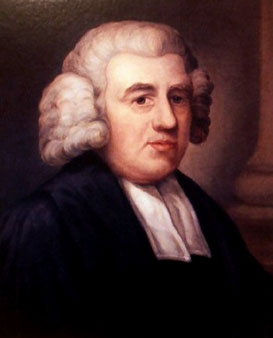
John Newton Frases y Citas
John Newton: Frases en inglés
As quoted in The Christian Pioneer (1856) edited by Joseph Foulkes Winks, p. 84. Also in The Christian Spectator, vol. 3 (1821), p. 186 http://books.google.com/books?id=mv4oAAAAYAAJ&dq=ah%2C%20how%20imperfect%20and%20deficient!%20I%20am%20not%20what%20I%20wish%20to%20be&pg=PA186#v=onepage&q=ah,%20how%20imperfect%20and%20deficient!%20I%20am%20not%20what%20I%20wish%20to%20be&f=false <br class="br">Often paraphrased as I am not the man I ought to be, I am not the man I wish to be, and I am not the man I hope to be, but by the grace of God, I am not the man I used to be."'
Variante: Amazing grace! How sweet the sound
That saved a wretch like me!
I once was lost, but now am found,
Was blind, but now I see.
Fuente: Olney Hymns (1779), Amazing Grace
Variante: Thou art coming to a King,
large petitions with thee bring,
for His grace and pow'r are such
none can ever ask too much.
John Newton Olney Hymns
Hymn 70: True and False Zeal
Olney Hymns (1779)
John Newton Olney Hymns
Olney Hymns (1779), Amazing Grace
“Whether men are pleased or not, we will, we must, worship the Lamb that was slain.”
The Works of the Rev. John Newton http://books.google.com.mx/books?id=ejYIv91QlGUC&pg=PA382&lpg=PA382&dq=newton+we+must+worship+the+lamb&source=bl&ots=zNMOTpAZ3y&sig=llNL3C_qLM50GDCA9RkmkZDWuYs&hl=es-419&sa=X&ei=__KXUsexDZXeoAScnoLgBg&ved=0CCsQ6AEwAA#v=onepage&q=newton%20we%20must%20worship%20the%20lamb&f=false, Vol. 2, p. 382.
Fuente: Dictionary of Burning Words of Brilliant Writers (1895), P. 475.
John Newton Olney Hymns
Olney Hymns (1779), Amazing Grace
As quoted in The Works of the Rev. John Newton... to which are Prefixed Memoirs of His Life (1839), Vol. 2, U. Hunt, pages 429-230.
Fuente: Dictionary of Burning Words of Brilliant Writers (1895), P. 281.
These lines were not written by Newton. They have often been accreted to various hymns, including "Amazing Grace", since the mid-nineteenth century.
Misattributed
John Newton Olney Hymns
Olney Hymns (1779), Amazing Grace
Fuente: Dictionary of Burning Words of Brilliant Writers (1895), P. 266.
Letter (February 1772) http://www.graceonlinelibrary.org/articles/full.asp?id=33|35|383
Alluding to the biblical verse in Isaiah 33:1. As quoted in The Works of the Rev. John Newton... to which are Prefixed Memoirs of His Life (1839), Vol. 2, U. Hunt., page 438.
The pitiable state of the survivors who are torn from their relatives, connections, and their native land must be taken into account. I fear the African trade is a national sin, for the enormities which accompany it are now generally known; and though, perhaps, the greater part of the nation would be pleased if it were suppressed, yet, as it does not immediately affect their own interest, they are passive. {...] Can we wonder that the calamities of the present war begin to be felt at home, when we ourselves wilfully and deliberately inflict much greater calamities upon the native Africans, who never offended us?. "Woe unto thee that spoilest, and thou wast not spoiled when thou shalt cease to spoil, thou shalt be spoiled"
Alluding to the biblical verse in Isaiah 33:1. As quoted in The Works of the Rev. John Newton... to which are Prefixed Memoirs of His Life (1839), Vol. 2, U. Hunt., page 438.


