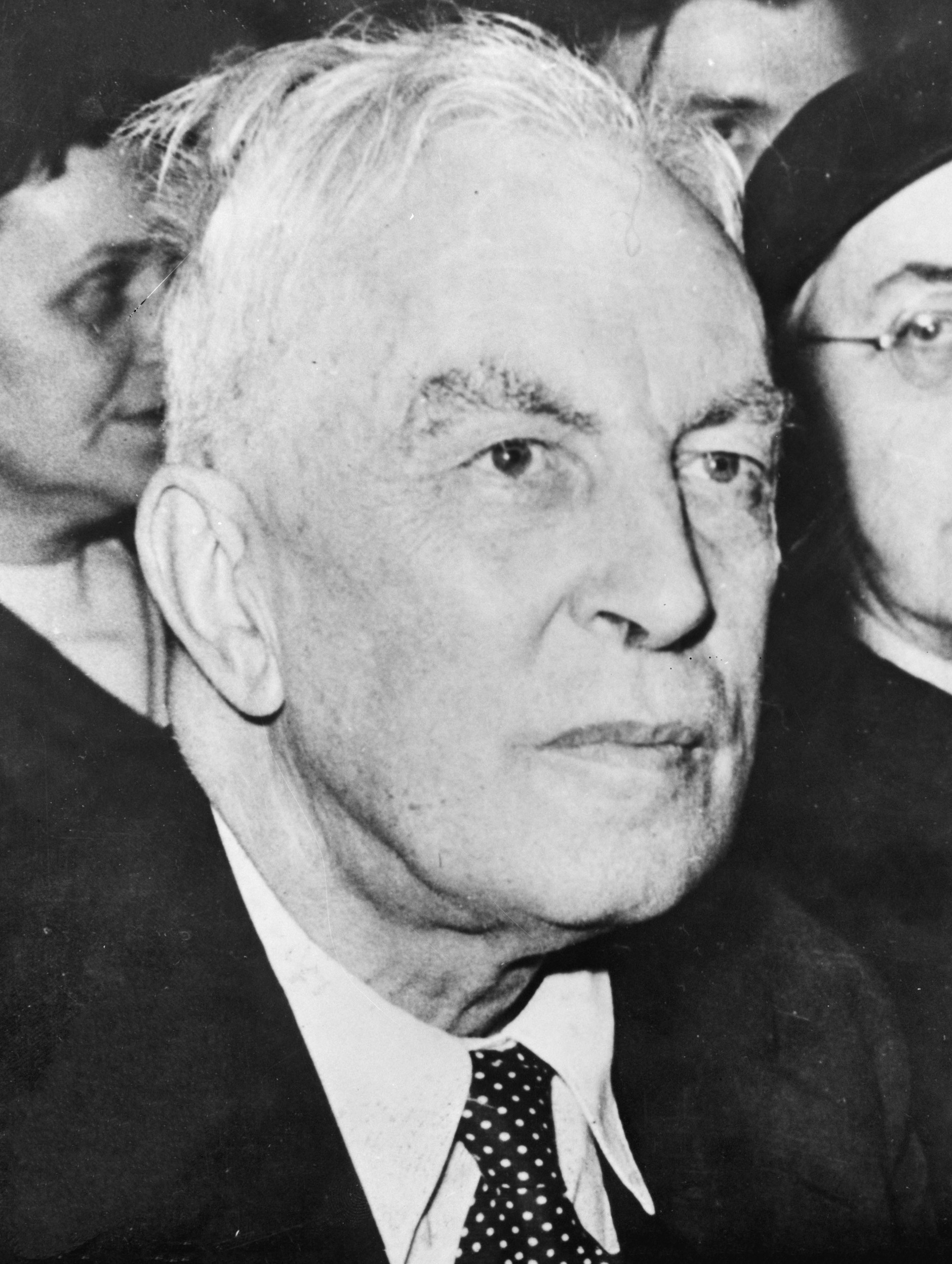
Arnold J. Toynbee: 25 citas6 Me gusta
Frases célebres de Arnold J. Toynbee
Fuente: Citado en Etznab, Kenai. Poemas de Utilidad Política 7.3. Editorial Lulu.com. ISBN 9780557138807.
“La civilización es un movimiento y no una condición, un viaje y no un puerto.”
Fuente: Vergara Montero, Enrique. Arqueología y vida: Duccio Bonavia. Editor Institut français d’études andines, 2015.
Fuente: Civilization on trial, 1948.
Fuente: Toynbee, Arnold. Artículo en Intellectual Digest, Volumen 2. Editorial Intellectual Communications Systems, Incorporated, 1971.
Fuente: Intellectual Digest, volumen 2, pág. 59 (diciembre de 1971).
Fuente: Christianity among the Religions of the World pág. 82 (1958).
Fuente: El cristianismo entre las religiones del mundo (1960).
Fuente: Christianity among the Religions of the World pág. 96 (1958).
Fuente: El cristianismo entre las religiones del mundo (1960).
Arnold J. Toynbee: Frases en inglés
Civilization on Trial (1948), chapter 2, p. 23.
Contexto: Of the twenty or so civilizations known to modern Western historians, all except our own appear to be dead or moribund, and, when we diagnose each case, in extremis or post mortem, we invariably find that the cause of death has been either War or Class or some combination of the two. To date, these two plagues have been deadly enough, in partnership, to kill off nineteen out of twenty representatives of this recently evolved species of human society; but, up to now, the deadliness of these scourges has had a saving limit.
The Trend of International Affairs Since the War (1931)
Contexto: If we are frank with ourselves, we shall admit that we are engaged on a deliberate and sustained and concentrated effort to impose limitations upon the sovereignty and independence of the fifty or sixty local sovereign independent States which at present partition the habitable surface of the earth and divide the political allegiance of mankind.
It is just because we are really attacking the principle of local sovereignty that we keep on protesting our loyalty to it so loudly. The harder we press our attack upon the idol, the more pains we take to keep its priests and devotees in a fool’s paradise—lapped in a false sense of security which will inhibit them from taking up arms in their idol’s defense. The local national state, invested with the attributes of sovereignty — is an abomination of desolation standing in the place where it ought not. It has stood in that place now — demanding and receiving human sacrifices from its poor deluded votaries — for four or five centuries. Our political task in our generation is to cast the abomination out, to cleanse the temple and to restore the worship of the divinity to whom the temple rightfully belongs. In plain terms, we have to re-transfer the prestige and the prerogatives of sovereignty from the fifty or sixty fragments of contemporary society to the whole of contemporary society — from the local national states by which sovereignty has been usurped, with disastrous consequences, for half a millennium, to some institution embodying our society as a whole.
In the world as it is today, this institution can hardly be a universal Church. It is more likely to be something like a League of Nations. I will not prophesy. I will merely repeat that we are at present working, discreetly but with all our might, to wrest this mysterious political force called sovereignty out of the clutches of the local national states of our world. And all the time we are denying with our lips what we are doing with our hands...
"Man and Hunger: The Perspectives of History" (Speech to the World Food Congress, January 9, 1963).
“… the dogma that History is just "one damned thing after another…."”
"Law and Freedom in History," <i>A Study of History</i>, Vol. 2 (1957). The embedded quotation is attributable to Elbert Hubbard.
[Civilization on Trial, Oxford University Press, 156, (1948)]
Surviving the Future (1971), Oxford University Press, 1972, p. 95.
Arnold J. Toynbee libro A Study of History
Vol. 4 (1948), part B, p. 6.
A Study of History (1934–1961)
Arnold J. Toynbee in 'One World and India' (New Delhi, 1960) pp. 59-60
“The supreme accomplishment is to blur the line between work and play.”
Statement of 1964, as quoted in Mindfulness edited by Ellen J. Langer, p. 133; also in Social Creativity Vol. 2 (1999) edited by Alfonso Montuori and Ronald E. Purser.
“Civilization is a movement and not a condition, a voyage and not a harbor.”
As quoted in Reader's Digest (October 1958).
Variation: Civilization is a movement, not a condition. It is a voyage, not a harbor.
As quoted in The Social Welfare Forum (1968) by the National Conference on Social Welfare.
Arnold J. Toynbee libro A Study of History
A Study of History (1934–1961)
“There is no such thing as gratitude in international politics.”
Arnold J. Toynbee libro A Study of History
A Study of History (1934–1961)
Lama Surya Das, Awakening the Buddha Within, Broadway Books, NY, 1997.
The Toynbee-Ikeda Dialogue: Man Himself Must Choose (1976).
Civilization on Trial (1948), chapter 4, p. 56.
“Man’s true end is to glorify God and to enjoy Him for ever.”
The source of this quotation (with "chief" in place of "true") is the Westminster Shorter Catechism, http://www.reformed.org/documents/wsc/index.html?_top=http://www.reformed.org/documents/WSC.html. <br class="br">As quoted in Watchtower ONLINE LIBRARY http://wol.jw.org/en/wol/d/r1/lp-e/2006768?q=Arnold+Toynbee&p=par
Arnold J. Toynbee libro A Study of History
A Study of History (1934–1961)


