“No importa que el gato sea blanco o negro; mientras pueda cazar ratones, es un buen gato.”
Con fuente
Fuente: De un discurso suyo en 1962, durante un encuentro del secretariado del Partido Comunista Chino. [ref. no válida]
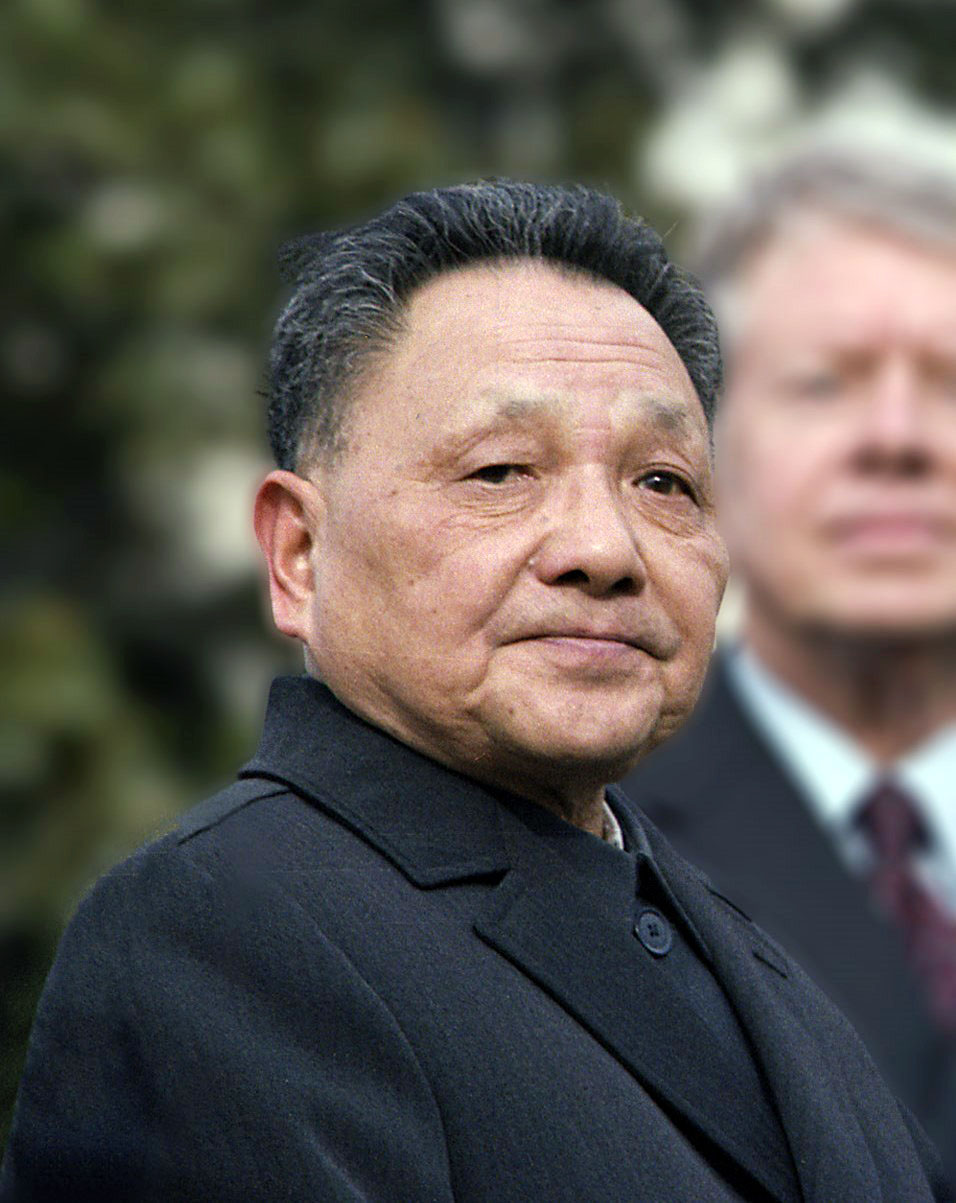
Este es un nombre chino, el apellido es DengDeng Xiaoping fue un político chino, máximo líder de la República Popular China desde 1978 hasta los últimos años de su vida.
Bajo su liderazgo, la República Popular China emprendió las reformas económicas de liberalización de la economía socialista[1] que permitieron a este país alcanzar unas impresionantes cuotas de crecimiento económico.[2] Frente a estos éxitos en la economía, Deng ejerció un poder de marcado carácter autoritario, y su papel fue decisivo en la represión violenta de las protestas de la Plaza de Tian'anmen en 1989.
Miembro del Partido Comunista de China desde sus años de estudio en Francia y en la Unión Soviética, Deng se convertiría en uno de los dirigentes más importantes del Partido Comunista durante la época de Mao Zedong. Sin embargo, su cercanía ideológica al entonces presidente de la República Popular Liu Shaoqi, lo convirtió en uno de los blancos de la Revolución Cultural, campaña de reafirmación ideológica impulsada por Mao, presidente del partido, para mantener el poder frente a los reformistas como Deng y Liu, quienes fueron acusados de derechistas y contrarrevolucionarios. Apartado de la cúpula del poder durante esos años de conmoción ideológica, Deng acabaría volviendo a un primer plano de la actividad política tras la muerte de Mao, imponiéndose finalmente al sucesor de este, Hua Guofeng, en la lucha por el poder. A diferencia de su antecesor, sus apariciones públicas fueron escasas.
Durante los últimos años de su vida, Deng no ocupaba ya ningún cargo político y, aquejado de la enfermedad de Parkinson, apenas podía seguir los asuntos de estado. Con todo, se le siguió considerando el líder supremo de China hasta su muerte, acaecida el 19 de febrero de 1997. Wikipedia
“No importa que el gato sea blanco o negro; mientras pueda cazar ratones, es un buen gato.”
Con fuente
Fuente: De un discurso suyo en 1962, durante un encuentro del secretariado del Partido Comunista Chino. [ref. no válida]
Con fuente
“Deberíamos hacer más y hablar menos.”
Con fuente <br class="br">Fuente: Cartel de propaganda (en chino) https://chineseposters.net/gallery/e13-410.php
Cited by António Caeiro in Pela China Dentro (translated), Dom Quixote, Lisboa, 2004. ISBN 972-20-2696-8
Actually coined by Mao Zedong, popularized by Deng Xiaoping
Misattributed or apocryphal
“Let some people get rich first.”
"Nanxun" (Southern Tour) of 1992. Quoted in The Economist http://www.economist.com/node/639652 (31 May 2001). A summarization of several quotations from Deng Xiaoping, known in Chinese as, "让一部分人先富起来", News of the Communist Party of China http://cpc.people.com.cn/GB/34136/2569304.html World Development Report 2009 https://books.google.com/books?id=ZkDE5CxAqHcC&pg=PA73&lpg=PA73&dq=%22some+areas+must+get+rich+before+others%22&source=bl&ots=ezli3nfD8W&sig=ACfU3U2wto-q9C3waDTgnGgB2xLgodbruA&hl=en&sa=X The Nanxun Legacy and China's Development in the Post-Deng Era https://books.google.com/books?id=jDJqDQAAQBAJ&pg=PA202&dq=%22to+get+rich+first%22&hl=en&sa=X. <br class="br">Misattributed or apocryphal
Deng is commonly quoted with this phrase in western media but there is no proof that he actually said it<br>However, this phrase in Chinese is more accurately translated as ""wealth is glorious,"" where wealth can have a very general meaning, including knowledge, personal relationships, family: anything of value. Understood this way, the quote is not as directly controversial as a ideological/political statement, and so it is not hard to believe that he really did say this.<br><br>Source: http://pqasb.pqarchiver.com/latimes/access/689588251.html?dids=689588251:689588251&FMT=ABS <br class="br">Misattributed or apocryphal
“A basic contradiction between socialism and the market economy does not exist.”
As quoted in Daily report: People's Republic of China, Editions 240-249 (1993), p. 30
Interview, Time, 4 November 1985.
Variante: There are no fundamental contradictions between a socialist system and a market economy.
As quoted in Forbes, Vol. 176, Editions 7-13 (2005), p. 79
“Crossing the river by feeling the stones”
摸着石头过河 (mō zhe shítou guòhé) <br class="br">Meaning: proceed gradually, by experimentation. <br class="br">Traditional saying, first used in Chinese Communist context by Chen Yun, 1980 December 16, then popularized by Deng 1984 October. Frequently misattributed to Deng. <br class="br">Misattributed or apocryphal <br class="br">Fuente: Henry He, Dictionary of the Political Thought of the People's Republic of China, Routledge, 2016, ISBN 978-1-31550044-7, p. 287 https://books.google.com/books?id=XSi3DAAAQBAJ&lpg=PA287&dq=%22cross%20the%20river%20by%20feeling%20the%20stones%22&pg=PA287#v=onepage <br class="br">Fuente: Evan Osnos, Boom Doctor https://www.newyorker.com/magazine/2010/10/11/boom-doctor, New Yorker, October 11, 2010:<br>The strategy, as Chen Yun put it, was “crossing the river by feeling for the stones.” (Deng, inevitably, received credit for the expression.) <br class="br">Fuente: Chinese land reform: A world to turn upside down https://www.economist.com/briefing/2013/10/31/a-world-to-turn-upside-down, The Economist, 2013 October 31<br>Liu Hongzhi, who oversees the scheme, quotes a famous phrase often attributed to Deng, though in fact coined by a colleague: “We are crossing the river by feeling the stones.”
Actually from the Han Shu 《漢書·河間獻王劉德傳》, not coined by Mao Zedong nor by Deng Xiaoping, popularized by various people before them.
Misattributed or apocryphal
When asked about China's political stability by a group of American professors in 1983, as quoted in The Pacific Rim and the Western World: Strategic, Economic, and Cultural Perspectives (1987), p. 105
“It doesn't matter whether the cat is black or white, as long as it catches mice.”
Quoted in Hung Li China's Political Situation and the Power Struggle in Peking (1977), p. 107
According to Chambers Dictionary of Quotations (1993), p. 315, this quote is from a speech at the Communist Youth League conference in July 1962.
“If you open a window for fresh air, you have to expect some flies to blow in.”
» Great Firewall of China Torfox, cs.stanford.edu, 2018-05-02 https://cs.stanford.edu/people/eroberts/cs201/projects/2010-11/FreedomOfInformationChina/category/great-firewall-of-china/index.html,
Speech at the Opening Ceremony of the National Conference on Science (March 1978) (exerpts)
Speech at the Opening Ceremony of the National Conference on Science (March 1978) (exerpts)


