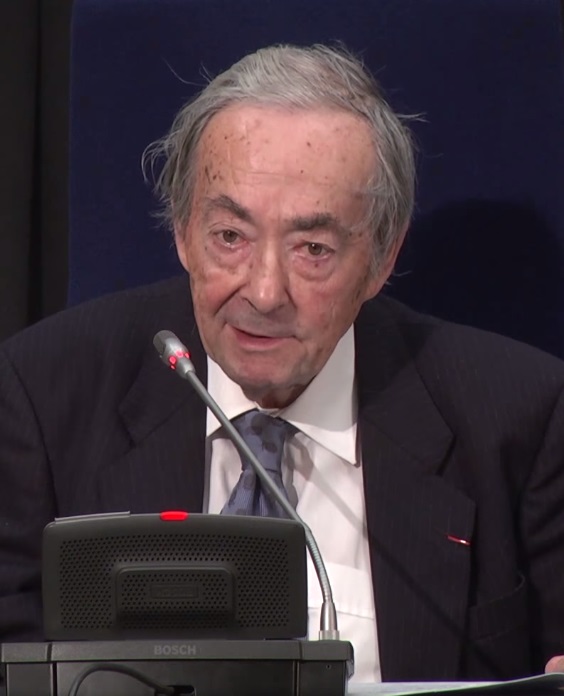
Frases célebres de George Steiner
Frases de amor de George Steiner
Dix raisons (possibles) à la tristesse de pensée
Frases de muerte de George Steiner
George Steiner Frases y Citas
http://www.fce.com.mx/prensaImprimir.asp?art=271
Language & Silence: Essays on Language, Literature & the Inhuman
Steiner, G. (2006). Sevilla: Editorial Gedisa (trabajo original publicado en New York, 1976), p. 12.
Dix raisons (possibles) à la tristesse de pensée
George Steiner: Frases en inglés
"In a Post-Culture".
In Bluebeard's Castle (1971)
Fuente: Real Presences (1989), I: A Secondary City, Ch. 1 (p. 3).
Fuente: Real Presences (1989), I: A Secondary City, Ch. 4 (p. 11).
"The Retreat from the Word," Kenyon Review (Spring 1961).
Language and Silence: Essays 1958-1966 (1967)
Preface.
Language and Silence: Essays 1958-1966 (1967)
Contexto: We come after. We know now that a man can read Goethe or Rilke in the evening, that he can play Bach and Schubert, and go to his day's work at Auschwitz in the morning. To say that he has read them without understanding or that his ear is gross, is cant. In what way does this knowledge bear on literature and society, on the hope, grown almost axiomatic from the time of Plato to that of Matthew Arnold, that culture is a humanizing force, that the energies of spirit are transferable to those of conduct?
Fuente: Real Presences (1989), II: The Broken Contract, Ch. 3 (p. 76).
"The Cleric of Treason".
George Steiner: A Reader (1984)
Fuente: Real Presences (1989), I: A Secondary City, Ch. 6 (p. 27).
Fuente: Real Presences (1989), III: Presences, Ch. 1 (p. 144).
"Tomorrow".
In Bluebeard's Castle (1971)
“Nothing in a language is less translatable than its modes of understatement.”
Fuente: The Death of Tragedy (1961), Ch. III (p. 104).
Fuente: The Death of Tragedy (1961), Ch. X (p. 351).
"The Hollow Miracle" (1959).
Language and Silence: Essays 1958-1966 (1967)
Fuente: Real Presences (1989), II: The Broken Contract, Ch. 7 (p. 117).
Fuente: Real Presences (1989), III: Presences, Ch. 7 (p. 229).
Fuente: The Death of Tragedy (1961), Ch. VIII (p. 302).
“The immense majority of human biographies are a gray transit between domestic spasm and oblivion.”
"In a Post-Culture".
In Bluebeard's Castle (1971)
Fuente: Real Presences (1989), III: Presences, Ch. 4 (p. 183).
Fuente: The Death of Tragedy (1961), Ch. IX (p. 309).
Fuente: The Death of Tragedy (1961), Ch. IX: (p. 314).
"Tomorrow"
In Bluebeard's Castle (1971)
"The Cleric of Treason"
George Steiner: A Reader (1984)
Fuente: Real Presences (1989), II: The Broken Contract, Ch. 4 (p. 82).
Fuente: Real Presences (1989), III: Presences, Ch. 6 (p. 224).
“Men are accomplices to that which leaves them indifferent.”
"A Kind of Survivor".
Language and Silence: Essays 1958-1966 (1967)
"The Cleric of Treason," The New Yorker (1980-12-08).
George Steiner: A Reader (1984)


.jpg)