Frases de Henry Kissinger

Henry Alfred Kissinger,[n. 1]​ nacido Heinz Alfred Kissinger , es un político estadounidense de origen alemán que tuvo una gran influencia sobre la política internacional, no solo de Estados Unidos con respecto a los demás países sino también sobre otras naciones. Ejerció como secretario de Estado durante los mandatos de Richard Nixon y Gerald Ford, desempeñando este papel preponderante en la política exterior de Estados Unidos entre 1969 y 1977 y fue consejero de Seguridad Nacional durante todo el mandato inicial del primero.

Kissinger se caracterizó por llevar las riendas de un proceder internacional fuerte pero al mismo tiempo negociador, siendo el artífice de la denominada «política de distensión» con la Unión Soviética y China, país con el cual logró, durante el mandato de Richard Nixon, consolidar relaciones pacíficas.

Tuvo que hacerse cargo de poner fin a la muy criticada Guerra de Vietnam y gestionar la crisis de la Guerra de Yom Kippur, concibiendo una nueva visión de como llevar la política exterior estadounidense, al colocar como último recurso la intervención militar, siendo este nuevo proceder el que lo llevó a obtener el Premio Nobel de la Paz en 1973, gracias al alto al fuego que logró establecer en Vietnam.

Aun así, la controversia ha persistido sobre su figura, debido a la intervención de la CIA en varios Golpes de Estado sucedidos en Latinoamérica durante la década de 1970. Sus críticos lo consideran instigador de genocidios sistemáticos de grupos políticos,[1]​[2]​[3]​[4]​ estando ligado a varios regímenes totalitarios latinoamericanos, tales como la dictadura militar chilena de Augusto Pinochet o el Proceso de Reorganización Nacional de Argentina, así como por ser el responsable de planes represivos como lo sería la Operación Cóndor, cuya célula de origen habría sido la Escuela de las Américas. Todo esto ha ocasionado que existan numerosas iniciativas que persiguen conseguir su procesamiento ante instancias judiciales internacionales, así como la retirada de su Premio Nobel.

Ha pasado a actuar desde el sector privado, fundó la Kissinger Associates, y es accionista y cofundador de la Kissinger & McLarty Associates, así como miembro de las juntas directivas y asesor de las empresas The Hollinger Group y Gulfstream Aerospace. Además es rector de la Universidad de Georgetown y sirvió en Indonesia como Asesor General de Gobierno.

En el 2001, Kissinger fue llamado por el gabinete de George W. Bush para liderar un comité de crisis internacional a causa de los ataques del 11-S así como para que a través de su firma prestase asesoría diplomática y política al gobierno, no obstante Kissinger se retiró poco después de este proyecto.

Henry Kissinger es por mucho una de las figuras políticas y de la diplomacia más relevantes de la Historia de los Estados Unidos, tanto como controvertida. Si bien sus méritos en la política internacional son notables , su negativa a devolver el Premio Nobel de la Paz que recibió gracias al alto al fuego que hubo en la Guerra de Vietnam y que posteriormente se rompió, así como las decenas de acusaciones de colaborar e incluso promover regímenes dictatoriales y acciones terroristas en diferentes partes del mundo, que cometieron severas violaciones a los Derechos Humanos, han ocasionado que su persona haya sido duramente criticada desde numerosas entidades tanto como por personalidades de la política o intelectuales, siendo algunos de los más conocidos el juez español Baltasar Garzón, asesor del Tribunal de la Haya, quien intentó fallidamente procesarlo por violaciones a los Derechos Humanos, y el periodista y escritor Christopher Hitchens, autor del best-seller Juicio a Kissinger.

Henry Kissinger también ha recibido críticas por ser uno de los miembros fundadores y todavía activo, del polémico Grupo Bilderberg, entidad no gubernamental, en la que se reúnen varias de las personas más poderosas e influyentes de todo el mundo, incluyendo monarcas, aristócratas, políticos, empresarios y magnates.[5]​ Wikipedia  

✵ 27. mayo 1923 – 29. noviembre 2023  •  Otros nombres Henry A. Kissinger
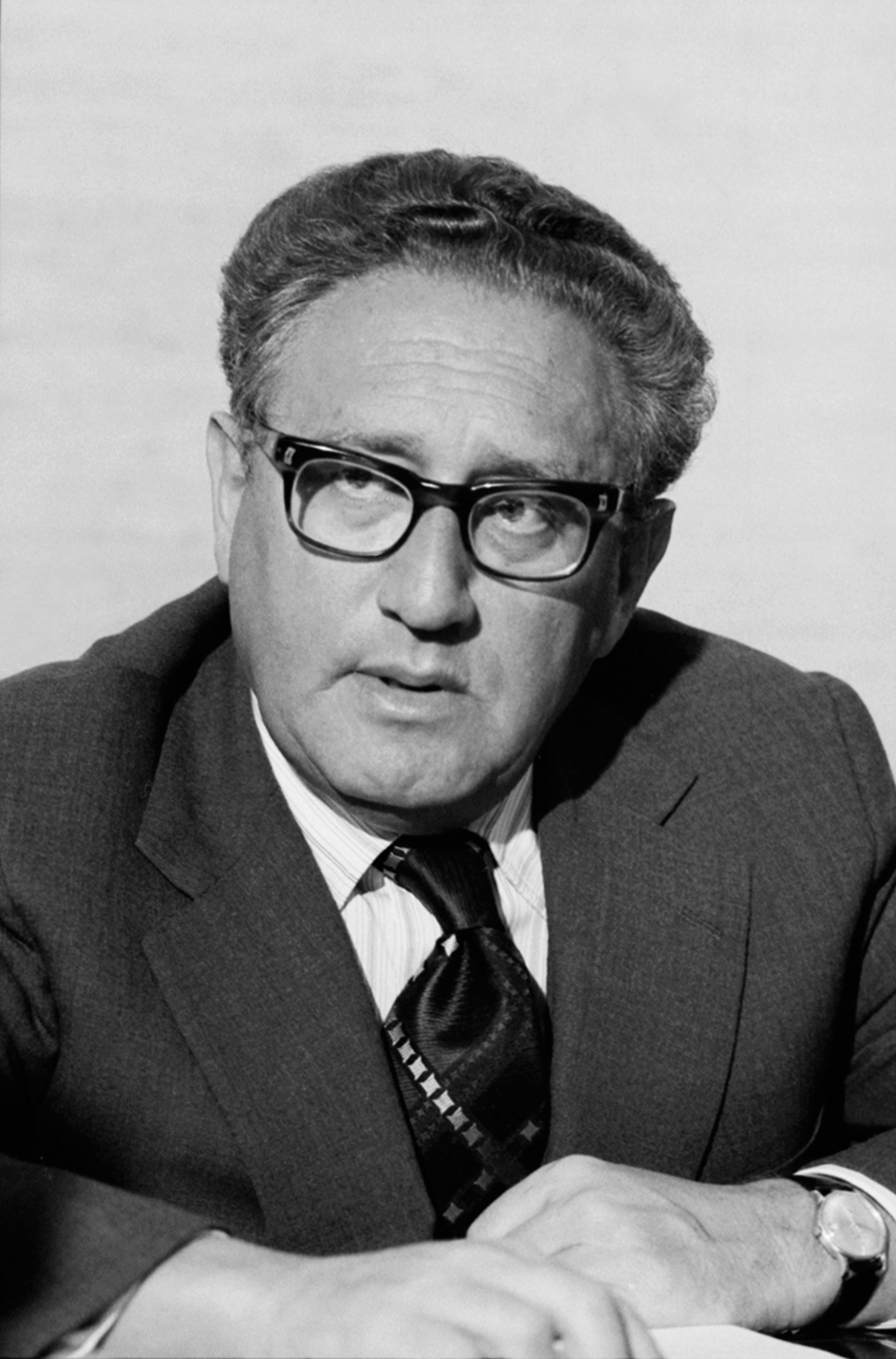
Henry Kissinger Foto
Henry Kissinger: 64 citas13 Me gusta

Frases célebres de Henry Kissinger

“Como estadista, uno tiene que obrar con la suposición de que los problemas se tienen que resolver.”

Henry Kissinger

[As a statesman, one has to act on the assumption that problems must to be solved.]
Fuente: Cleva, Gregory D. Henry Kissinger and the American Approach to Foreign Policy. Ed. Bucknell University Press, 1989. ISBN 978-08-3875-147-3. p. 40.

“No puede haber ninguna crisis la próxima semana. Mi horario ya está lleno.”

Henry Kissinger

Fuente: New York Times Magazine (1 de junio, 1969)

“No seas demasiado ambicioso. Haz una cosa al año, lo que creas que es más importante, y tu carrera se hará por sí misma.”

Henry Kissinger

Fuente: Zuckerman, Andrew. Sabiduría, Editorial Blume, 2009. [falta la página]

Henry Kissinger Frases y Citas

“Espero que tengan las preguntas adecuadas para mis respuestas.”

Henry Kissinger

Fuente: Vichique De Gasperín, Miguel Angel. La gestión institucional de crisis: Estrategia clave en el siglo XXI. Editorial UOC, 2016. ISBN 978-84-9116-336-7. [falta la página]

Henry Kissinger: Frases en inglés

“Corrupt politicians make the other ten percent look bad.”

Henry Kissinger

As quoted in The Other 637 Best Things Anybody Ever Said (1984) by Robert Byrne
1980s
Variante: Ninety percent of the politicians give the other ten percent a bad reputation.

“The reason that university politics is so vicious is that the stakes are so small.”

Henry Kissinger

This remark was first attributed to Kissinger, among others, in the 1970s. The Quote Verifier (2006) attributes it to political scientist Paul Sayre, but notes earlier similar remarks by Woodrow Wilson. Clyde J. Wingfield referred to it as a familiar joke in The American University (1970)
Unattributed variants:
Somebody once said that one of the reasons academic infighting is so vicious is that the stakes are so small. There's so little at stake and they are so nasty about it.
The Craft of Crime : Conversations with Crime Writers (1983) by John C. Carr
The reason that academic politics is so vicious is that the stakes are so small.
Mentioned as an "old saw" in Teachers for Our Nation's Schools (1990) by John I. Goodlad
Misattributed

“This amazing, romantic character suits me precisely because to be alone has always been part of my style or, if you like, my technique.”

Henry Kissinger

Interview with Oriana Fallaci (November 1972), as quoted in &quot;Oriana Fallaci and the Art of the Interview&quot; in Vanity Fair (December 2006) http://www.vanityfair.com/politics/features/2006/12/hitchens200612; Kissinger, as quoted in &quot;Special Section: Chagrined Cowboy&quot; in TIME magazine (8 October 1979) http://www.time.com/time/magazine/article/0,9171,916877,00.html called this &quot;without doubt the single most disastrous conversation I ever had with any member of the press&quot; and claimed that he had probably been misquoted or quoted out of context, but Fallaci later produced the tapes of the interview. <br class="br">1970s <br class="br">Contexto: I&#x27;ve always acted alone. Americans like that immensely.<br>Americans like the cowboy who leads the wagon train by riding ahead alone on his horse, the cowboy who rides all alone into the town, the village, with his horse and nothing else. Maybe even without a pistol, since he doesn&#x27;t shoot. He acts, that&#x27;s all, by being in the right place at the right time. In short, a Western. … This amazing, romantic character suits me precisely because to be alone has always been part of my style or, if you like, my technique.

“America has no permanent friends or enemies, only interests.”

Henry Kissinger

Henry Kissinger: The White House Years, quoted from Dinesh D&#x27;Souza: What&#x27;s so great about America http://books.google.com/books?id=tFcDN5D1SLQC&amp;pg=PA164&amp;dq=kissinger+america+friends+only+interests&amp;lr=&amp;as_drrb_is=q&amp;as_minm_is=0&amp;as_miny_is=&amp;as_maxm_is=0&amp;as_maxy_is=&amp;num=50&amp;as_brr=0&amp;ei=_UCDSs7YA6fuygTH3LTiCg&amp;hl=sv#v=onepage&amp;q=kissinger%20america%20friends%20only%20interests&amp;f=false. This echoes Lord Palmerston&#x27;s words: &quot;We have no eternal allies, and we have no perpetual enemies. Our interests are eternal and perpetual&quot;. <br class="br">1980s

“Who do I call if I want to speak to Europe?”

Henry Kissinger

Speaking in Warsaw in 2012, Kissinger said that he didn&#x27;t think the saying originated with him, &quot;I am not sure I actually said it, but it&#x27;s a good statement so why not take credit for it?&quot; <br class="br">Misattributed <br class="br">Fuente: http://bigstory.ap.org/article/kissinger-says-calling-europe-quote-not-likely-his

“If you believe that their real intention is to kill you, it isn't unreasonable to believe that they would lie to you.”

Henry Kissinger

Observation made privately, quoted by Time journalist Michael Kramer, The Case for Skepticism http://www.time.com/time/magazine/article/0,9171,956604,00.html Time, (26 December 1988), in the context of doubts about PLO sincerity in hinting about recognition of Israel. <br class="br">1980s

“I don't see why we need to stand by and watch a country go communist due to the irresponsibility of its own people.”

Henry Kissinger

Meeting of the "40 Committee" on covert action in Chile (27 June 1970) quoted in The CIA and the Cult of Intelligence (1974); the quotation was censored prior to publication due to legal action by the government. See New York Times (11 September 1974) "Censored Matter in Book About C.I.A. Said to Have Related Chile Activities; Damage Feared" by Seymour Hersh
1970s

“The superpowers often behave like two heavily armed blind men feeling their way around a room, each believing himself in mortal peril from the other, whom he assumes to have perfect vision.”

Henry Kissinger

The White House Years (1979)
1970s
Contexto: The superpowers often behave like two heavily armed blind men feeling their way around a room, each believing himself in mortal peril from the other, whom he assumes to have perfect vision. Each side should know that frequently uncertainty, compromise, and incoherence are the essence of policymaking. Yet each tends to ascribe to the other a consistency, foresight, and coherence that its own experience belies. Of course, over time, even two armed blind men can do enormous damage to each other, not to speak of the room.

“Ever since the secret trip to China, my own relationship with Nixon had grown complicated.”

Henry Kissinger

As quoted in &quot;Special Section: Chagrined Cowboy&quot; in TIME magazine (8 October 1979) http://www.time.com/time/magazine/article/0,9171,916877,00.html <br class="br">1970s <br class="br">Contexto: Ever since the secret trip to China, my own relationship with Nixon had grown complicated. Until then I had been an essentially anonymous White House assistant. But now his associates were unhappy, and not without reason, that some journalists were giving me perhaps excessive credit for the more appealing aspects of our foreign policy while blaming Nixon for the unpopular moves.<br>These tendencies were given impetus by an interview I granted to the Italian journalist Oriana Fallaci, without doubt the single most disastrous conversation I ever had with any member of the press. I saw her briefly on Nov. 2 and 4, 1972, in my office. I did so largely out of vanity. She had interviewed leading personalities all over the world. Fame was sufficiently novel for me to be flattered by the company I would be keeping. I had not bothered to read her writings; her evisceration of other victims was thus unknown to me.

“We fought a military war; our opponents fought a political one.”

Henry Kissinger

"The Vietnam Negotiations", Foreign Affairs, Vol. 48, No. 2 (January 1969), p. 214; also quoted as "A conventional army loses if it does not win. The guerilla army wins if he does not lose."
1960s
Contexto: We fought a military war; our opponents fought a political one. We sought physical attrition; our opponents aimed for our psychological exhaustion. In the process we lost sight of one of the cardinal maxims of guerrilla war: the guerrilla wins if he does not lose. The conventional army loses if it does not win. The North Vietnamese used their armed forces the way a bull-fighter uses his cape — to keep us lunging in areas of marginal political importance.

“I've always acted alone. Americans like that immensely.”

Henry Kissinger

Interview with Oriana Fallaci (November 1972), as quoted in &quot;Oriana Fallaci and the Art of the Interview&quot; in Vanity Fair (December 2006) http://www.vanityfair.com/politics/features/2006/12/hitchens200612; Kissinger, as quoted in &quot;Special Section: Chagrined Cowboy&quot; in TIME magazine (8 October 1979) http://www.time.com/time/magazine/article/0,9171,916877,00.html called this &quot;without doubt the single most disastrous conversation I ever had with any member of the press&quot; and claimed that he had probably been misquoted or quoted out of context, but Fallaci later produced the tapes of the interview. <br class="br">1970s <br class="br">Contexto: I&#x27;ve always acted alone. Americans like that immensely.<br>Americans like the cowboy who leads the wagon train by riding ahead alone on his horse, the cowboy who rides all alone into the town, the village, with his horse and nothing else. Maybe even without a pistol, since he doesn&#x27;t shoot. He acts, that&#x27;s all, by being in the right place at the right time. In short, a Western. … This amazing, romantic character suits me precisely because to be alone has always been part of my style or, if you like, my technique.

“Of course, over time, even two armed blind men can do enormous damage to each other, not to speak of the room.”

Henry Kissinger

The White House Years (1979)
1970s
Contexto: The superpowers often behave like two heavily armed blind men feeling their way around a room, each believing himself in mortal peril from the other, whom he assumes to have perfect vision. Each side should know that frequently uncertainty, compromise, and incoherence are the essence of policymaking. Yet each tends to ascribe to the other a consistency, foresight, and coherence that its own experience belies. Of course, over time, even two armed blind men can do enormous damage to each other, not to speak of the room.

“Fame was sufficiently novel for me to be flattered by the company I would be keeping. I had not bothered to read her writings; her evisceration of other victims was thus unknown to me.”

Henry Kissinger

1970s <br class="br">Contexto: Ever since the secret trip to China, my own relationship with Nixon had grown complicated. Until then I had been an essentially anonymous White House assistant. But now his associates were unhappy, and not without reason, that some journalists were giving me perhaps excessive credit for the more appealing aspects of our foreign policy while blaming Nixon for the unpopular moves.<br>These tendencies were given impetus by an interview I granted to the Italian journalist Oriana Fallaci, without doubt the single most disastrous conversation I ever had with any member of the press. I saw her briefly on Nov. 2 and 4, 1972, in my office. I did so largely out of vanity. She had interviewed leading personalities all over the world. Fame was sufficiently novel for me to be flattered by the company I would be keeping. I had not bothered to read her writings; her evisceration of other victims was thus unknown to me.<br><br>As quoted in &quot;Special Section: Chagrined Cowboy&quot; in TIME magazine (8 October 1979) http://www.time.com/time/magazine/article/0,9171,916877,00.html

“Military men are "dumb, stupid animals to be used" as pawns for foreign policy.”

Henry Kissinger

Kissinger has denied saying it.
The only evidence that Kissinger ever said this was a claim in the book, The Final Days, by Bob Woodward and Carl Bernstein, in chapter 14 (p.194 in the 1995 paperback edition). Woodward & Bernstein claimed that one of Kissinger's political foes, Alexander Haig, had told someone unnamed, that he (Haig) had heard Kissinger say it. That's triple hearsay, made even weaker by the fact that one of the parties is anonymous. Kissinger has denied ever saying it, and it was never substantiated by Haig, nor by anyone of known identity who claimed to have heard it. As Kirkus Reviews noted about the whole book, "none of it is substantiated in any assessable way."
In fact, the quote is not even very plausible, on its face. Kissinger served with distinction in the U.S. Army during WWII, and was awarded the Bronze Star. He has always been very respectful of other servicemen and their sacrifices. For him to have said such a thing would have been wildly out of character. In fact, the awkward phrasing doesn't even sound like Kissinger, whose English prose is consistently measured and careful, despite his heavy accent, even when he speaks extemporaneously.
Misattributed

“Power is the ultimate aphrodisiac.”

Henry Kissinger

As quoted in The New York Times (28 October 1973)
Lesser known variant: Power is the great aphrodisiac.
As quoted in The New York Times (19 January 1971)
1970s

“The absence of alternatives clears the mind marvelously.”

Henry Kissinger

As quoted in &quot;Special Section: They Are Fated to Succeed&quot; in TIME magazine (2 January 1978) http://www.time.com/time/magazine/article/0,9171,915860,00.html <br class="br">1970s

“There cannot be a crisis next week. My schedule is already full.”

Henry Kissinger

As quoted in The New York Times Magazine (1 June 1969)
1960s
Variante: There can't be a crisis next week, my schedule is already full.

“The illegal we do immediately. The unconstitutional takes a little longer.”

Henry Kissinger

As quoted in The Washington Post (23 December 1973); he later joked further on this remark, on 10 March 1975 saying to Turkish Foreign Minister Melih Esenbel in Ankara, Turkey:<br>Before the Freedom of Information Act, I used to say at meetings &quot;The illegal we do immediately. The unconstitutional takes a little longer.&quot; … But since the Freedom of Information Act, I&#x27;m afraid to say things like that. <br class="br">As quoted in &quot;Sunshine Week Document Friday! Kissinger Says, “The illegal we do immediately; the unconstitutional takes a little longer. But since the FOIA, I’m afraid to say things like that.” in Unredacted : The National Security Archive, unedited and uncensored http://nsarchive.wordpress.com/2012/03/15/document-friday-kissinger-says-the-illegal-we-do-immediately-the-unconstitutional-takes-a-little-longer-but-since-the-foia-im-afraid-to-say-things-like-that/ <br class="br">Included in Cable P860114-1573_MC_b http://wikileaks.org/plusd/cables/P860114-1573_MC_b.html#efmCS3CUB Wikileaks <br class="br">1970s

“A country that demands moral perfection in its foreign policy will achieve neither perfection nor security.”

Henry Kissinger

Fuente: "Reflections on Containment", Foreign Affairs, Vol. 73, No. 3 (June 1994), p. 130

Autores similares

Franklin Delano Roosevelt Foto
Franklin Delano Roosevelt44
político estadounidense None
Hannah Arendt Foto
Hannah Arendt12
filósofa política alemana y posteriormente estadounidense None
Ronald Reagan Foto
Ronald Reagan23
actor y político estadounidense None
John Fitzgerald Kennedy Foto
John Fitzgerald Kennedy74
político estadounidense None
Enéas Carneiro Foto
Enéas Carneiro2
político brasileño None
Arnold Schwarzenegger Foto
Arnold Schwarzenegger13
actor y político estadounidense nacido en Austria None
Golda Meir Foto
Golda Meir28
política israelí None
Winston Churchill Foto
Winston Churchill113
político británico None
Malcolm X Foto
Malcolm X12
político estadounidense None
Jawaharlal Nehru Foto
Jawaharlal Nehru4
político hindú None