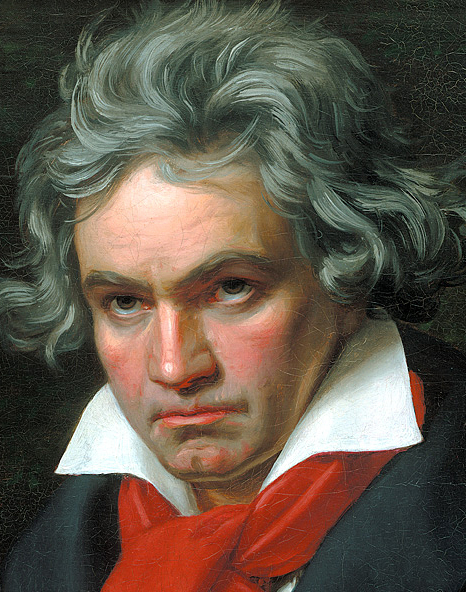
Frases célebres de Ludwig Van Beethoven
Variante: El genio se compone del dos por ciento de talento y del noventa y ocho por ciento de perseverante aplicación
Frases de música de Ludwig Van Beethoven
Frases de hombres de Ludwig Van Beethoven
Ludwig Van Beethoven Frases y Citas
Fuente: Amate Pou, Jordi. Paseando por una parte de la Historia: Antología de citas. Editorial Penguin Random House Grupo Editorial España, 2017. ISBN 9788417321871, p. 32.
“Todo el que obra recta y noblemente puede, por ello mismo, sobrellevar el infortunio.”
Fuente: Boletín bibliográfico, números 430-453. Autor México. Secretaría de Hacienda y Crédito Público. Publicado en 1970, p. 23.
Carta dirigida a su íntimo amigo Carl Friedrich Amenda, quien pasaba dificultades económicas. <br class="br">Fuente: Massin, Jean y Brigitte. Ludwig van Beethoven. Colección Turner música. Traducido por Isabel De Asumendi. Editorial Turner, 2012. ISBN 9788415427438.Página 96. https://books.google.es/books?id=LtXTbPIU9OgC&pg=PA96&dq=Beethoven+era+demasiado+feo+y+estaba+demasiado+loco&hl=es&sa=X&ved=0ahUKEwjj2ubW9Z_gAhVYBGMBHViYA7IQ6AEIKDAA#v=onepage&q=Beethoven%20era%20demasiado%20feo%20y%20estaba%20demasiado%20loco&f=false
“Aplaudid, amigos míos, la comedia ha terminado.”
En su lecho de muerte, 1827. <br class="br">Original: «Plaudite, amici, comedia finita est». <br class="br">Fuente: Gelinek, Joseph. La décima sinfonía. Editorial Penguin Random House Grupo Editorial España, 2010. ISBN 9788401016080. https://books.google.es/books?id=rgu5FJUYTAEC&pg=PT3&dq=Plaudite,+amici,+comedia+finita+est.+Ludwig+van+Beethoven&hl=es&sa=X&ved=0ahUKEwiAtdS68Z_gAhUIORQKHYNcAOcQ6AEIKzAA#v=onepage&q=Plaudite%2C%20amici%2C%20comedia%20finita%20est.%20Ludwig%20van%20Beethoven&f=false
Ludwig Van Beethoven: Frases en inglés
“Music is like a dream. One that I cannot hear.”
Conversations (January 1804)
“To play a wrong note is insignificant; to play without passion is inexcusable”
Not found in Beethoven's known works. It may be a summary of the following description of Beethoven from his piano pupil Ferdinand Ries: "When I left out something in a passage, a note or a skip, which in many cases he wished to have specially emphasized, or struck a wrong key, he seldom said anything; yet when I was at fault with regard to the expression, the crescendo or matters of that kind, or in the character of the piece, he would grow angry. Mistakes of the other kind, he said were due to chance; but these last resulted from want of knowledge, feeling or attention. He himself often made mistakes of the first kind, even playing in public." <br class="br">Disputed <br class="br">Fuente: "When Beethoven gave me a lesson" https://books.google.com/books?id=j8RIq67v51cC&pg=PA294&dq=%22when+beethoven+gave+me+a+lesson%22&hl=en&sa=X&ved=0CBwQ6AEwAGoVChMI7Yyz0PiNyQIViDuICh1YIAzR#v=onepage&q=%22when%20beethoven%20gave%20me%20a%20lesson%22&f=false
“To play without passion is inexcusable!”
Not found in Beethoven's known works. It may be a summary of the following description of Beethoven from his piano pupil Ferdinand Ries: "When I left out something in a passage, a note or a skip, which in many cases he wished to have specially emphasized, or struck a wrong key, he seldom said anything; yet when I was at fault with regard to the expression, the crescendo or matters of that kind, or in the character of the piece, he would grow angry. Mistakes of the other kind, he said were due to chance; but these last resulted from want of knowledge, feeling or attention. He himself often made mistakes of the first kind, even playing in public."
Disputed
Variante: To play a wrong note is insignificant; to play without passion is inexcusable
As reported by Elizabeth Brentano (Bettina) in a letter to Goethe, 27 May 1810.
Quoted in Edwin Burgum The new criticism (1930), p. 179
Fahre fort, übe nicht allein die Kunst, sondern dringe auch in ihr Inneres; sie verdient es, denn nur die Kunst und die Wissenschaft erhöhen den Menschen bis zur Gottheit.
Letter to Emilie, July 17, 1812.
Quoted in Musical news, Vol. 3 (1892), p. 627
“Music is indeed the mediator between the spiritual and sensual life.”
Attributed to Beethoven by Bettina von Arnim in a letter to Goethe (28 May 1810); Goethe's Correspondence with a Child http://books.google.pt/books?id=UC8HAAAAQAAJ&pg=PA210&dq=%22+music+is+indeed+the+mediator+between+%22&hl=pt-PT&sa=X&ei=sF40VL3AIILwaIThgNgL&ved=0CEgQ6AEwBjgK#v=onepage&q=%22%20music%20is%20indeed%20the%20mediator%20between%20%22&f=false (1837)
“Music is a higher revelation than all wisdom and philosophy.”
Musik höhere Offenbarung ist als alle Weisheit und Philosophie.
http://books.google.com/books?id=W2k6AAAAcAAJ&q=%22Musik+h%C3%B6here+Offenbarung+ist+als+alle+Weisheit+und+Philosophie%22&pg=PA193#v=onepage
As reported by Bettina von Arnim in a letter to Goethe, 28 May 1810.
Goethe's Briefwechsel mit einem Kinde: Seinem Denkmal, Volume 2, Dümmler, 1835, p. 193.
Variante: Music is a higher revelation than all wisdom and philosophy.
“I would rather write 10,000 notes than a single letter of the alphabet.”
"A meeting of minds", The Guardian, 18 November 2005. http://www.guardian.co.uk/music/2005/nov/18/classicalmusicandopera.thomasstearnseliot <br class="br">Attributed
Variante: Never shall I forget the days I spent with you. Continue to be my friend, as you will always find me yours.
“I want to seize fate by the throat.”
Letter to F.G. Wegeler, 16 November, 1801.
“Applaud my friends, the comedy is over…”
on his death bed
Original: Plaudite, amici, comedia finita est.
“Whoever tells a lie is not pure of heart, and such a person can not cook a clean soup.”
To Mme. Streicher, in 1817, or 1818, after having dismissed an otherwise good housekeeper because she had told a falsehood to spare his feelings. in Beethoven: the Man and the Artist, as Revealed in his own Words http://www.fullbooks.com/Beethoven-the-Man-and-the-Artist-as-Revealed2.html by Ludwig van Beethoven, edited by Friedrich Kerst <br class="br">Attributed <br class="br">Variante: Anyone who tells a lie has not a pure heart, and cannot make a good soup.


